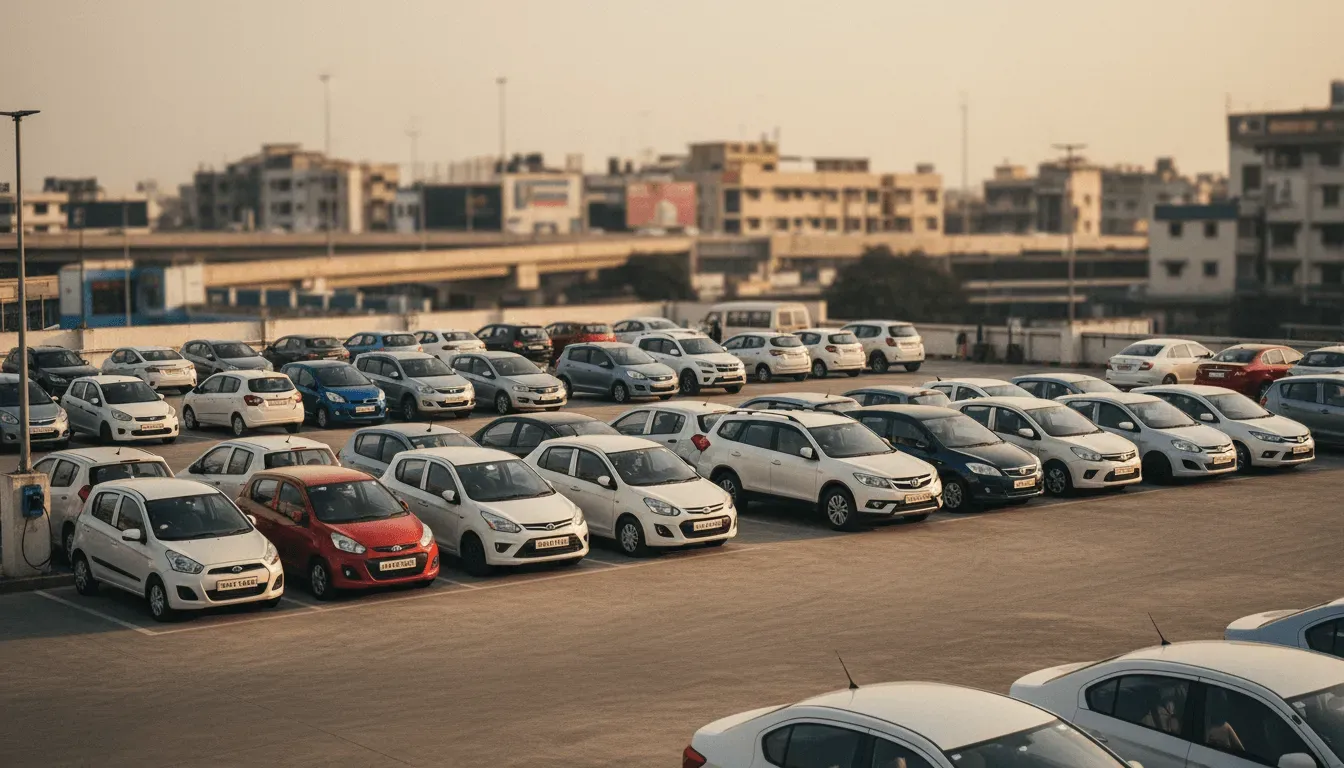
The best 15 car companies to compare in India in 2026 are Maruti Suzuki, Hyundai, Tata Motors, Mahindra, Toyota Kirloskar Motor, Kia India, Honda Cars India, Renault India, Skoda Auto Volkswagen India, MG Motor India, Nissan Motor India, Citroen India, Mercedes-Benz India, BMW India, and Audi India.
This buyer's list of the top 15 auto manufacturing companies does not constitute the 2026 car brand sales ranking because the information brief does not contain company-wise sales/registrations data or market share.
Which are the top 15 car companies in India in 2026?
| Rank in this buyer shortlist | Car company | Main India category | Why Indian buyers usually compare it |
|---|---|---|---|
| 1 | Maruti Suzuki | Mass market | Wide model range, broad service network, strong small-car and compact-car presence |
| 2 | Hyundai Motor India | Mass market | Feature-rich hatchbacks, sedans, compact SUVs, and mid-size SUVs |
| 3 | Tata Motors | Mass market | Strong SUV portfolio, electric vehicle presence, and safety-focused positioning |
| 4 | Mahindra | Mass market | SUV-focused portfolio, ladder-frame SUVs, lifestyle SUVs, and family SUVs |
| 5 | Toyota Kirloskar Motor | Mass market and premium mass market | Hybrid options, MPVs, SUVs, and reputation for long-term durability |
| 6 | Kia India | Premium mass market | Feature-loaded SUVs and MPVs with modern cabin and technology packages |
| 7 | Honda Cars India | Mass market | Sedans and SUVs with petrol engine refinement and brand reliability appeal |
| 8 | Renault India | Mass market | Entry-level and compact cars, especially for value-focused buyers |
| 9 | Skoda Auto Volkswagen India | Premium mass market | European-style sedans and SUVs with turbo-petrol engines and strong driving appeal |
| 10 | MG Motor India | Premium mass market | Connected-car features, SUVs, and electric vehicle options |
| 11 | Nissan Motor India | Mass market | Compact SUV focus and value-led positioning |
| 12 | Citroen India | Mass market and premium mass market | Comfort-focused cars and SUVs with a distinct design approach |
| 13 | Mercedes-Benz India | Luxury | Large luxury portfolio across sedans, SUVs, performance cars, and electric cars |
| 14 | BMW India | Luxury | Luxury sedans, SUVs, performance-oriented cars, and electric models |
| 15 | Audi India | Luxury | Luxury sedans, SUVs, quattro models, and premium technology-led positioning |
Which companies should you compare by budget?
The options you should consider mainly depend on your budget. An individual with a budget of Rs 10 lakh would normally consider Maruti Suzuki, Hyundai, Tata Motors, Mahindra, Renault, Nissan, Honda, and Citroen. Consumers who plan to spend more than Rs 50 lakh usually consider brands such as Mercedes-Benz, BMW, Audi, Volvo, Lexus, Jaguar Land Rover, among others. In spite of having only three luxury brands listed among the total of fifteen.
| Buyer category | Usual budget band | Companies from this list to compare first | Typical decision factor |
|---|---|---|---|
| Entry-level and compact car buyer | Below Rs 10 lakh | Maruti Suzuki, Hyundai, Tata Motors, Renault, Nissan, Citroen | On-road price, mileage, service access, resale value |
| Compact SUV and mid-size SUV buyer | Rs 10 lakh to Rs 25 lakh | Hyundai, Tata Motors, Mahindra, Kia, Toyota, Honda, MG, Skoda Auto Volkswagen | Safety features, engine choice, cabin space, automatic option, warranty |
| MPV and family SUV buyer | Rs 12 lakh to Rs 35 lakh | Maruti Suzuki, Toyota, Mahindra, Kia, Hyundai, MG | Seating comfort, boot space, fuel efficiency, second-row and third-row usability |
| Electric car buyer | Varies by model and segment | Tata Motors, MG Motor India, Hyundai, Mahindra, Kia, Mercedes-Benz, BMW, Audi | Real-world range, charging access, battery warranty, home charging cost |
| Luxury car buyer | Usually above Rs 45 lakh | Mercedes-Benz India, BMW India, Audi India | After-sales support, comfort, performance, brand preference, warranty package |
Ranking caveat
A 2026 "top 15" list can be revised at any point as soon as new official data is released. Passenger car rankings based on retail registrations may not exactly match those from wholesale shipments, as registrations measure cars sold to end users, whereas wholesale counts are the number of cars shipped from manufacturers to the retail sales network.
Where should you verify the official 2026 ranking?
Don't rely solely on sales data until you are sure which metric you are looking at. Usually, SIAM data is used for domestic sales and dispatch trends from manufacturers; FADA provides vehicle retail data, and VAHAN shows registration data from transport offices where available.
| Source | What it broadly shows | What it is useful for | Limit to remember |
|---|---|---|---|
| SIAM | Industry statistics and domestic sales trends | Understanding manufacturer-level and segment-level dispatch trends | Wholesale data may not equal final retail demand in the same month |
| FADA | Retail vehicle data from dealers | Understanding buyer-level retail sales trends | Coverage and categorisation can differ from manufacturer reporting |
| VAHAN | Vehicle registration data | Checking registration trends by state, fuel type, and vehicle category | Not every registration trend directly equals manufacturer sales performance |
How should you shortlist a car company?
Fix your budget
Start by defining your on-road budget. A buyer spending Rs 10 lakh and one spending Rs 25 lakh will not compare the same companies or body styles.
Pick the segment
Consider the body style you need. Options include hatchback, sedan, compact SUV, mid-size SUV, MPV, electric car, or luxury car.
Check service access
Look into whether the company has permitted service support within a reasonable distance from your place of residence or work.
Compare model-level details
Compare at least three models. Review price, safety features, and fuel type. Check the automatic option and warranty. Consider boot space and total ownership cost.
Test-drive and compare quotes
Test-drive a vehicle on roads similar to those on your daily route, then compare the final on-road quotes, which also include insurance, registration, extended warranty, and accessories.
How can you compare three companies with numbers?
A simple rating system that lets you compare companies without solely relying on brand recognition or popularity. The following example uses 100 points and presents three companies that a buyer of compact SUVs may compare. The scores given are just for illustration, but do not represent an official ranking.
| Factor | Maximum points | Company A score | Company B score | Company C score |
|---|---|---|---|---|
| On-road price fit | 25 | 22 | 18 | 20 |
| Service access near your location | 20 | 19 | 16 | 14 |
| Safety and features | 20 | 15 | 18 | 17 |
| Fuel efficiency or running cost | 15 | 13 | 11 | 12 |
| Resale and long-term confidence | 10 | 8 | 7 | 7 |
| Test-drive comfort | 10 | 7 | 9 | 8 |
| Total | 100 | 84 | 79 | 78 |
Company A scored 84 out of 100, Company B scored 79 out of 100 and Company C scored 78 out of 100 in the example. You can figure out if a 5-point lead that Company A has over Company B is actually worth the Rs 75, 000 difference if Company A's final on-road quotation is Rs 75, 000 higher than that of Company B.
What should you check beyond the company name?
In general, Indian customers consider brands when comparing companies, but the actual choice should be made at the model and variant levels. Just because a company is big does not mean they offer you the right model with regard to cost, city, driving pattern, and after-sales services.
Fuel type: Petrol is the most popular fuel for private car buyers; Diesel is important for buyers of SUVs that drive a lot; CNG reduces running costs in the city, hybrids can be good for varied driving, while electric cars depend on the availability of charging stations.
Garage availability: If you do not live in a metro area, you may be interested in the proximity of the service station rather than a more featured car.
Price by variant: The lowest variant of a premium brand will usually have less equipment than a higher variant of another brand having the same on road cost. Since on-road cost largely determines a car's IDV, two cars priced similarly can still end up with different insurance premiums depending on their variants and features.
Resale value: Resale value depends on the popularity of the brand, model, fuel, age, kilometers, accident history, and local market trend.
Insurance and repair costs: Premium headlamps, sensors, ADAS equipment, alloy wheels, and body parts are associated with higher repairs costs and car insurance claims.
Key takeaways
The 15 popular car brands competing in the Indian market are Maruti Suzuki, Hyundai, Tata Motors, Mahindra, Toyota, Kia, Honda, Renault, Skoda Auto, Volkswagen, MG, Nissan, Citroen, Mercedes-Benz, BMW, and Audi, which is the top one.
It is not claimed to provide sales rankings based on actual sales data for each company, as we lack verified company-wise sales figures, market shares, or vehicle registrations for cars in 2026.
One will have to look up the data from SIAM, FADA, and VAHAN in order to determine an official ranking based on the volume of sales, as well as the registration numbers of vehicles.
It is to be expected that, according to the budget, the choice of comparison may change. In the sub-10-lakh category, mainstream car brands dominate the segment; however, high-end buyers typically compare Mercedes-Benz, BMW, Audi, and other premium brands.
Price for the individual model, service availability, fuel type, safety amenities, warranty period, running expenses, and comfort during the test drive will help you create an accurate shortlist when comparing cars for your own needs.
Frequently asked questions
Who tops as the best car company is a matter of personal choice your budget as well as the purpose of your car are the determining factors. Small cars or compact cars, several buyers compare Maruti Suzuki, Hyundai, Tata Motors, Renault, Nissan, and Citroen
A first time buyer is advised to compare at least three companies that are at a similar price level and category. For example, a buyer of a compact SUV can check, just one representative model each from Hyundai, Tata Motors, Mahindra, Kia, Toyota, Honda, MG, or Skoda Auto Volkswagen, before finally fixing on a variant.
In India, when a customer wants a luxury car, they frequently compare brands such as Mercedes-Benz, BMW, or Audi. In the end, the purchase decision tends to be influenced more after understanding the car model, after-sales service, local dealer support, comfort, performance, and brand preference.
Yes, customers interested in buying an electric car should consider several factors, including the car's actual range, public charging, the battery warranty period, the service support offered, and insurance costs. You can choose from various manufacturers like Tata Motors, MG, Hyundai, Mahindra, Kia, Mercedes-Benz, BMW, and Audi, among others.
About the authors

Nikhila PS
Written by · Senior Content EditorNikhila is a content creator with 6+ years in EdTech and motor insurance, turning complex policies into clear, engaging content. She enjoys exploring digital trends, social media, and art while planning her next short escape.

Rekhit Singh Kaushal
Reviewed by · Senior Director - Motor UnderwritingRekhit Singh Kaushal is Senior Director at ACKO, a leading digital motor insurance provider in India. With deep expertise in insurance strategy and innovation, he brings trusted insights on car and bike insurance to help drivers stay protected.


