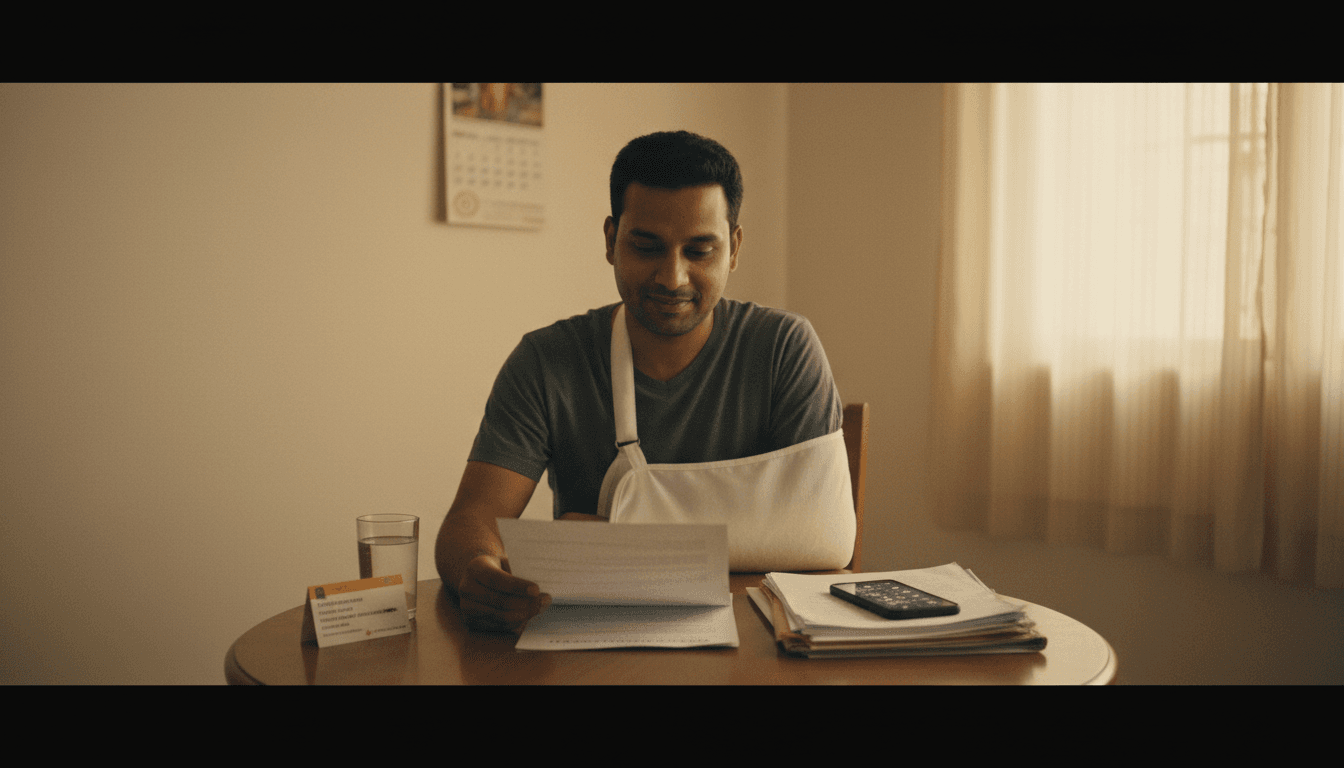
The Group Personal Accident (GPA) claim process is the set of steps used to report an accident, submit proof, get the claim assessed, and receive payment under a group accident policy. In most employer or organisation-based GPA policies, employee or employee nominee first inform the employer, HR team, broker, TPA, or insurer, then submit the claim form and accident-related documents for assessment.
A GPA claim process is different from group health insurance claims. Group Personal Accident insurance generally pays a fixed amount for covered accidental death or disability, and may also pay accident-related medical expenses if that benefit is included in the policy schedule. The exact payout, documents, exclusions, and time limits come from the master policy, employee certificate, and claim form.
Who Can File A GPA Claim?
A group personal accidental claim can be done by covered members, nominee, borrowers, account holders, associated members or customers against any specified accidental event. Usually, the employer or company are the policyholders and the insured person is the covered member.
When the covered accident happens the claim process starts. The claim process starts when the covered accident happens. The claimant can be the insured person for disability or medical expense claims, or the nominee or legal heir for an accidental death claim.
| Person or entity | Role in the claim | What they usually provide |
|---|---|---|
| Insured person | Files a claim for accidental injury, disability, or covered medical expenses | Claim form, identity proof, medical papers, disability certificate where applicable |
| Nominee or legal heir | Files a claim after accidental death of the insured person | Death certificate, FIR or police papers where applicable, nominee or legal heir proof, bank details |
| Employer or group administrator | Confirms membership and forwards documents to the insurer, broker, or TPA | Employment or membership confirmation, policy details, certificate of insurance if issued |
| Insurer, broker, or TPA | Registers, assesses, and processes the claim | Claim number, document checklist, queries, approval or rejection communication |
Inform The Group Administrator Or Insurer
Inform about the accident to your employer, HR team, broker, TPA, or insurer as soon as possible. Share all the required documents like insured person's name, policy or employee details, accident date, hospital reports etc.
Get The Claim Form And Checklist
Request for GPA claim form to submit your details, claim number if generated and the checklist of documents for the exact claim type like accidental death, permanent or total disability, medical expenses etc.
Collect Accident And Medical Proof
Collect all important hospital bills, accident related reports, discharge summary, any kind of police reports or FIR, post-martem report or any kind of accident evidence which applies on case.
Submit The Claim Documents
After getting the GPA form, fill the claim carefully and attach all the listed important documents. For a death claim the nominee or legal heir signs the form and in case of disability or medical claims the insured person normally signs it unless they are unable to do so.
Claim Assessment Begins
Claim verification is done by the insurer, broker, or TPA; they confirm whether the person was covered on the accident date, whether the event is covered, all documents are submitted by the employee or nominee or not or are there any exclusions in policy.
Reply To Queries
If a document or any report is missing then the insurance company may ask many clarification queries or they can ask for different documents to cross-check employee claim requests. That is why sharing all updated and correct data is important to avoid these kinds of problems.
Receive Approval, Payment, Or Rejection
If the claim amount is approved by the insurance company, the insurer pays the admissible amount to the insured person, nominee, legal heir, or other eligible recipient as per policy terms. If the claim is rejected, the insurer should share the reasoning for rejecting the claim request.
Which Documents Do You Need for claiming under Group Personal Accident policy?
The document's requirement for claim depends on the insurers and the type of claim employee is requesting for. The insurance company may only ask for hospital related documents and policy documents which are related to medical expenses but in case of accident they may ask for evidence, reports, GPA policy document and exclusions if any. But these are some common documents that every insurer asks from the employee. For eg claim GPA form, policyholder details etc. The policy details should state the claim process and required documents clearly so that there is no confusion for employees while claiming. .1
| Claim type | Common documents | Why the document is needed |
|---|---|---|
| All GPA claims | Completed claim form, policy or certificate details, insured person's identity proof, bank details, employer or group membership confirmation | To identify the covered person, confirm active cover, and set up payment |
| Accidental death | Death certificate, FIR or police report where applicable, post-mortem report where applicable, nominee proof, legal heir or succession documents if nominee details are not available | To prove death, cause of death, accident circumstances, and claimant entitlement |
| Permanent total disability | Treating doctor's certificate, disability certificate from a competent medical authority where required, medical reports, investigation reports, employer confirmation if work status is relevant | To prove the nature, extent, and permanence of disability |
| Permanent partial disability | Medical certificate, disability assessment, X-rays or scan reports, operation notes if applicable, follow-up records | To match the disability with the policy's disability benefit table |
| Temporary total disability | Doctor's advice for rest, medical leave records, fitness certificate, employer leave or absence confirmation where required | To prove the period during which the insured person could not work because of the accident |
| Accident medical expense reimbursement | Hospital bills, payment receipts, discharge summary, prescriptions, diagnostic reports, medicine bills | To verify actual treatment cost and admissible reimbursement if this benefit is included |
| Accident involving vehicle or public place | FIR, medico-legal case papers, driving licence where relevant, registration certificate where relevant, accident photographs if available | To establish accident facts and rule out policy exclusions where relevant |
Intimate first, submit final documents later
Do not wait until all treatment is complete before informing the insurer or group administrator. Early intimation creates a claim record, and final bills or disability documents can usually be submitted later when they are available.
How Is The Claim Amount Calculated under GPA Policy?
The GPA claim amount is calculated from the policy's benefit document, not only from the accident's emotional or financial impact. For accidental death or partial total disability there is fixed amount cover, the sum insured or benefit percentage in the policy decides the amount. For reimbursement benefits such as accident medical expenses, the admissible bill amount and the sub-limit, if any, decide the payment.
Here is a simple worked example. Assume an employee is covered for Rs 10 lakh under a GPA policy. The policy schedule says accidental death pays 100% of the sum insured, and accident medical expenses are reimbursed up to Rs 50,000 if incurred before death. The employee dies in a covered road accident, and the nominee submits hospital bills of Rs 38,000 from treatment before death.
| Item | Policy value or bill amount | Admissible amount in this example |
|---|---|---|
| Accidental death benefit | Rs 10 lakh sum insured, 100% payable | Rs 10,00,000 |
| Accident medical expense benefit | Sub-limit Rs 50,000 | Rs 38,000, because the bill is below the Rs 50,000 sub-limit |
| Total payable before any policy-specific deductions | Rs 10,00,000 plus Rs 38,000 | Rs 10,38,000 |
If the same policy did not include accident medical expense cover, the payable amount in this example would be Rs 10,00,000, not Rs 10,38,000. If the policy had a different benefit table, the answer would change according to that table.
Why Can A GPA Claim Be Delayed Or Rejected?
A GPA claim can be delayed when the insurer cannot connect the accident, injury, disability, death, and policy coverage with enough evidence. A delay does not always mean rejection, but it usually means the insurer needs missing documents, clarification, or verification.
| Issue | What it means | What to submit or check |
|---|---|---|
| Late intimation | The accident was reported after a gap | Submit the reason for delay and any proof that supports the accident date and treatment timeline |
| Missing FIR or police papers | The accident involved road traffic, workplace incident, unnatural death, or public place incident, but police papers are unavailable | Submit FIR, police report, medico-legal case papers, or a written explanation if police papers were not filed |
| Cause of death is unclear | The papers do not clearly show that death was accidental | Submit death certificate, post-mortem report if conducted, hospital records, and police documents where applicable |
| Disability is not certified | The claimed disability has not been assessed by an authorised doctor or competent medical authority | Submit disability certificate, medical board certificate where required, and treating doctor's reports |
| Person was not active under the group policy | The insurer cannot confirm that the insured person was covered on the accident date | Submit employee ID, joining or membership proof, certificate of insurance, or employer confirmation |
| Exclusion may apply | The accident may fall outside the policy terms | Ask for the exact exclusion being applied and submit evidence that addresses that point |
What Can You Do If The Claim Is Rejected in Group Personal Accident Insurance?
If the insurer rejects a GPA claim, ask for the rejection letter and the exact policy clause used for rejection. Then compare the stated reason with the policy schedule, certificate of insurance, claim form, submitted documents, and accident evidence.
- First, respond to the insurer with any missing document or clarification requested in the rejection or query letter.
- Second, escalate to the insurer's grievance officer if you believe the rejection is incorrect or the claim has not been handled properly.
- Third, if the grievance is not resolved, you can use IRDAI's Bima Bharosa grievance platform or other grievance channels listed by the regulator.2
Keep copies of every email, acknowledgement, claim form, medical record, and courier proof. A clear document trail is useful if the matter has to be reviewed again.
Key Takeaways
Group Personal Accident insurance covers members of a group against specified accidental events under one master policy.
The GPA claim process usually starts with claim intimation to the employer, group administrator, broker, TPA, or insurer.
The claimant is usually the insured person for injury or disability claims and the nominee or legal heir for accidental death claims.
Accidental death, disability, temporary disability, and accident medical expense claims need different document sets.
The claim amount comes from the policy's benefit schedule, sum insured, sub-limits, and admissible documents.
A claim can be delayed if accident proof, medical records, police papers, disability certification, or active coverage confirmation is missing.
If a claim is rejected, the rejection letter should be checked against the exact policy clause and the submitted evidence.
Frequently asked questions
After the employee's accidental death their nominee can file a GPA claim. If nominee details are not available or are not correct then the insurance company may ask for legal heir or succession details before payment.
GPA claims are reimbursement based; they are not like standard cashless claims. But some group covers may have special arrangements through TPA or hospital network provider, still employees should confirm from their insurer before using cashless service for any kind of treatment, hospitalisation or accident.
For an accidental injury claim employee must have the usual claim form first of all, identity proof, employee details, hospital or injury documents, hospital bills if reimbursement is covered and proof of accident. For road accidents, serious injuries or death, police documents or FIR these documents are also sometimes needed.
A GPA claim can be filed late only if the employee or nominee submitted a reason in writing why their claim was submitted late, evidence of accident with exact date mentioned, hospitalisation time period and policy details. The policy terms and conditions decide how late the claim request is treated.
The claim payment of GPA is received by the eligible person whose name is mentioned as a nominee or in the recipient name according to policy conditions. For different claims like disability or medical expense these are done to the covered employee and for accidental death claims it goes to their nominee or their legal heir.
No, GPA does not cover every accident, it only covers those accidents which fall within the policy conditions. Employees must be covered on the date of accident and no exclusions are applied.
Sources and references
- 1.Insurance Regulatory and Development Authority of India, Protection of Policyholders' Interests, Operations and Allied Matters of Insurers Regulations, 2024Regulatory reference on policyholder protection, claim-related communication, and insurer obligations in India.
- 2.Bima Bharosa, IRDAI grievance redressal platformIRDAI grievance platform for insurance policyholders in India.
About the authors

Nikita Joshi
Written by · Marketing Specialist - ACKO for BusinessNikita Joshi works on Group Mediclaim at Acko General Insurance, spanning client advisory, growth analytics, and marketing for the SME segment. She combines data-driven insight with content and campaign strategy to build credible, useful health insurance experiences for employers and employees alike.

Nitesh Kapur
Reviewed by · Senior Director – Underwriting & Claims, Group Health Insurance at ACKOWith over 15 years of experience in health insurance underwriting, he has led group health insurance strategy, risk assessment, and policy design. He has held leadership roles at leading insurers, building risk frameworks, evaluating complex health risks, and strengthening underwriting standards.