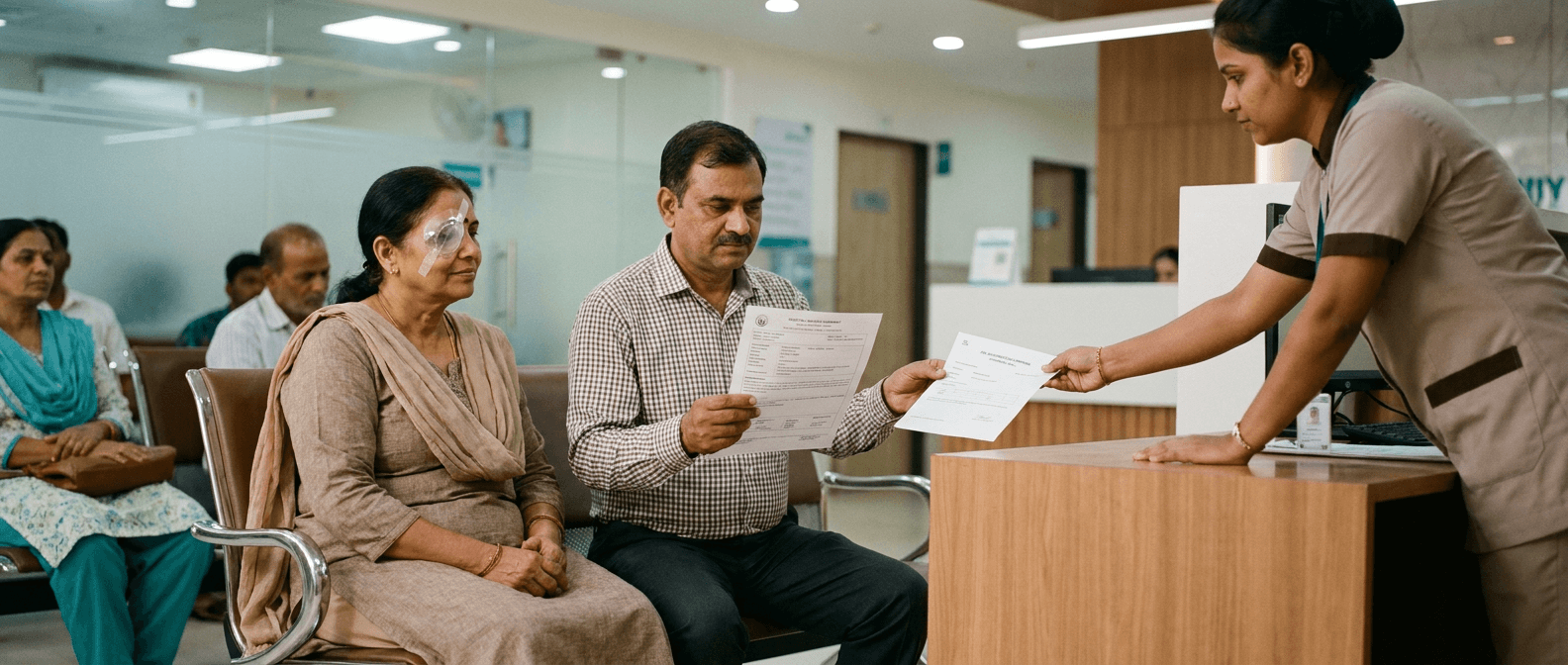
What is claim intimation in health insurance?
Claim intimation in health insurance is a simple notice you send to your insurance company or TPA to tell them you've had or will have a medical event like going to the hospital, surgery, or a test. It acts as the official notification that initiates the claim process for your insurer and generates a unique Claim Reference Number, also known as an Intimation Ticket Number.
Claim intimation is not a claim approval or payment for your medical expenses. Final claim approval depends on various factors such as your policy terms, waiting periods, document verification, etc.
Claim intimation comes first
In India, whether you use cashless treatment at an approved hospital or pay yourself and get reimbursed later, the first step is to inform your insurance about the claim.
Why is timely claim intimation important?
- Activates pre-authorisation for cashless care: For cashless treatment, early intimation allows the insurer to coordinate directly with the hospital's insurance desk at the site of treatment to approve initial pre-authorisation limits.
- Provides immediate guidance: After you intimate your health insurance company or TPA, they give you a list of what is needed and also confirm you about anything that cannot be claimed under the policy.
- Prevents disputes and delays: If you notify your health insurance company late, it can lead to delays or additional checks during your final claim settlement.
Claim intimation timelines: Planned vs emergency hospitalisation.
Health insurance companies in India have specific deadlines for reporting and settling claims. Under IRDAI rules and standard policies, these deadlines depend on whether the policyholder's hospital stay was planned or an emergency.
| Hospitalisation Type | When to Intimate | Key Action Required |
|---|---|---|
| Planned Hospitalisation, such as cataract surgery or elective joint replacement | At least 48 to 72 hours prior to admission | Contact the insurer or TPA, submit the pre-authorisation form and treatment estimate from the treating doctor. |
| Emergency Hospitalisation, such as an accident, sudden heart attack, or severe fever | Within 24 hours of admission, or as soon as reasonably possible | Intimate via app, helpline, or hospital desk immediately after emergency stabilisation. |
| Cashless Everywhere, Non-Network Hospital | 48 hours prior for planned hospitalisation, or within 24 hours for emergency hospitalisation | Intimate the insurer to initiate temporary cashless arrangements with the non-empanelled registered hospital. |
IRDAI Protection Rule
The Insurance Regulatory and Development Authority of India (IRDAI) specifies that any genuine insurance claims made by policyholders cannot be rejected by the insurer just because there's a delay in intimation caused by unavoidable circumstances or severe medical emergency. However, policyholders must provide a written explanation, also known as a condonation letter, along with all supporting medical documents.
What details are required for claim intimation?
When contacting your insurer or TPA to report a claim, keep the following details ready:
| Detail Category | Data Required | Purpose |
|---|---|---|
| Policyholder Information | Health policy number, Member ID / UHID, policyholder name | Validates active policy coverage |
| Patient Details | Name, age, gender, relationship to policyholder | Confirms covered beneficiary |
| Hospital Information | Hospital name, address, city, and network/non-network status | Determines cashless desk coordination |
| Medical Details | Primary diagnosis, illness/injury cause, treating doctor's name | Verifies medical necessity & coverage |
| Admission Details | Date and expected duration of hospitalisation | Establishes claim timeline |
| Cost Estimate | Approximate bill estimate provided by hospital (if available) | Sets preliminary financial reserve |
| Claim Type | Cashless claim OR Reimbursement claim | Routes request to appropriate department |
How is it different from claim submission?
Claim intimation and claim submission are separate steps. Intimation tells the insurer that a claim may arise. Claim submission gives the insurer the documents needed to decide how much is payable.
| Point of difference | Claim intimation | Claim submission |
|---|---|---|
| Meaning | First notice to the insurer about hospitalisation or treatment | Formal filing of claim documents for assessment |
| Timing | Before planned treatment or soon after emergency admission | After treatment, discharge, or final billing, unless cashless pre-authorisation is being processed |
| Main purpose | To register the claim and start guidance or pre-authorisation | To verify expenses and decide admissible claim amount |
| Documents needed | Basic policy, hospital, patient, diagnosis, and estimate details | Bills, receipts, discharge summary, prescriptions, reports, claim form, KYC, and bank details if required |
| Outcome | Claim reference number or intimation acknowledgement | Approval, query, partial payment, rejection, or settlement |
How to intimate a health insurance claim (step-by-step)
You can intimate a claim using digital or offline channels.
Available intimation channels
- Insurer mobile app: Tap “File a Claim” or “Register Claim”, select the insured family member, upload the doctor’s prescription or admission advice, and submit.
- Insurer web portal: Log into your portal account and fill out the online Claim Intimation Form.
- Toll-free customer care or WhatsApp: Call the helpline or send a message to the insurer's official WhatsApp handle with your policy number.
- Hospital insurance desk: Show your health card at the hospital desk. They will take care of the paperwork for the cashless service.
- Email or branch visit: Send an email to the insurer’s designated claim intimation address or visit the nearest branch.
Step-by-step claim intimation process.
Select your claim route
Confirm whether you are getting cashless treatment at an empanelled hospital or paying upfront for later reimbursement.
Submit the necessary information
Share your insurance policy number, along with the patient's and hospital details, either by phone or email.
Save the claim reference number
The insurer will generate a Claim Reference Number. Keep it safe for tracking your claim status and all future correspondence.
Follow the next claim step
For cashless claims, confirm if the hospital insurance desk has sent the pre-authorisation form to the insurer. Keep all your original medical bills and discharge summary safe to file a reimbursement claim after hospital discharge.
Claim Intimation vs Pre-Authorisation vs Claim Submission
Many policyholders confuse these three terms. Here is how they differ:
| Feature | Claim Intimation | Cashless Pre-Authorisation | Claim Submission |
|---|---|---|---|
| Definition | Initial notification that a claim will be made | Request for insurer's approval to pay hospital directly | Formal filing of final bills and medical documents |
| Stage in Journey | Step 1, before or at admission | Step 2, at admission or during treatment | Step 3, at discharge or post-discharge |
| Required Data | Policy ID, patient name, hospital, diagnosis | Pre-auth form, doctor note, bill estimates, diagnostic reports | Original itemised bills, discharge summary, payment receipts, KYC |
| Regulated SLA, IRDAI Rules | Acknowledged within 24 hours, usually instant digitally | Initial approval within 1 hour of complete submission | Final discharge approval within 3 hours. Reimbursement settled within 30 days |
| Primary Outcome | Claim Reference Ticket Number | Cashless sanction limit | Final claim approval, partial payout, query, or rejection |
What happens after claim intimation?
After claim intimation, the next step depends on whether the claim is cashless or reimbursement. A cashless claim is handled between the network hospital and the insurer or TPA. A reimbursement claim is paid to you after you submit eligible documents and the insurer approves the claim.
1. Cashless Claim Pathway
| Step | What happens |
|---|---|
| Pre-authorisation processing | The hospital submits the pre-authorisation form along with initial cost estimates to the insurer or TPA. |
| 1-hour turnaround rule | Under IRDAI Master Circular guidelines, insurers must convey their decision on initial cashless pre-authorisation within 1 hour of receiving complete documents. |
| Treatment and billing | You receive treatment up to the sanctioned cashless amount. The insurer pays admissible costs directly to the hospital, subject to approval and policy terms. |
| 3-hour discharge approval | At discharge, the hospital sends the final bill and discharge summary. Insurers must issue final cashless authorisation within 3 hours. Any hospital charges caused by insurer delays beyond 3 hours must be borne by the insurer. |
2. Reimbursement Claim Pathway
| Step | What happens |
|---|---|
| Treatment and payment | You complete treatment and pay all hospital bills out of pocket. |
| Document gathering | Collect the original discharge summary, itemised hospital bills, pharmacy receipts, doctor prescriptions, diagnostic reports, payment slips, and canceled cheque. |
| Submission window | Submit the physical or scanned claim form along with documents within 15 to 30 days of discharge, as specified in your policy. |
| Settlement SLA | Insurers must settle valid reimbursement claims within 30 days of receiving all complete documents. |
In both cases, the final decision depends on your insurance coverage, whether the treatment is necessary, any required documents, what is not covered, the limits, and the final bill.
What happens if claim intimation is delayed?
There are various reasons for a delay in a health insurance claim if it exceeds the deadline. Some of them are explained below:
- Reimbursement route conversion: You might not be able to use a health insurance card or online payments quickly. You may need to pay the hospital bills upfront and get them reimbursed later.
- Additional information requests: The emergency admission proof, ICU records, or an explanation letter will be requested by the insurance company.
- Condonation letter requirement: You may need to submit a formal letter explaining the reason for the delay, such as the patient being in ICU, no family member being present, or access issues in a remote location.
- IRDAI guidelines on delayed intimation: None of the insurance companies can reject a genuine claim only because intimation was delayed, if the medical condition and expenses are verified as genuine and the delay was beyond the policyholder's reasonable control.
Key takeaways
- First step in claims: Claim intimation is the initial notice sent to your insurer or TPA to register a health claim. It does not mean your final bill has been approved.
- Strict timelines: The policyholder must provide at least 48 hours' notice before planned hospitalisation. In emergency cases, inform your insurer within 24 hours if possible.
- IRDAI protection: Claims cannot be rejected only because of delayed intimation if there were genuine medical emergency reasons for the delay.
- Fast processing: IRDAI mandates a 1-hour TAT for cashless pre-authorisation and a 3-hour TAT for discharge approval.
Frequently asked questions
Most health insurance policies require you to inform the insurer or TPA within the timeline stated in the policy. The exact rule depends on the policy wording, so check the claim procedure section of your policy document.
At a network hospital, the hospital staff usually helps raise the intimation with the insurance company or TPA before the patient receives treatment. You should still confirm that the intimation has been registered by your insurer and save the claim reference number generated.
Yes, you should intimate the insurer even if you plan to pay the hospital bill yourself and claim reimbursement later. Early intimation helps the insurer record the claim and tell you which documents will be needed.
No. A claim number only confirms that the insurer has registered the claim. Your claim is approved after the insurer checks the policy terms and other required documents.
You can give an estimated cost at the intimation stage if the final bill is not ready. The insurance company will decide the final claim payout after checking the actual bills and insurance policy details.
About the authors

Neviya Laishram
Written by · Senior Editor – Health, Life and Group Health Insurance Content at ACKOWith a journalism background, she brings 9 years of experience in strategising and editing health, life, and group health insurance content. Having written for magazines and digital publications, she combines research and editorial expertise to create credible, useful content for readers.

Dr Nitin Kumar Gupta
Reviewed by · SVP – Health Underwriting & Claims at ACKO General InsuranceWith 20+ years of experience in digital transformation and growth, he is a leader specialising in health, life, accident, and disability insurance. Backed by an MBBS degree and insurance designations (FLMI, FALU, FLHC, ACS, ARA), he combines expertise with leadership.