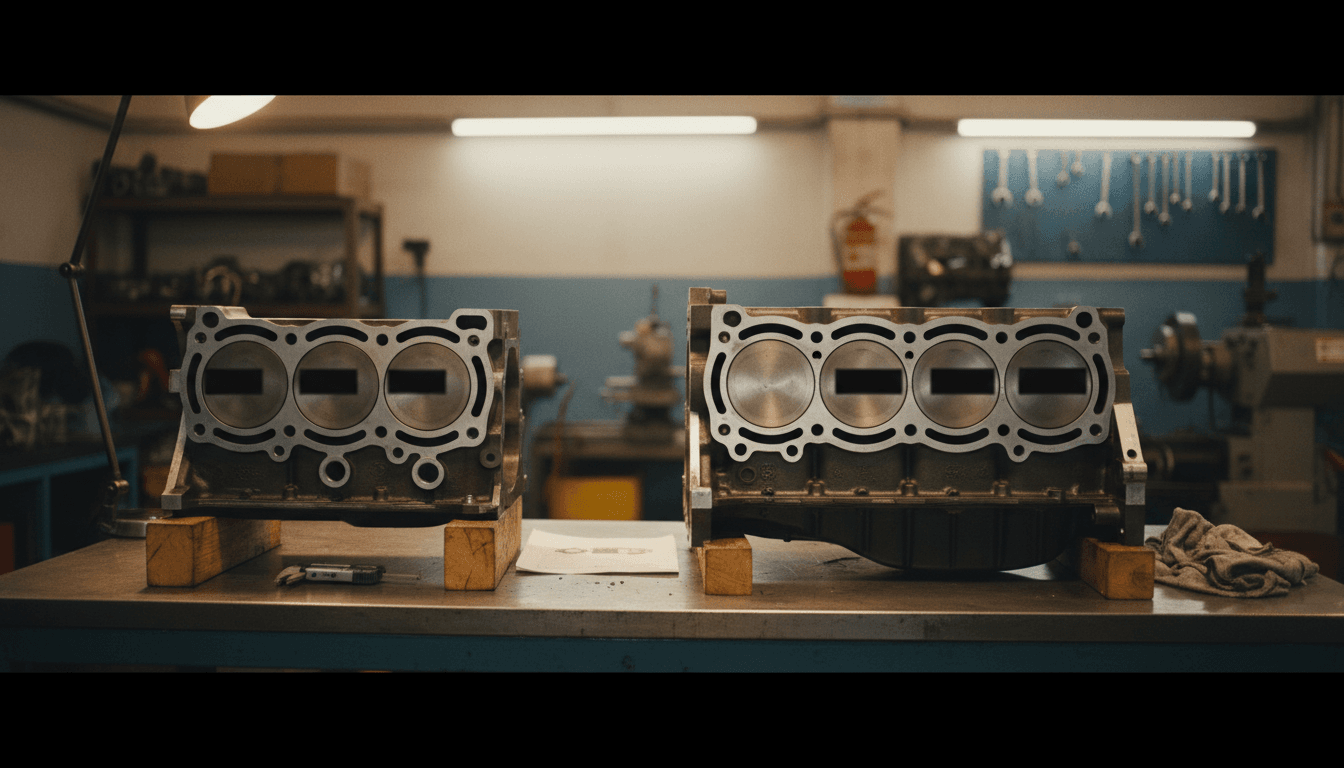
A 4-cylinder and a 6-cylinder engine share a very similar function, whereby the ignition of fuel occurs, followed by the movement of pistons. The difference between the two is that the 4-cylinder has 4 chambers of combustion and the 6-cylinder has 6. In general terms, a 6-cylinder provides a more powerful and smoother ride than the 4 cylinder.
What does cylinder count mean?
A cylinder in an internal-combustion engine refers to the chamber where the air-fuel mixture burns and pushes the piston. This piston movement turns the crankshaft, and ultimately, power is generated and transmitted to the wheels.
An engine consisting of four cylinders means four such chambers are present. Similarly, an engine with six cylinders means six. In a four-stroke engine, each cylinder has a power stroke once every two crankshaft revolutions. Therefore, a 6-cylinder engine will produce more combustion events per cycle than a 4-cylinder engine.
| Engine type | Number of cylinders | Basic meaning | Common layout |
|---|---|---|---|
| 4-cylinder engine | 4 | Four pistons create power inside four cylinders | Usually inline-four in mass-market cars |
| 6-cylinder engine | 6 | Six pistons create power inside six cylinders | Often inline-six or V6, depending on the vehicle |
Does the engine type impact your car?
Yes. Engine type has a significant influence on various aspects of your car, such as power, smoothness, fuel consumption, weight and maintenance cost. Whereas 4-cylinder engines are known for efficiency, 6-cylinder engines are preferred for better performance.
| Factor | 4-cylinder engine | 6-cylinder engine |
|---|---|---|
| Power and acceleration | Usually adequate for hatchbacks, sedans, compact SUVs, and city driving | Usually stronger, especially in larger cars and SUVs |
| Smoothness | Can feel slightly more stressed at high speeds or under heavy load | Usually smoother because power delivery is spread across more cylinders |
| Fuel use | Usually consumes less fuel when engine size and technology are comparable | Usually consumes more fuel because it has more cylinders and is often fitted to heavier vehicles |
| Weight | Usually lighter and more compact | Usually heavier and physically larger |
| Maintenance | Usually has fewer parts such as spark plugs or injectors | Usually has more parts to service because there are two extra cylinders |
| Best fit | Daily commuting, city traffic, lower running cost | Highway cruising, performance, larger vehicles, towing or heavy loads |
Is a 6-cylinder always more powerful?
A 6-cylinder does not necessarily mean more power. The turbocharged 4-cylinder will outdo the older or naturally aspirated 6-cylinder if the engine can breathe better, the boost pressure is higher, or the engine is more efficient. The more radical tuning also helps.
Therefore, if you want to know which car is better by the numbers, look at the real figures instead of just the cylinder count. The main factors to look out for are peak power in PS or hp, peak torque in Nm, when torque is at its maximum (i.e. rpm), weight of the car, type of transmission, and fuel consumption classification.
In fact, according to FuelEconomy.gov, real-world fuel economy depends on driving behaviour, speed, idling, load, and maintenance, rather than on engine design alone.
Note:
An engine having more parts makes it more expensive when repair work needs to be done. So you better make sure your car insurance can cover engine failure, particularly if you have a turbocharged engine or one with a sophisticated fuel system.
How to select between the 4-cylinder and 6-cylinder engine?
For most Indian buyers, the right choice is largely influenced by the driving pattern and the car's size. City commutes and family use should not require more than a 4-cylinder engine, whereas the use of a 6-cylinder engine would make perfect sense in case the car is of a larger size, heavy-duty, performance-centred, or regularly used to travel long distances with passengers and luggage.
| Use case | Usually better fit | Reason |
|---|---|---|
| Daily city commute | 4-cylinder engine | Lighter, simpler, and usually more efficient in stop-go traffic |
| Family hatchback, compact sedan, compact SUV | 4-cylinder engine | Enough performance for most urban and highway use |
| Large SUV or luxury sedan | 6-cylinder engine | Extra torque and smoother power delivery suit heavier vehicles |
| Frequent highway trips with full load | 6-cylinder engine | More relaxed cruising and stronger overtaking performance |
| Lowest running cost priority | 4-cylinder engine | Usually better fuel efficiency and fewer cylinder-related service parts |
| Performance priority | Depends on actual output | A modern turbo 4-cylinder can be quick, but a strong 6-cylinder is usually smoother and more effortless |
What should you check before buying a 4-cylinder and a 6-cylinder car?
Never rate an engine solely by how many cylinders it has. To compare 4-cylinder and 6-cylinder cars, examine the figures that are significant to the vehicle owner.
Engine power: Look at the PS or hp, not just the engine size.
Torque: Look at the figures for Nm and the RPM at which the maximum torque is achieved.
Efficiency: Look at the km/l figure, as well as the actual mileage reported by owners in urban and highway driving conditions.
Vehicle mass: High-powered engines tend to be slower in heavier cars than smaller engines in lightweight vehicles.
Service costs: 6-cylinder engines have more spark plugs, injectors, and other components than 4-cylinder engines.
Fuel type: Some high-performance engines require specific fuel types.
Test-drive experience: Pay attention to low-speed performance, overtaking power, engine noise and vibration, and highway cruising comfort.
Key takeaways
4-cylinder engines contain four cylinders. On the other hand, 6-cylinder ones have six cylinders.
Compared to 4-cylinder engines, 6-cylinder engines typically offer smoother power delivery and greater performance when the two engines are otherwise at the same level in terms of technology and vehicle weight. Certainly, the larger the engine size, the more the third party car insurance cost will be, because IRDAI regulates it based on cubic centimeters.
In general, a 4-cylinder engine is lighter, simpler, and more fuel-efficient for regular driving.
The number of cylinders alone is not the deciding factor in performance, as turbocharging, displacement, tuning, gearbox, and kerb weight can all affect the outcome.
A 4-cylinder engine, on the other hand, will usually meet most of what a typical Indian city user needs. For large cars, heavy loads, and frequent highway cruising, the 6-cylinder engine will feel more relaxed.
Frequently asked questions
The major difference is in the number of cylinders. A four-cylinder engine has four combustion chambers in the engine block, whereas a six-cylinder engine has six. The six-cylinder engine delivers smoothness and power, and the four-cylinder engine generally provides higher efficiency and lower operating costs.
Yes. The 4-cylinder engine serves well for daily usage like going to work, school, and other places, as well as driving on the highway. A number of hatchbacks, sedans, and small SUVs feature the 4-cylinder engine.
6-cylinder engines offer advantages in smoothness, quick acceleration, power for larger vehicles, and leisurely cruising on highways. This engine is not necessarily better for all consumers since it will likely be more expensive and less economical.
The 4-cylinder engine offers better fuel efficiency compared to the 6-cylinder engine due to its smaller size and reduced weight. However, fuel efficiency will vary with vehicle weight and other factors.
6-cylinder engines are more balanced because the power strokes are delivered by six rather than four cylinders. It gives an impression of a smooth flow of power delivery.
Yes. There is a chance that a turbocharged 4-cylinder engine can be quicker than a non-turbocharged 6-cylinder engine if it produces greater power and torque. Or it may just be that it is installed in a lighter car.
About the authors

Nikhila PS
Written by · Senior Content EditorNikhila is a content creator with 6+ years in EdTech and motor insurance, turning complex policies into clear, engaging content. She enjoys exploring digital trends, social media, and art while planning her next short escape.

Rekhit Singh Kaushal
Reviewed by · Senior Director - Motor UnderwritingRekhit Singh Kaushal is Senior Director at ACKO, a leading digital motor insurance provider in India. With deep expertise in insurance strategy and innovation, he brings trusted insights on car and bike insurance to help drivers stay protected.