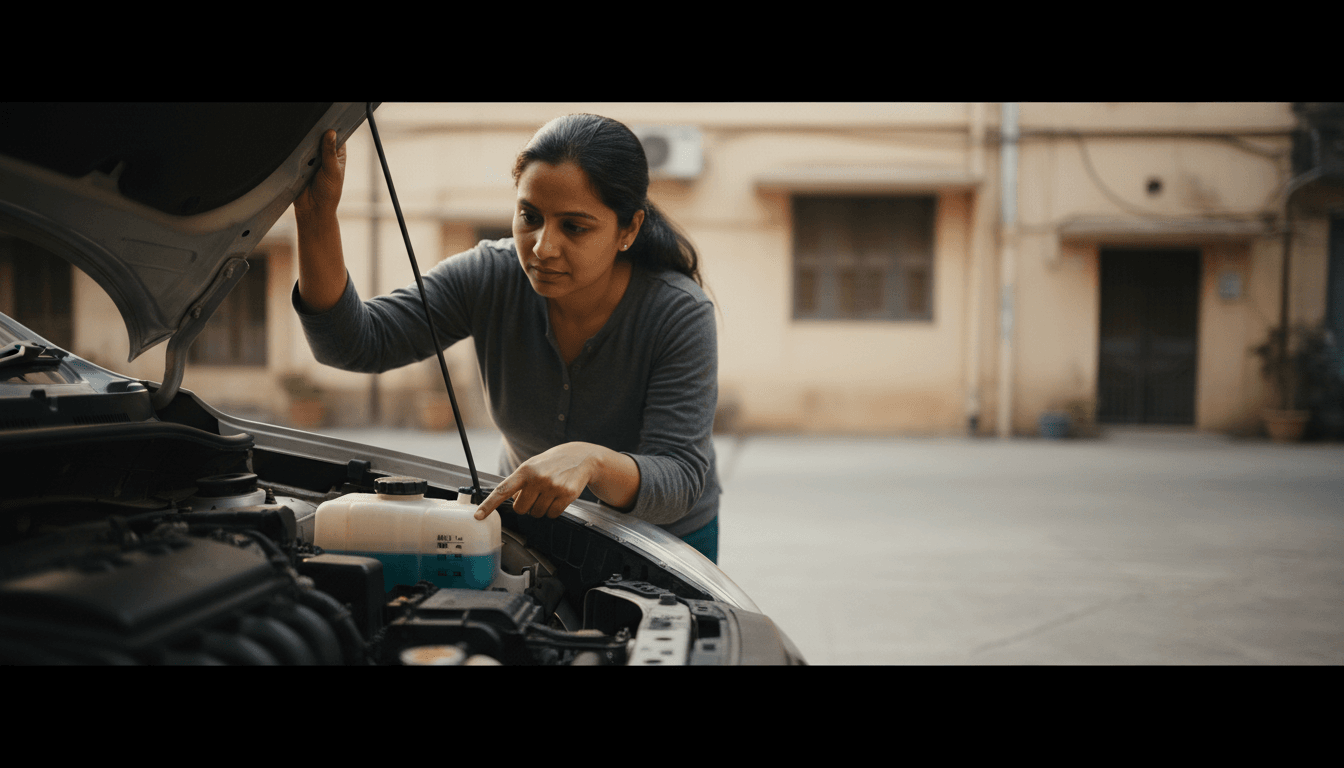
To check the car's coolant level, park it on a flat road and let the engine cool completely. Then, go to a place where you can see the coolant reservoir well. Look closely at the coolant reservoir to determine whether the coolant is between the MIN and MAX levels marked on the tank.
If the level is below MIN, replenish it with the coolant recommended for your car model. Also, make sure not to open the radiator cover or the cap of a pressurised coolant reservoir once the engine is hot.
Steps to check your car's coolant level?
Park and cool the car
Turn the car off. Put the car in parking position and make sure that parking brake is engaged. Let the car cool down completely before opening the hood.
Find the coolant reservoir
Open the lid and locate a transparent or semi-transparent plastic reservoir connected to the radiator or engine cooling components. The opening might be labelled as 'coolant' or have a warning symbol that indicates exposure to high temperatures.
Read the level from outside
If you want to know whether the engine coolant level is normal, look at the level outside of the reservoir rather than the coolant level inside. On a cold engine, the coolant level can be seen between the min and max markings.
Compare it with the marks
When the coolant level sits between MIN and MAX, it is normal. A reading below MIN indicates the car needs a top-up. If the level rises above MAX, do not add any more coolant.
Top up only if needed
Only use the coolant grade or mixture specified for your car. Gradually fill to a level between “MIN” and “MAX,” and then close the cap properly.
Recheck for repeated loss
Start the engine once you’ve tightened the cap. If the coolant level drops soon after, check the cooling system for any leaks.
Wait until the engine is cold
Never attempt to open a radiator cap or pressurized coolant reservoir cap without making sure that the engine has cooled down. Hot coolant and steam under pressure can be expelled unexpectedly and cause burns.
What level should the coolant be at?
When the engine is completely cooled down, the normal coolant level is between the MIN (minimum) and MAX (maximum) markers on the coolant tank. Below is the table which depicts the most common explanations for these readings and what you can do after that.
| Coolant reading when cold | What it means | What to do |
|---|---|---|
| Between MIN and MAX | The coolant level is in the normal range. | Do not top up. Close the bonnet after checking the cap is secure. |
| At or just above MIN | The level is still within range but close to low. | Monitor it over the next few drives. Top up if it falls below MIN. |
| Below MIN | The cooling system does not have enough coolant in the reservoir. | Top up with the correct coolant after the engine is cold. Check for leaks if it falls again. |
| Above MAX | The reservoir may be overfilled, or the reading may have been taken when hot. | Do not add coolant. Recheck when the engine is fully cold. |
| Reservoir appears empty | The cooling system may be very low on coolant or the reservoir may be stained and hard to read. | Do not continue driving if the temperature gauge rises. Get the cooling system inspected. |
What does a real check look like?
The simplest approach to the problem would be to consider the markings on the reservoir as a scale. If the cold coolant mark is between MIN and MAX, the level is acceptable and no additional coolant should be added. In case it is below MIN, you just add little by little to bring it within the markings.
| Example check | Observed level | Decision | Final action |
|---|---|---|---|
| Morning check before starting the car | Coolant line is halfway between MIN and MAX | Normal level | No top-up needed |
| Morning check before starting the car | Coolant line is below MIN | Low level | Add the specified coolant until the line is between MIN and MAX |
| After a city drive | Coolant line appears near MAX while engine is hot | Reading may be affected by expansion | Do not open the cap. Recheck after the engine cools fully |
When should you add coolant?
Add coolant only when the coolant level falls below the MIN mark. The types of coolant you may be allowed to add are clearly indicated in your vehicle manual or on the coolant reservoir. Some vehicle models require particular types of coolant mix. Mixing of incompatible coolants reduces the efficiency of your coolant system or leaves deposits in the coolant system.
When nobody is around and your engine gets hot, find a safe place to park your car and leave it running for a while until it cools off. Don’t drive with a rising gauge, steam coming out of your bonnet, or a light indicating a coolant problem on your dashboard.
Should you check the radiator or the reservoir?
It's usually easier and safer to check the coolant level in the reserve tank than in the radiator, since the reserve tank is only used for visual checks. A large number of newer cars have a sealed or pressurised cooling system, which means the hood cannot be opened for the simple reason of checking the level unless the car manual tells you otherwise." Owner's manual" specifically.
| Part | How you check it | When to open it |
|---|---|---|
| Coolant reservoir | Read the MIN and MAX marks from outside the translucent tank. | Open only when cold and only if you need to top up. |
| Radiator cap | Not usually needed for a routine visual level check. | Open only when cold and only if your owner's manual or mechanic tells you to. |
| Temperature gauge or warning light | Watch it on the dashboard while driving. | Do not open the cooling system when hot. Stop safely and let the car cool. |
What if the coolant keeps getting low?
A low coolant level might be due to coolant evaporating through an unclosed cap, a leaking hose, radiatory, water pump, or coolant tank, or by topping up the level before the engine and other components cool down after some repairs.
Get your vehicle checked out as soon as possible if the level of the coolant drops over again, you notice some colorful liquid dripping from underneath the car, the temperature of the engine increases, you detect chemicals odour around the engine, or the heater in the cabin suddenly stops working if the heating function was working perfectly before.
However, if extensive repairs are needed, it is advisable to check whether your car insurance policy is active to ensure you have coverage for the repairs.
How often should you check the coolant level?
Always check the coolant levels before a long highway journey and before the height of summer travel. Also, do this after any cooling system repair and if the dashboard displays an engine temperature or coolant warning.
Under typical Indian road conditions, long waiting periods at junctions, congested traffic, extreme summer heat, and mountain climbs can put extra stress on a weak cooling system, causing it to reveal any issue more quickly. Having the correct amount of coolant enables the heat generated by the engine to be properly cooled, thus keeping the engine running at a normal operating temperature without overheating.
However, even with a a normal coolant level, the problem of overheating will still remain to some extent if the causes are not repaired, e.g., coolant leaks; a faulty fan or thermostat; a radiator that is partly or completely blocked; etc.
Key takeaways
- Inspecting the coolant level should be done when the engine has cooled completely and the vehicle is level.
- The correct coolant level is from MIN to MAX on the coolant reservoir.
- If the level is below MIN, add the coolant specified for your automobile.
- It is very important not to open the radiator cap or the pressurised reservoir cap when the engine is hot.
- The coolant level is still decreasing even after adding coolant, which means you need to inspect the vehicle for leaks.
- The coolant reservoir is the common place to visually inspect the coolant level in most modern vehicles.
Frequently asked questions
No. One should not check the coolant level by removing the cap while the engine is still hot. Rather, wait until the engine is completely cold. Then, you can check the coolant level through the side of the fluid storage tank.
Check your owner's manual or the label on the reservoir for the recommended coolant type. When in doubt, consult a service centre prior to mixing different coolant types.
Plain water shouldn't be the coolant you use to run your vehicle. It may only be used as a temporary measure in some cases, and once that happens, the system should be corrected with the correct coolant mixture right away.
If the coolant level is below the MIN mark, fill the tank only to the point where the indicator shows between MIN and MAX. Never fill above the MAX level as coolant enlarges when heated.
Stop the car safely, then turn off the engine and let it cool down. Never try to open the coolant cap if the engine is still hot. If the warning light reappears or the temperature gauge rises, call for roadside assistance or take the car to a workshop for a checkup.
Normal operation does not involve constantly refilling coolant. Repeated coolant loss should be an indicator of a coolant leak or another cooling system problem that requires servicing, for example, getting the cooling system repaired or replaced, depending on the type of faulty component.
About the authors

Nikhila PS
Written by · Senior Content EditorNikhila is a content creator with 6+ years in EdTech and motor insurance, turning complex policies into clear, engaging content. She enjoys exploring digital trends, social media, and art while planning her next short escape.

Rekhit Singh Kaushal
Reviewed by · Senior Director - Motor UnderwritingRekhit Singh Kaushal is Senior Director at ACKO, a leading digital motor insurance provider in India. With deep expertise in insurance strategy and innovation, he brings trusted insights on car and bike insurance to help drivers stay protected.