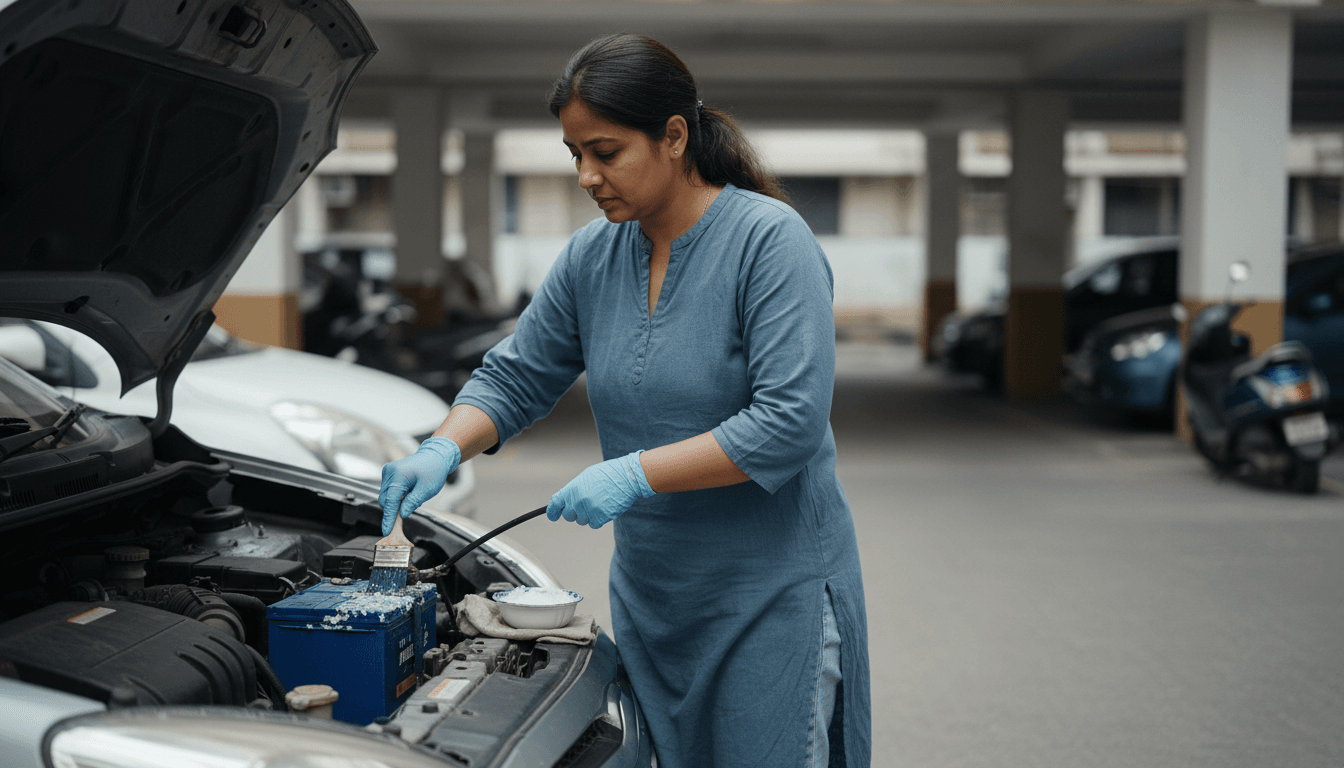
You can remove car battery corrosion by simply turning the engine off, covering your eyes and hands, disconnecting the negative terminal first, preparing a cleaning solution with baking soda and water that you apply to the terminal with oxidation, scrubbing it thoroughly with a brush, making sure it is well dried afterwards, and reconnecting the battery starting with the positive terminal. If there is a possibility that the case is open, the battery is leaking, swollen, hot, or giving off a very strong acid smell, you will have to have a professional clean the battery, not do it yourself.
Safety first
Lead-acid car batteries are dangerous due to the corrosive electrolyte and the potential production of flammable hydrogen gas. You should avoid smoking and using open flame near the batteries. While working with such equipment, you should protect your eyes and skin with appropriate protective clothing. In addition, you should not place any metallic objects on the battery terminals.
When is it safe to clean the corrosion in a car battery at home?
You can only clean corrosion on the outer surfaces of the battery terminals and cable clamps. Sealed-type batteries should not be opened, cleaning solution or liquid of any other kind should not be poured inside the battery, and you should not attempt to fix a broken battery case.
| Battery condition | What it means | What you should do |
|---|---|---|
| Light white, blue, or green powder on the terminal | External terminal corrosion | You can usually clean it if the battery case is intact |
| Loose cable clamp with powder around it | Poor contact and possible repeated corrosion | Clean it, then tighten the clamp correctly |
| Cracked, leaking, swollen, or hot battery | Possible battery damage or acid leak | Do not clean it yourself, get professional help |
| Corrosion keeps returning quickly after cleaning | Possible overcharging, old battery, loose clamp, or seal issue | Have the battery and charging system checked |
What do you need to clean the corrosion in a car battery?
You will need some basic protective tools, a mild deoxidant solution, a brush, and a cloth. The standard mix for a light terminal cleaning job is 1 tablespoon of baking soda mixed with 1 cup of water. Use this solution only on the rusty areas of the terminal and clamp.
| Item | Use | Important note |
|---|---|---|
| Safety glasses | Protects your eyes from splashes and loose powder | Wear before touching the battery |
| Rubber or nitrile gloves | Protects your hands from residue and cleaning solution | Do not touch your face while cleaning |
| Baking soda | Helps neutralise acidic residue on the outside of the battery | Use 1 tablespoon for 1 cup of water |
| Water | Dilutes the baking soda and helps rinse residue | Use small amounts, do not flood the battery area |
| Old toothbrush or terminal brush | Scrubs corrosion from the terminal and clamp | Do not reuse it for household cleaning |
| Spanner | Loosens and tightens terminal clamps | Keep it away from both terminals at the same time |
| Clean dry cloth | Dries the terminals before reconnection | Drying is necessary before starting the car |
| Petroleum jelly or battery terminal protectant | Slows future moisture and corrosion build-up | Apply a thin layer after the terminals are clean and dry |
What are the steps to remove corrosion from a car battery?
Engine shutdown:
Park your car carefully on a flat surface, turn off the vehicle, take out and put aside the ignition key, and, if you have driven the car only recently, give the engine compartment a chance to come down in temperature.
Wear protective equipment
Goggles and gloves ought to be on your list of protective gear. Flame, cigarette, and loose metal objects should never be brought in the vicinity of the battery.
Condition Check of the Battery:
Check if there are any signs such as cracks, leaks, bulges, heat, or a sour smell of battery acid. If you suspect any of these situations, halt your activities immediately and seek the service of a mechanic or battery specialist.
Separate the connections:
You should start loosening the negative terminal and removing it first. Usually, the minus sign indicates the negative. After that, the plus sign usually indicates the positive. However, the order of the connections is quite important. If one gets wrong then we will end up causing a spark which is hazardous!
Make the cleaning solution
Dissolve 1 level tablespoon of baking soda to a cup of ordinary water. Shake well enough till most of the powder becomes liquid.
Cleaning process
You can first apply the solution to the dirty terminal and then leave it a little time for the bubble to come. After that, you can use any brush that is old to your taste so that you will not have much work cleaning off the stuff.
Use a paper towel to wipe off dust
Make use of a little of the clean water only or just simply a moist tissue so as to clear the area, but not to make it very wet. Remember, no water droplets should be put on the battery or the area of nearby electronic units!
Completely dry all things
Gently dry the terminals, clips, and the area above the battery with a fresh towel or similar cloth. The parts should have no signs of moisture when you plan to reconnect.
Closing the battery connection:
Making sure that the positive connector is reattached before the negative should be your first step. After fixing everything, hand-tighten the clamps so they won't slip, and you shouldn't have to go to such an extent.
Preventive measures & check for performance:
Using a thin layer only, you can cover the terminals with petroleum jelly or the battery terminal protector, as the case may be, from the sides. Finally, you shall need to drive it; then you can check whether it still works normally or if the starting procedure is affected.
What does a complete cleaning of corrosion look like?
This is a good, typical example showing a negative terminal with a little amount of white powder and the presence of blue-green discolouration of the terminal clamps.
| Step | Real quantity or action | Result |
|---|---|---|
| Cleaning mix | 1 tablespoon baking soda plus 1 cup water | Enough solution for both terminals in a normal cleaning job |
| Application | Use 2 to 3 spoonfuls of solution on the corroded terminal area | The powdery build-up softens and may fizz |
| Scrubbing | Scrub for 30 to 60 seconds per terminal with a toothbrush or terminal brush | Most visible residue comes off the clamp and post |
| Drying | Wipe until the terminal and clamp are visibly dry | The cable can be reconnected without moisture sitting on the terminal |
| Final check | Try moving each cable clamp by hand after tightening | If the clamp does not move, the contact is secure |
If, after this process, corrosion is still caked inside the cable clamp, remove the clamp again and clean the inside. For a successful start-up, the metal surface needs to be in complete, clean contact with the battery post.
Can you use Coke, vinegar, or plain water to remove corrosion from a car battery?
Baking soda and water are the safer default for typical lead-acid battery terminal corrosion because it helps neutralise acidic residue on the outside of the battery. Coke, vinegar, and plain water may remove some visible grime, but they are not the preferred method for terminal cleaning.
| Cleaner | Should you use it? | Reason |
|---|---|---|
| Baking soda and water | Yes, for external terminal corrosion | It helps neutralise acidic residue and is easy to wipe away |
| Commercial battery terminal cleaner | Yes, if used as directed | It is made for battery terminals and usually includes use instructions |
| Coke or other soft drink | No as a first choice | It can leave sticky sugar residue around the battery area |
| Vinegar | No as a first choice | It is acidic and is not the standard cleaner for lead-acid battery terminal residue |
| Plain water only | Only for final wiping in small amounts | It can rinse loosened residue but does not neutralise acidic build-up as well as baking soda solution |
Why does battery corrosion keep coming back?
Corrosion generally comes back because the root problem hasn't been corrected. Typical reasons that lead to corrosion are the presence of an acid vapour due to battery vents, a terminal clamp that's not tightened properly, an aging battery, a damaged terminal seal, or overcharging happening through the vehicle charging system.
After removing the corrosion, make sure to clean and tighten the loose terminal clamps.
Ensure the battery is kept dry and dust-free on its top surface.
After you have finished cleaning, protect your work by applying a thin layer of protection; do not apply it before cleaning.
In the case of repeated corrosion very shortly after cleaning, go ahead and request a mechanic to perform an alternator and charging system diagnostic.
Take the battery back and get a new one if it is damaged, leaking, bloated, or no longer retaining charge adequately.
However, it might be a good idea to verify whether your car insurance would cover such repairs since the general problems like corrosion are usually not covered while electrical damages may be.
Can you drive the car with battery corrosion?
A battery cable that is loosely connected, one whose terminal is badly corroded, or even a car that refuses to start, might be all the reasons not to drive. If the connection is slack or the corrosion is heavy, there could be a power interruption during starting, and it could result in a breakdown of the car.
| Symptom | Likely seriousness | Next step |
|---|---|---|
| Small amount of dry powder, car starts normally | Low to moderate | Clean the terminal soon |
| Slow cranking or clicking sound when starting | Moderate to high | Clean and test the battery before relying on the car |
| Clamp moves by hand | High | Tighten or replace the clamp before driving |
| Battery is leaking, swollen, or hot | High | Do not drive, get professional help |
Key takeaways
The signs of corrosion on a car battery include a white, blue, or green substance appearing near the battery's terminals, cable clamp, and cable ends.
A regular cleaning solution for home use is one tablespoon of baking soda in one cup of water. It can be applied only to the external corroded surfaces of the battery
It is necessary to remove the negative terminal first and then the positive terminal. Concerning reconnection, you have to start with the positive terminal and finish with the negative one
Do not clean the battery if it shows signs of being cracked, leaking, swollen, or hot, or if it emits an acidic odour.
Corrosion coming back can mean that there is a loose clamp, a worn-out battery, a broken seal or problems with the charging system
Having a comprehensive car insurance policy that offers coverage for a road side assistance plan is a great idea, considering breakdown problems related to the car’s battery.
Frequently asked questions
Yes, battery terminal corrosion may cause a vehicle to fail to start by creating barriers for direct contact between the battery post and the cable clamp. Additionally, it may cause slow cranking or intermittent electrical problems.
Minor corrosion of the battery exterior can usually be cleaned at home using gloves, safety goggles, baking soda, water, and a brush. You must not attempt to clean the battery yourself if it is damaged or cracked, leaking, or overheating.
The terminals must be cleaned if there is a powder deposit or if there are weak-starting issues due to poor terminal contact. Always make it a practice to check the terminals each time you open the bonnet.
Yes, a terminal brush is helpful because it can clean not only the battery post but also the clamp's interior. While an old toothbrush may be sufficient for removing light corrosion, the terminal brush will be more effective on clamped corrosion.
No, do not put the baking soda solution into your car battery. The solution should be applied to the surface of the terminals and clamps, but not into the battery. Otherwise, it will harm the battery.
White powder is mostly formed as a result of the dried remains of battery acid near the terminals of a lead-acid battery. Blue or green powders occur due to the reaction of copper from the cable or clamp with corrosive material.
About the authors

Nikhila PS
Written by · Senior Content EditorNikhila is a content creator with 6+ years in EdTech and motor insurance, turning complex policies into clear, engaging content. She enjoys exploring digital trends, social media, and art while planning her next short escape.

Rekhit Singh Kaushal
Reviewed by · Senior Director - Motor UnderwritingRekhit Singh Kaushal is Senior Director at ACKO, a leading digital motor insurance provider in India. With deep expertise in insurance strategy and innovation, he brings trusted insights on car and bike insurance to help drivers stay protected.