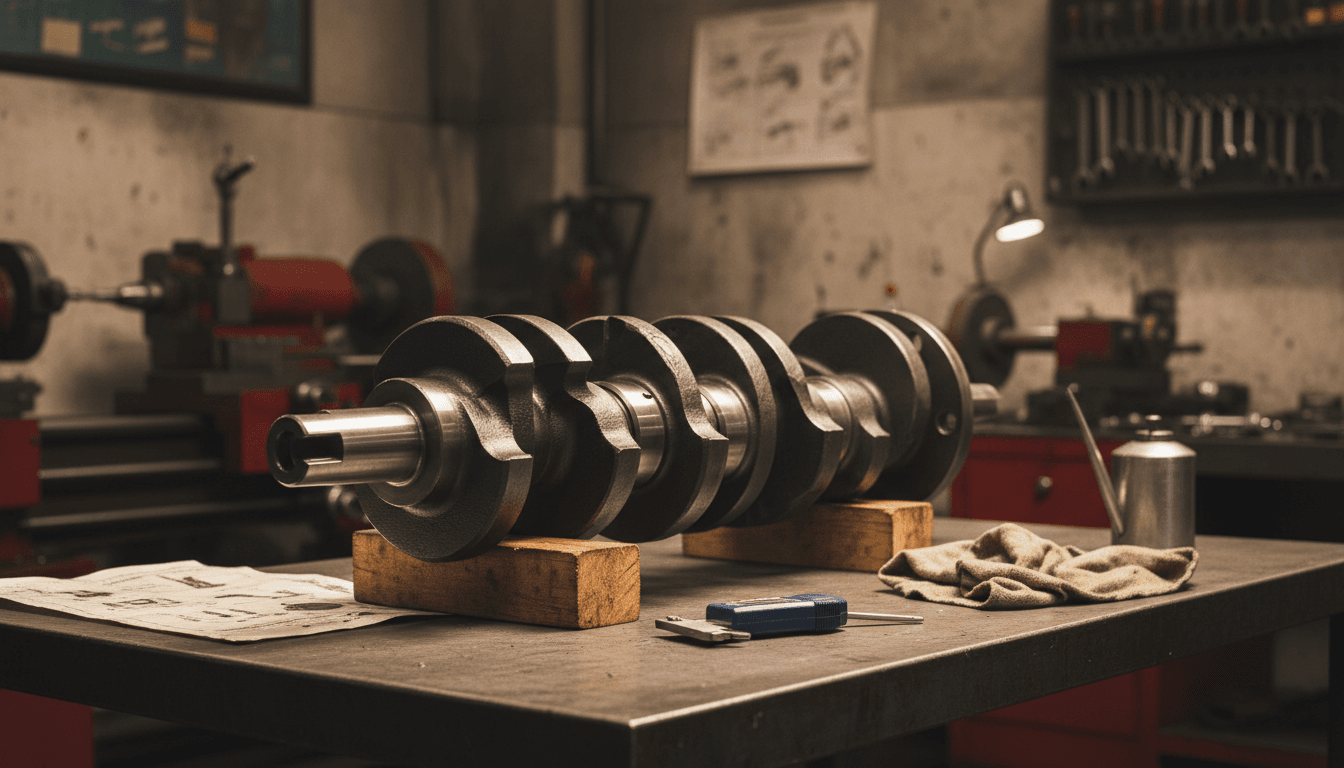
The crankshaft is a moving part located inside the engine of the car, which turns the movement of the pistons from up-and-down to circular motion in order to power the car wheels using the transmission. The crankshaft is located at the bottom of the engine block and connected to all the pistons with a connecting rod.
Common types of car crankshafts
Crankshaft selection is usually made according to the degree of stress that the engine can be exposed to. Whereas economy models apply less complex techniques, high-performance engines require better materials due to their higher speeds and stresses. The following list contains the most popular ones.
| Type | Manufacturing Process | Best For |
|---|---|---|
| Cast Crankshaft | Molten iron is poured into a mould. It is cost effective and works well for standard passenger cars. | Budget and mid range daily drivers. |
| Forged Crankshaft | A block of steel is heated and hammered into shape. This creates a stronger grain structure than casting. | Turbocharged engines and heavy duty trucks. |
| Billet Crankshaft | Machined from a single solid block of high quality steel. It offers the highest strength and precision. | Professional racing and custom high end builds. |
| Ductile Iron Crankshaft | Uses a special type of iron with additives to make it more flexible and resistant to cracking. | Modern diesel engines and light commercial vehicles. |
| Fully Counterweighted | Features weights opposite every crank pin to perfectly balance the rotating mass. | High RPM engines where vibration must be minimal. |
What are the main functions of a crankshaft?
Crankshafts are vital components of the internal combustion engine, as they perform multiple essential functions. Their chief role is to change piston motion from back-and-forth to circular. Besides that, here are other roles fulfilled by the crankshaft:
Energy Delivery: It forwards the mechanical power obtained to the flywheel and transmission.
Secondary Power Source: It supplies power to various engine parts such as the alternator, water pump, and air conditioning compressor via belt-driven mechanisms.
Engine Coordination: It works in tandem with the camshaft so that, at the right moment, the valves open and close.
Vibration Reduction: Its counterweights help balance the engine, thereby reducing piston-generated vibrations.
Understanding the role of a car crankshaft
Think of the crankshaft as the structural heart of your car engine. It is the component that, in its essence, transforms the vertical motion of the pistons into a complete circular movement as you would pedal on a bicycle with your legs. This kind of transformation is necessary because your wheels must be turned by some means of rotation. The crankshaft is connected to the pistons through rods, and it is usually made of high strength forged steel or cast iron, able to handle enormous pressure and temperature. The crankshaft also works with the flywheel to maintain continuous momentum and reduce engine vibrations as you keep driving. You may not appreciate this part at a glance, but without it, the fuel-combustion-based power generation system would be rendered absolutely ineffective.
What are the key parts of a crankshaft?
If you want to get an idea of the whole crankshaft work, here's a breakdown of its main components:
Main Journals: These sections of the shaft fit into the engine block housing and support the shaft rotation.
Crankpins: Offset crankpins, which serve as attachments for the piston rods.
Counterweights: Masses positioned opposite the crankpins in order to balance the rotation of moving parts.
Straight Washers: Parts made to restrict the forward and backward movement of the crankshaft to the smallest limits.
Common stresses on the crankshaft
The crankshaft in your car operates under constant pressure whenever the engine runs. If you understand what causes it to wear out, you can avoid expensive repairs down the road. These are the main stressors that affect its performance.
Shaft twisting stress: The different pistons' movement results in torque being applied to the crankshaft. These rapid twist cycles gradually damage the crankshaft metal, eventually causing it to crack.
Bending stress: The connecting rods receive the combustion forces and they exert their pressure against the crankshaft, a pressure that may lead to the crankshaft being bent, particularly in a car engine, when revving high or carrying heavy loads.
Heat caused by friction: When a car is driven without sufficient lubrication, the metal parts of the car get hot from the rubbing. This heat may cause the crankshaft to warp or the bearings to seize.
Vibration: Any engine will have its natural vibrating frequency. Damaged harmonic balancer or flywheel will make these vibrations be very intense and eventually lead the crankshaft to break.
Oil contamination: The engine oil contaminated with particles like dirt or metal shavings acts as sandpaper that slowly wears the smooth surfaces of the crankshaft journals.
In most car insurance policies, crankshaft wear is a gradual degradation rather than an accident. Hence repairs like this are not typically covered by insurance but rather sudden and external damages like flooding might only be covered with an add-on such as engine protection cover.
How to prevent crankshaft damage?
Maintaining your car's crankshaft is mainly centered on keeping the engine in good condition. As this part is hidden deep inside the engine, you are not able to inspect it every day, but you still follow these steps to ensure it runs smoothly.
Replace your engine oil frequently: For the crankshaft to turn without friction, it needs an oil film. Contaminated or old oil might result in metal-to-metal contact and fast wear of the crankshaft.
Choose the correct grade of oil: Always use the correct oil viscosity recommended by the car manufacturer. Oil of incorrect thickness might affect lubrication of the bearings of the crankshaft.
Monitor the engine temperature: High temperature might cause warping or cracking of the crankshaft. When the temperature rises excessively, try to stop your car and give the engine a chance to cool down.
Do not louse up your engine: Engine lousing happens when you drive at a low speed in a high gear, resulting in immense strain on the crankshaft.
Eliminate vibrations immediately: If there are any engine vibrations, there is a possibility that your harmonic balancer is damaged. This part absorbs engine shocks, and the crankshaft becomes exposed if the balancer fails.
What you have to know is that own damage insurance in general will only cover the crankshaft damage for a case arising from a sudden accident, such as hitting something, but not when caused by a broken harmonic balancer that failed over time due to regular usage.'
Key takeaways
The crankshaft transforms the back-and-forth movement of the pistons into rotary motion to propel the car's wheels.
The crankshaft is usually manufactured from cast iron for regular cars and from steel for racing cars.
It drives auxiliary systems such as alternators and the water pump.
The crankshaft makes two turns per cycle in a four-stroke engine cylinder.
The presence of counterweights is necessary for eliminating vibrations in engines.
Frequently asked questions
Yes. Light wear in the journals could be easily fixed by grinding and oversizing the bearings. But in cases when there is severe warping or cracking of the crankshaft, it needs to be replaced.
The most frequent reasons why an engine fails are lack of lubrication (oil starvation), overheating of the engine, or too much vibration from a bad harmonic balancer
No. The crankshaft converts the pistons' reciprocating motion into rotary motion, while the camshaft controls the engine's valves.
About the authors

Nikhila PS
Written by · Senior Content EditorNikhila is a content creator with 6+ years in EdTech and motor insurance, turning complex policies into clear, engaging content. She enjoys exploring digital trends, social media, and art while planning her next short escape.

Rekhit Singh Kaushal
Reviewed by · Senior Director - Motor UnderwritingRekhit Singh Kaushal is Senior Director at ACKO, a leading digital motor insurance provider in India. With deep expertise in insurance strategy and innovation, he brings trusted insights on car and bike insurance to help drivers stay protected.