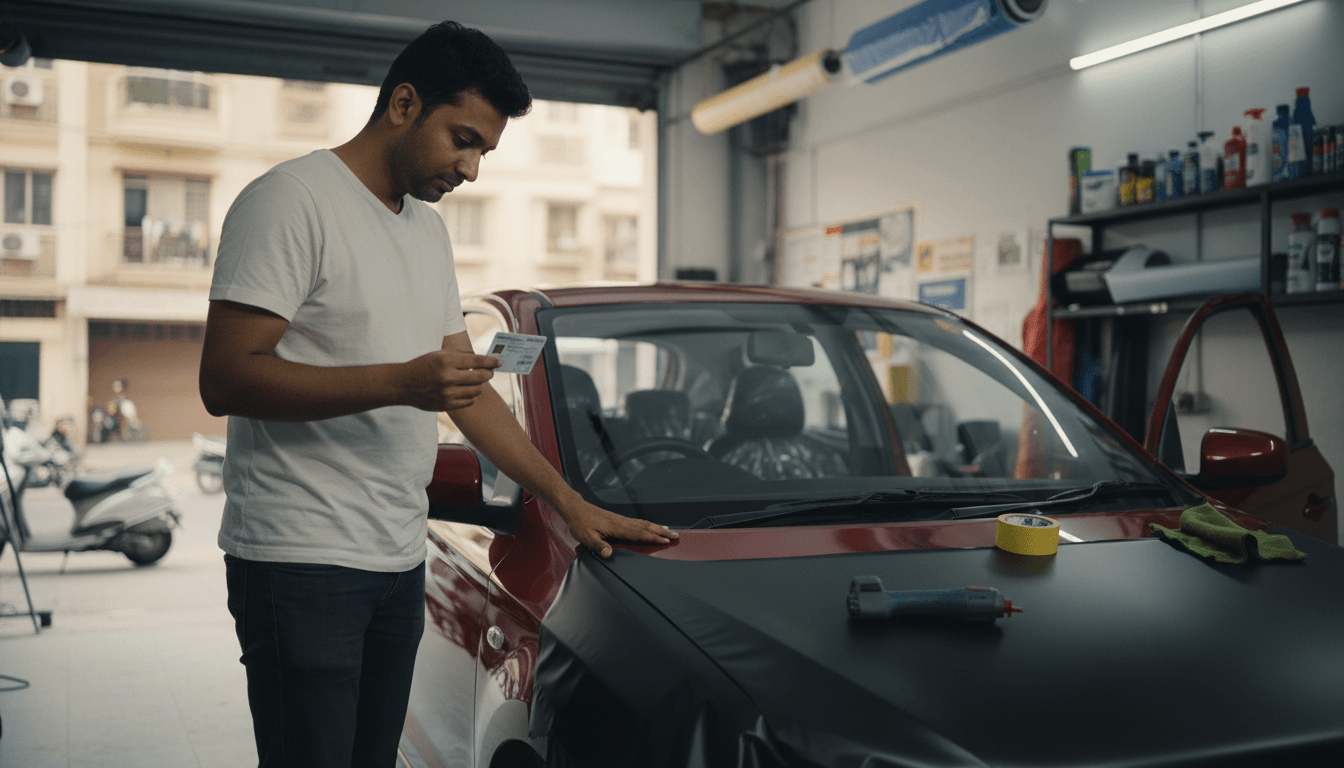
Car wrapping is legal in India as long as the wrapped vehicle does not display any false information in the Registration Certificate (RC) details. When you get a full wrap that changes the car's visible colour, such as from white to black, it must be approved and endorsed by the Regional Transport Office. The vehicle colour is mentioned in the RC format of the Central Motor Vehicles Rules (CMVR). Hence, colour mismatch is clearly visible during traffic checks, when you sell or purchase (or during insurance inspection), or during re-registration, which can raise issues.
What rule applies to car wrapping?
The key provision is under Section 52 of the Motor Vehicles Act, 1988. Section 52 states that an owner shall not change a motor vehicle in such a way that the registration certificate details differ from the original manufacturer's details.
Concerning car wrapping, the relevant detail in the RC is primarily the colour. Wrapping the car with a material that does not reveal the colour on the registration certificate is not the same as wrapping the car and hiding the colour such that it seems like a new one.
| Wrap situation | RC colour mismatch? | Legal position in practice | Usual action |
|---|---|---|---|
| Transparent paint protection film over a white car | No, the car still appears white | Generally not treated as a colour alteration | Keep the invoice and do not cover number plates, lights, or glass |
| White wrap over a white car | No, the visible colour remains white | Generally low-risk if no other legal feature is affected | No colour endorsement is usually needed |
| Matte black wrap over a white car | Yes, the car now appears black | Can be treated as an unapproved alteration if the RC still says white | Get RTO approval and update the RC colour |
| Commercial advertising wrap on a private or business car | Depends on visible colour and design | Motor vehicle rules still apply, and local advertisement rules may also apply | Check colour endorsement, local permissions, and visibility of plates and glass |
When is a car wrap usually allowed?
Wrapping a car is normally permitted provided it doesn't modify the car's registered identity or obscure the vehicle's mandatory safety and identification elements. It is recommended to use a clear protective layer for the wrapping, as this doesn't change the registered colour and therefore is the minimal interference option.
| Allowed or low-risk wrap type | Why it is usually acceptable | What you should still check |
|---|---|---|
| Transparent paint protection film, also called PPF | It protects paint while keeping the original colour visible | The film should not be applied to number plates, lights, mirrors, or windscreens in a way that affects visibility |
| Same-colour vinyl wrap | The car still matches the RC colour entry | The shade should not create a clear colour mismatch, such as RC says white but the car appears silver or grey |
| Small decals or stripes | The base colour remains the same | The decal should not imitate police, ambulance, defence, or government markings |
| Partial roof or bonnet wrap | It may not change the main body colour | If the car visibly becomes two-colour, ask the RTO whether the RC should mention both colours |
When can a wrap become illegal?
It is possible to make wrapping the car illegal if the wrap is done in such a way that the car's original color is not visible, without going to the RTO (Registrar of Motor Vehicles) for a new endorsement, the wrap hides any of the mandatory car identification numbers, the wrap reduces the driver and other people's visibility, or the car is made to look like official or emergency vehicle through the wrap.
Colour change wrap is an issue if the RC does not show the new colour.
A wrap cannot conceal or interfere with the registration number plate as the vehicle has to display its registration mark under the Central Motor Vehicles Rules.
The wrap cannot conceal headlights, taillights, reflectors, indicators, mirrors, and sensors to the extent that it poses a threat to road safety.
Black films and unapproved films on safety glasses constitute a distinct legal issue, as per the decision of the Supreme Court of India in Avishek Goenka v Union of India, regarding black films on vehicles beyond the approved standard for glasses.3
A wrap that resembles the wraps used on police vehicles, ambulances, government vehicles, military vehicles, diplomatic vehicles, or other official entities is an independent concern, even if the colour is approved.
Do you need RTO permission before wrapping?
RTO permission is required whenever there is any colour change in the visual appearance of the vehicle through the wrap that differs from what is mentioned in the RC book. If your RC book mentions Pearl White, but your car has been wrapped into Nardo Grey completely, then there is no match between the RC book and the visible colour of the vehicle.
Unfortunately, there is no online system available in India for colour change through wrap that can be applied uniformly across all the states. The best thing to do is to talk to the registering RTO and know about the necessary documents and inspection before changing the colour of the vehicle.
How do you update the RC after a colour change?
Check the RC colour first
The RC should have the colour entry listed. If there is no change in colour from the proposed wrap, the RC colour update will not be necessary. But if there is any change in colour, continue with the RTO procedure.
Seek guidance from the registering RTO before the wrap
It is necessary to inquire with the RTO where the car is registered, whether approval and inspection of the vehicle are required before and after wrapping. Requirements can vary by state and the office of the RTO.
Prepare the documents
Generally, the required documents are the original RC, insurance certificate, pollution under control certificate, ID and proof of address for the owner, wrap invoice, and pictures of the vehicle. Please follow the specific list provided by your RTO.
Inspection of the vehicle
Take the car for inspection if required by the RTO. The officer will check whether the vehicle identity, chassis number, registration mark, and the color match the application.
Retrieve the updated RC
Once the approval is received, have the colour change recorded on the RC or on the digital RC form. Retain the approval copy, the receipt, and the wrapping invoice along with the car documents.
What does a practical example look like?
This is an example showing how the interpretation of a legal problem can vary greatly for the same car.
| Example | RC colour before wrapping | Wrap applied | Visible colour after wrapping | What you should do |
|---|---|---|---|---|
| 1 | White | Clear PPF | White | No colour change endorsement is usually needed |
| 2 | White | Gloss white vinyl | White | No colour change endorsement is usually needed if the colour still matches the RC |
| 3 | White | Matte black full wrap | Black | Get RTO approval and update the RC colour to black |
| 4 | Silver | Black roof and bonnet wrap | Silver and black | Ask the RTO whether the RC should record two colours |
Regarding example 3, the issue here isn’t the vinyl substance but the fact that the color of the car on the road has become black, while the RC states that it is white.
Can police fine you for a car wrap?
Yes, if the wrap causes colour mismatch, hides the vehicle registration, hides any safety equipment, or breaches any other road law, the traffic police are authorised to book the violation and issue a challan. For a change that violates the Motor Vehicles Act or any allied rule, under Section 182A, the punishment can be imprisonment of up to 6 months, a fine of up to Rs 5,000 per change, or both.
| Issue noticed during checking | Why it matters | Possible consequence |
|---|---|---|
| RC says white, car is fully wrapped black | The registered colour does not match the visible vehicle | Challan, direction to update RC, or direction to restore the original colour |
| Wrap covers number plate edges or makes the number unclear | The registration mark must remain clearly displayed | Challan and requirement to fix the plate display |
| Dark film or wrap on glass | Vehicle glass rules and Supreme Court directions apply separately | Removal of film and enforcement action |
| Wrap imitates official or emergency vehicle markings | It can mislead other road users and authorities | Separate enforcement action depending on the design and use |
Can wrapping affect insurance?
A wrap can affect car insurance records if the visibly altered colour and the RC are not updated. It is likely that insurance companies check vehicle details from RC; therefore, a discrepancy between the car, the RC and the insurance record may be raised as an issue during inspection, claim settlement or sale.
An RC change should be made prior to notifying the insurer about using another colour of full wrap in order to keep the policy records in sync. Of course, in case one uses clear PPF or same colour paint, there is no need for an RC or policy change. Still, it is recommended that you carry along the invoice and photos of the vehicle as proof that the wrap didn't change the vehicle's identity.
Key takeaways
- Vehicle Wrapping is not prohibited in India, but it cannot result in any wrong data on the car’s RC details.
- A complete wrapping which changes the colour of the car should be approved and endorsed by the RTO.
- Wraps that are clear and of the same colour as that of the vehicle are generally low risk as the change in color is not much.
- Even if the wrapping is removable, it is not automatically exempted from Section 52 if the car's visible color has changed from its RC.
- The wrapping should not cover any number plates, lights, mirrors, reflectors or any glass part of the vehicle, contrary to the rules of road.
- There is also a provision of fine as per Section 182A of the Motor Vehicles Act of up to Rs 5,000 for each alteration, along with imprisonment up to six months.
Frequently asked questions
Yes. Body wrap of your vehicle is legal as per law, provided the colour of the vehicle is registered and follows all the rules and regulations. However, if the body wrap of your vehicle completely changes the colour, then the RC should have that new colour endorsement, which is possible only after getting permission from the RTO.
If you want to have a vehicle fully covered with a matte black wrap and it is legal, it is necessary that the change of registered colour is properly noted on the car. Suppose your RC card states the car as white, silver, red, or some other colour but now the car is matte black wrapped. You must go to the RTO to change the carcolour through your RC.
Transparent PPF is mostly legal as it doesn't alter the car's registered Colour. Besides that, its usage should not interfere with the number plates, lights, mirrors, or legally required visibility through glasses.
There will be no need to obtain an RTO permission even if you get the same color wrap provided the RC color of the vehicle is maintained. However, you must keep your invoice safe and stay away from any design that impacts the identity and security of your vehicle.
If the RC number and the visible number on your vehicle do not match, you may receive a challan and be asked to change your RC or remove the vehicle wrap you are wearing. In addition to this, Section 182A of the Indian Motor Vehicles Act gives power to the concerned authority to impose a penalty for illegal modifications made to a vehicle.
Advertising wraps for vehicles cannot be assessed solely under the Motor Vehicles Act. They should adhere to the RC colour code, not obscure number plates and windshields, and might also require permission from the municipal or state authorities for car advertisement.
About the authors

Nikhila PS
Written by · Senior Content EditorNikhila is a content creator with 6+ years in EdTech and motor insurance, turning complex policies into clear, engaging content. She enjoys exploring digital trends, social media, and art while planning her next short escape.

Rekhit Singh Kaushal
Reviewed by · Senior Director - Motor UnderwritingRekhit Singh Kaushal is Senior Director at ACKO, a leading digital motor insurance provider in India. With deep expertise in insurance strategy and innovation, he brings trusted insights on car and bike insurance to help drivers stay protected.