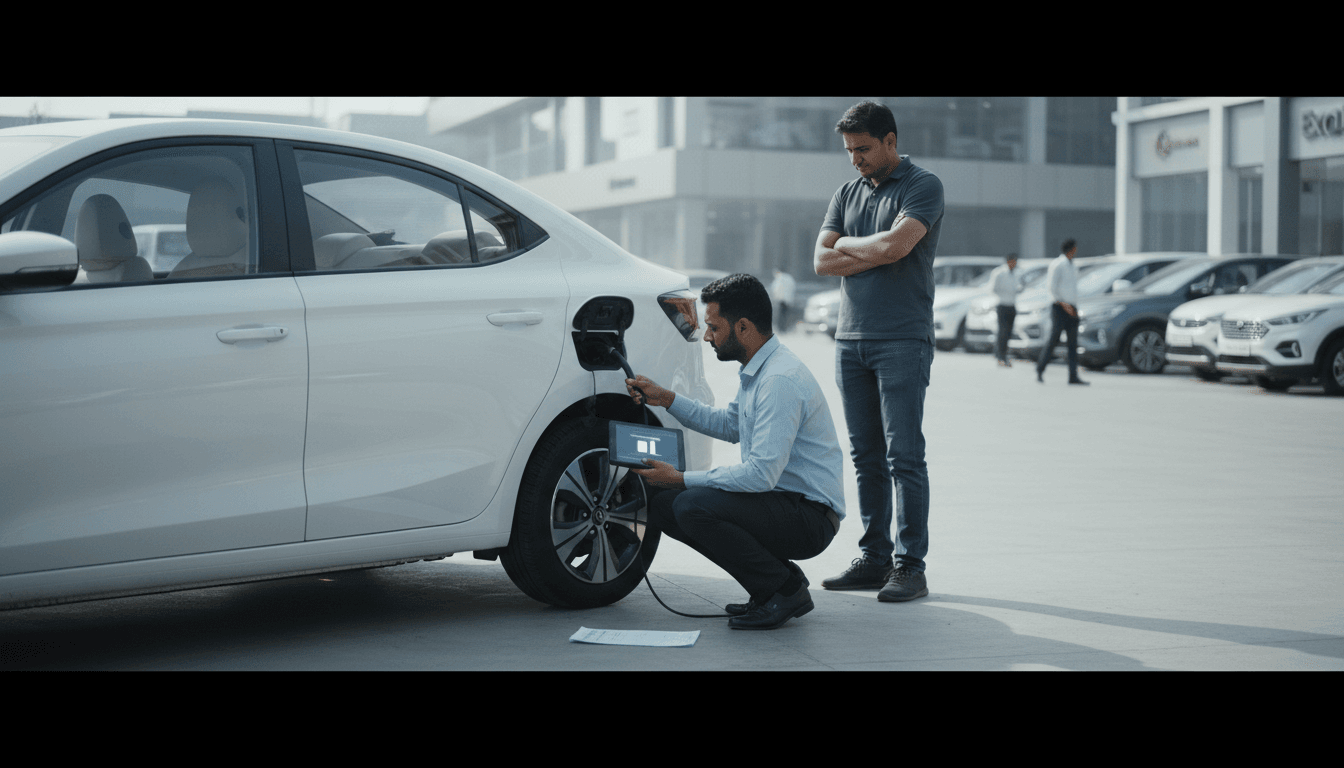
Depreciation rate of electric vehicles is influenced primarily by battery condition, remaining warranty period, actual driving range, availability of charging, demand for the make, age of the vehicle, mileage, accident history, software updates, and changes in prices of newly bought EVs. In India, the value of electric cars may fluctuate significantly due to price reductions of new models or release of higher range models and changes in their warranty services.
Which factors affect the depreciation rate?
The key variables are those that affect the expected cost, usable range, and the buyer's confidence in the car. The table below shows the real effect of each variable.
| Factor | What buyers look at | Effect on depreciation |
|---|---|---|
| Battery health | State of health, range drop, charging behaviour, battery diagnostic report | Lower battery health increases depreciation because the buyer expects lower range or a future battery repair cost. |
| Battery warranty remaining | Years and kilometres left under the battery warranty | More warranty remaining usually supports resale value because the buyer has protection against major battery defects. |
| Real-world range | Range delivered in city use, highway use, summer traffic, and with AC on | Cars with practical daily range depreciate less than cars that force frequent charging for the same use case. |
| Charging speed and compatibility | Home charging support, DC fast-charging support, connector type, access to public chargers | Slower or less compatible charging can reduce demand, especially for buyers who travel between cities. |
| Brand and model demand | Number of buyers in the used market, service network, parts availability | High-demand models usually hold value better than low-volume or discontinued models. |
| New-car price cuts | Current ex-showroom price and discounts on the same or newer model | A new-car price cut can reduce used prices immediately because buyers compare the used EV with the lower new price. |
| Subsidies and tax changes | State EV incentives, road-tax waivers, registration costs, and policy changes | If a new EV becomes cheaper due to incentives, older used EVs may need a lower price to remain attractive. |
| Age and kilometres driven | Vehicle age, odometer reading, warranty status, tyre and brake condition | Higher age and kilometres usually increase depreciation, although EVs with strong battery health can still attract buyers. |
| Accident and flood history | Car insurance claims, structural repairs, water ingress, battery-pack damage | Accident, flood, or battery-pack damage can sharply reduce resale value because repair risk is high. |
| Software and connected features | Updates, app support, navigation, charging planner, feature availability | Cars with continued software support are easier to sell than cars with outdated or unsupported features. |
Why does battery health matter most?
The battery’s health is generally the only most EV-specific determinant of depreciation as the battery is the most expensive and range sensitive component of the car. An older EV with a healthy battery, range, and warranty coverage will instill more confidence in the buyer than an EV without known battery condition.
In order to determine depreciation due to battery, consider the following:
Health status of the battery: It reveals what percent of battery capacity has been used in comparison with the battery at the moment of delivery.
Actual range: The owner can compare the actual range provided by the car with the actual range which was achieved before buying it.
Charging history: It is not always negative, but it might be a red flag in combination with the overheating history of the battery.
Battery warranty period: It is easier to price the car with battery warranty period than the one where the buyer has to take all the risks of battery degradation.
Battery alerts: It is always a minus for the buyer.
Does charging speed affect depreciation?
Ease of charging impacts depreciation since a previously-owned electric vehicle will be worth more if it is easier to recharge at home and suitable for recharging along public charging routes. A vehicle that can be easily charged at home and DC fast charged is also easier to sell.
| Charging situation | Used-buyer concern | Likely resale impact |
|---|---|---|
| Buyer has dedicated home parking and charging | Low daily charging stress | Better resale demand for daily-use EVs |
| Buyer depends mainly on public chargers | Availability, queues, charger downtime, payment apps | Lower demand if the car charges slowly or uses a less common charging setup |
| Car supports DC fast charging | Intercity usability and shorter charging stops | Better demand than a similar car with only slow charging, especially for highway users |
| Car has slow charging only | Long charging time and limited flexibility | Higher depreciation if buyers expect occasional long-distance use |
Do new EV prices affect used prices?
Yes, because the depreciation of the used EV will be impacted by changes in the new EV pricing. For instance, when the new model of that EV becomes cheaper, has a larger battery, or has added features, then its old counterpart must have to become cheaper to be competitive.
The influence may be greater on the EVs compared to gasoline or diesel vehicles since EV technology is evolving rapidly. The newer variant that has greater range, fast charging capability, better battery guarantee, or more features will make the older model less desirable despite its physical condition being good.
Do new EV prices affect used prices?
Yes, new EV prices affect used EV depreciation directly. If the new version of the same model becomes cheaper, gets a bigger battery, or adds major features, the older used car usually has to be priced lower to compete.
This effect can be stronger for EVs than petrol or diesel cars because EV technology is still changing quickly. A newer variant with longer range, faster charging, better battery warranty, or more features can make an older variant less attractive even if the older car is in good physical condition.
Important check before pricing an EV
An old electric vehicle should not be valued just based on age and mileage alone. For instance, two electric vehicles of the same brand and age can have different resale values due to differences in battery condition, remaining warranty, clean maintenance record, and absence of accident or flooding.
How do you calculate depreciation?
You calculate the depreciation of an EV by deducting the vehicle's current resale price from the purchase price, excluding registration costs. If you want a percentage, take the amount you have lost, divide it by the on-road original price to get a decimal, and finally multiply by 100.
Mathematically, depreciation percentage = (current resale value/original on-road price) × 100.
| Item | EV A | EV B |
|---|---|---|
| Original on-road price | Rs 20,00,000 | Rs 20,00,000 |
| Age | 3 years | 3 years |
| Kilometres driven | 35,000 km | 55,000 km |
| Battery health | 92% | 78% |
| Battery warranty status | Warranty still active | Warranty close to expiry |
| Estimated resale value used in this example | Rs 12,00,000 | Rs 9,50,000 |
| Depreciation amount | Rs 8,00,000 | Rs 10,50,000 |
| Depreciation percentage | 40% | 52.5% |
EV A has depreciated 40% as (Rs 8, 00, 000 ÷ Rs 20, 00, 000 × 100 = 40). The second vehicle EV B was down to 52.5% (Rs 10, 50, 000 ÷ Rs 20, 00, 000 × 100=52.5%). Such difference cannot be accounted for simply by age. EV B has put more miles, the battery condition is worse, and the warranty period is shorter.
How should you check a used EV before buying?
Confirm the exact variant
Be sure to find out: the model year, variant, battery size, warranty periods, and whether the model is still being sold or is available with after-sales support.
Verify battery condition
If you want, you can request a Battery Health Report or Diagnostic Scan. These are different from simply trusting your car's odometer range indicator.
Check real-world range
Compare the range displayed with the seller's actual daily range in city driving, open road driving, and AC use.
Inspect charging hardware
Check if the home charging equipment is in order and make sure the charging cable is in good condition. Also DC fast-charging support and charging-port condition should be looked up.
Review records
Inspect service invoices, insurance claims, accident repairs, flood exposure, loan closure, and ownership transfer documents.
Compare with the current new price
When assessing the asking price, take into account the current new-car price at the dealership for the same or most similar variant. Do not compare it to the original purchase price.
When does depreciation become higher?
Typically, an electric vehicle will depreciate more rapidly when signs indicate expensive repairs, poor range performance, or inadequate future support. Such signs can reduce the pool of potential buyers, thus lowering the price of the used EV.
The condition of the battery is either poor or unknown.
The battery is no longer covered by the warranty period.
There is water damage to the vehicle's underbody or there are high-voltage system repairs.
The vehicle model has been discontinued, and service support is lacking.
The new EV model has significantly increased range and/or decreased price.
It is difficult to charge the car for potential buyers.
Key takeaways
The rate of depreciation of an electric vehicle depends on used-car factors and EV specific factors.
Choosing zero depreciation insurance coverage while purchasing car insurance can be useful for compensating the losses incurred due to accident repairs as well as protecting the value of your vehicle in the future.
Factors like the condition of the battery, the number of years left in the battery warranty, the actual range of the EV, and the ease of charging are the top four factors of EV specific.
Reduction in price of the new EV, new longer-range models, and change in the incentives may cause depreciation of used EVs.
Accident record, flood damage, lack of maintenance record, and unknown condition of the battery will result in depreciation of EVs.
Depreciation rate can be calculated using this formula: (Original on-road price - Resale price)/ Original on-road price * 100
A used EV needs to be inspected using battery diagnostics, maintenance records, warranty records, and new car prices.
Frequently asked questions
Depreciation in electric cars can speed up significantly if the battery condition is poor, only a few parts are covered by the warranty, there's a new, lower-priced EV model, or there are new models that offer a much longer range.
The battery is generally the most crucial element to consider, as it affects range, charging efficiency, customer satisfaction, and repair costs. A battery analysis provides a more objective basis for valuation compared to age and mileage information.
Yes. Reselling an old EV with an active battery warranty will be easier, since the buyer is protected against any battery-related defects. However, if the battery warranty has run out, the buyer can negotiate a reduced price.
Low kilometres will assist, but they are no guarantee of good resale value. An electric vehicle with low kilometres may also devalue if the battery condition is poor, it is old, its charging capacity is poor, or a new one can be bought more cheaply.
To prevent unnecessary depreciation, you should maintain service records, maintain the battery properly, avoid accidents or flooding, preserve charging equipment, update any software, and keep your warranty papers.
The best way to begin is to refer to the current market price of the same or very close new version, i.e., not just to the price paid by the first owner. If the new EV gets cheaper or its features are much improved, then the prices of used EVs generally need to be in line with the new ones.
About the authors

Nikhila PS
Written by · Senior Content EditorNikhila is a content creator with 6+ years in EdTech and motor insurance, turning complex policies into clear, engaging content. She enjoys exploring digital trends, social media, and art while planning her next short escape.

Rekhit Singh Kaushal
Reviewed by · Senior Director - Motor UnderwritingRekhit Singh Kaushal is Senior Director at ACKO, a leading digital motor insurance provider in India. With deep expertise in insurance strategy and innovation, he brings trusted insights on car and bike insurance to help drivers stay protected.