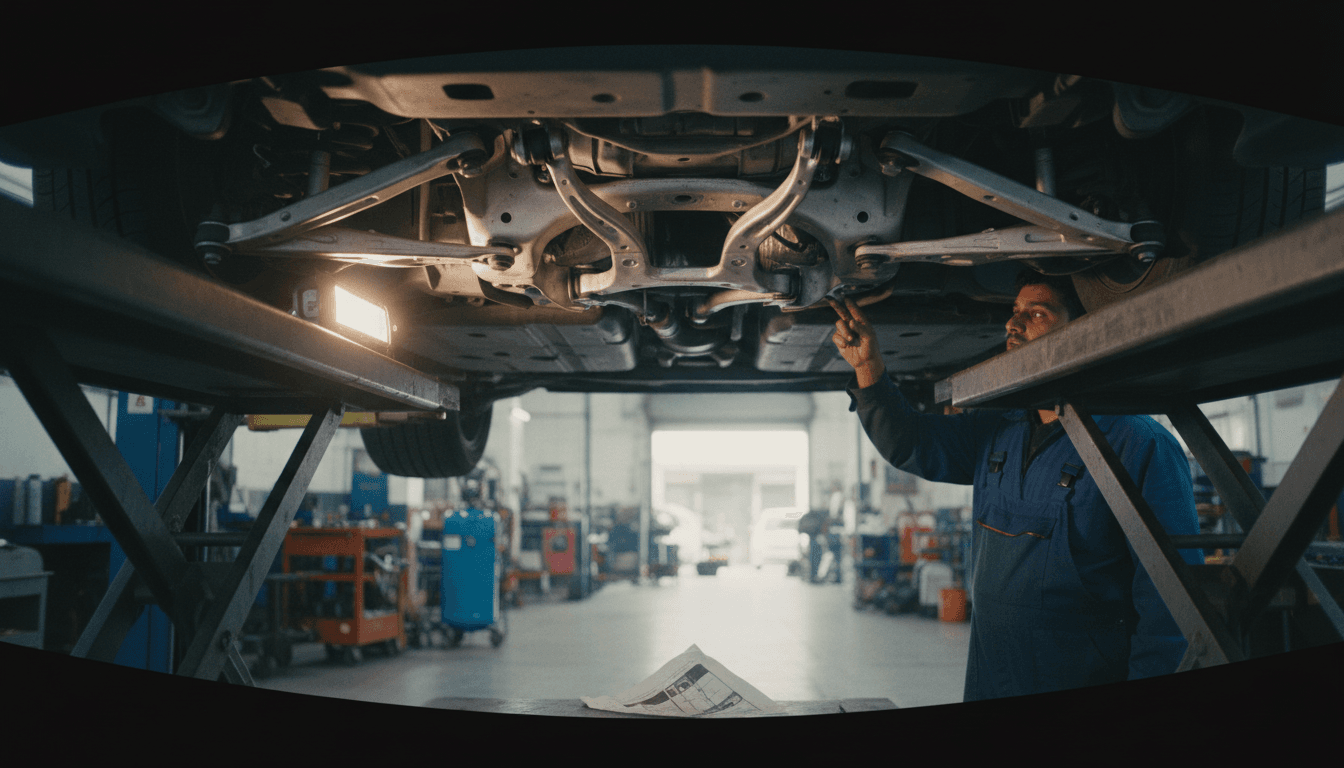
Multi-link suspension is a type of car suspension design in which wheels are supported by several different pivot points, or links. This system's main objective is to allow for greater precision in controlling wheel movements, so that the tyre can be kept better in line with the road during bumps, braking, cornering, and acceleration. It means that engineers will have a wider choice in fine-tuning ride comfort, tyre grip, and stability, but, as is also the case, this system will be more complex and, as a result, the parts will normally be a bit more costly to repair.
What does multi-link suspension mean?
The multi-link suspension is generally a type of independent suspension. This implies that one of the vehicle's wheels can move up or down with minimal direct effect on the other wheel. The car's suspension system bears its weight, absorbs road bumps, and enables the tyres to grip the road surface.
The term multi-link does not denote a unique, rigid suspension pattern. Instead, it refers to various suspension types that utilise multiple links or control arms. A typical technical definition is that a multi-link suspension employs three or more lateral links and one or more longitudinal links to locate the suspension.
The different links are assigned different functions. Whereas one link may be responsible for keeping the wheel's position when it moves forward and backwards, another might keep the wheel in alignment when it moves sideways. Some links may manage camber, and toe camber is the tilt of the wheel towards or away from the vertical axis viewed from the front or rear of the vehicle, whereas toe is the angle to which a wheel is pointed inwards or outwards when looking down from the top.
How does the multi-link suspension work?
The multi-link suspension allows the wheel to follow a smooth path as it moves up and down the road. Rather than trying to push the wheel into a basic arc, the many links permit the wheel angle to change in a much finer manner.
When the wheel passes over a pothole or a speed break, the spring shrinks, the damper limits the jump, and the links direct the wheel hub. Due to links being at various angles, the suspension unit may limit the movement of such undesirable parameters like camber, toe, and wheelbase.
Worked example: what a 5-link layout means
If the manufacturer states that the rear suspension is a 5-link layout, this means, in effect, that each rear wheel is mounted on 5 different suspension links. Therefore, with a two-wheel rear-axle suspension setup, there will be 10 suspension links in total, in addition to springs, dampers, hubs, carriers, bushes, bolts, and an anti-roll bar. The total number calculation is quite simple: 5 links per wheel x 2 rear wheels = 10 links.
However, just because a suspension system is multi-link, one should not assume that it is definitely 5-links one. A 5-link suspension design just means that one possible suspension design is the 5-link version.
What are the main parts of a multi-link suspension?
In a multi-link suspension system, the links, joints, spring, damper, and wheel carrier are among the main components. While the arrangement will differ for different cars, they share those components to fulfil the base role.
| Part | What it does | What the driver may notice |
|---|---|---|
| Links or control arms | Guide the wheel hub through its movement path. | Better control over wheel angle during cornering and bumps. |
| Bushes | Allow small controlled movement and reduce noise and vibration. | Worn bushes can cause knocking sounds, uneven tyre wear or loose handling. |
| Ball joints | Allow the links to pivot as the suspension moves. | Worn ball joints can cause play, noise or steering instability. |
| Spring | Supports the vehicle weight and absorbs vertical movement. | A weak or damaged spring can affect ride height and comfort. |
| Damper or shock absorber | Controls bouncing after the spring compresses and rebounds. | A worn damper can make the car feel floaty or unstable over repeated bumps. |
| Wheel carrier or hub carrier | Holds the wheel hub and connects it to the suspension links. | It helps maintain wheel position under load. |
| Subframe | Provides a mounting structure for the suspension links. | It helps isolate vibration from the vehicle body. |
What are the benefits of a multi-link suspension?
The main advantages of a multi-link suspension are greater wheel control accuracy, more comfortable ride quality, and greater stability at high speeds. However, the main benefit is clearly seen when the vehicle is driven on a rough road, when it turns, brakes or changes lanes.
| Benefit | How multi-link suspension helps | What it means for you |
|---|---|---|
| Better tyre contact | The links can control camber and toe changes more precisely. | The tyre can maintain a more useful contact patch on uneven roads. |
| Improved cornering stability | The wheel can be guided to stay better aligned under side load. | The car may feel more planted while taking curves or highway exits. |
| Better ride comfort | The suspension can absorb vertical movement while limiting unwanted wheel movement. | Sharp bumps may feel better controlled, especially at the rear. |
| Reduced effect from one side to the other | In an independent multi-link layout, one wheel can move with less direct movement transferred to the opposite wheel. | A bump under one rear wheel may disturb the cabin less than in some connected-axle layouts. |
| More tuning flexibility | Engineers can set the length, angle and mounting point of each link separately. | The same basic concept can be tuned for comfort, sporty handling or load stability. |
What are the drawbacks of a multi-link suspension?
The disadvantages of multi-link suspension are mainly due to its higher complexity, which in turn means more parts, repair costs that potentially can be higher in comparison to simpler systems, as well as the presence of more bushes and joints (which are also more links) that can wear out as time passes.
As multi-link suspensions will be more costly to repair than other types, it would be helpful to establish the scope of coverage for a comprehensive insurance policy, as such wear is normally considered a matter of regular maintenance and not an insurable one.
| Drawback | Why it happens | What it means for you |
|---|---|---|
| More parts | Each wheel may use several links, bushes and joints. | There are more wear points to inspect during service. |
| Higher repair complexity | Access and alignment can be more involved than in simpler layouts. | Diagnosis may take longer if there is a noise, pull or uneven tyre wear. |
| More sensitive to alignment | Camber and toe control are central to how the design works. | Poor alignment can reduce the benefit and increase tyre wear. |
| Packaging space | Multiple arms need space around the wheel and underbody. | Vehicle designers must balance suspension design with boot space, floor height and component placement. |
Model-specific costs are not covered here
The given research brief was devoid of a fitment list of vehicle-specific parts, repair costs or brand service charges. Please consider this article a general description of the technology, and not a price indication guide for a car model.
How multi-link suspension different from other suspension types?
A multi-link suspension is mostly different from a torsion beam and a MacPherson strut by the number of parts that guide the wheel and to what extent the design allows for control of wheel geometry.
| Suspension type | Basic layout | Main strength | Main limitation | Common use case |
|---|---|---|---|---|
| Multi-link | Several separate links guide each wheel. | Precise control of wheel movement, camber and toe. | More complex and has more wear parts. | Often used where comfort, handling and stability are priorities. |
| Torsion beam | Left and right wheels are connected by a beam that twists. | Simple, compact and generally cost-efficient. | One wheel's movement can affect the other side more than in an independent layout. | Often used at the rear of small and mass-market cars. |
| MacPherson strut | A strut combines spring, damper and upper location into one compact unit. | Compact and widely used, especially at the front. | Less geometry freedom than a multi-link layout. | Common front suspension layout in passenger cars. |
Where is the multi-link suspension used?
When vehicle manufacturers are looking to achieve the perfect compromise between a smooth ride, good steering, and the vehicle's ability to go straight ahead (tracking), they tend to go with multi-link suspension. It is a type that can be applied to either the front or rear axle. However, it is mostly associated with the rear wheel area; therefore, the term comes up quite often when the rear suspension is mentioned.
For an Indian customer, the real factor lies not only in whether the brochure says multi-link or not. The most valuable aspect is how the car performs on roads, which are the main routes you use. A properly calibrated yet simpler suspension might feel even better than the poorly calibrated suspension system of a complex type. Suspension geometry, tyre size, tyre pressure, wheelbase, vehicle weight and damper tuning all contribute to the ride comfort.
If there is any suspension damage caused by an accident like driving into a big pothole that bends a link, or an accident that causes wheel alignment issues, the suspension damage is probably going to be covered by your car insurance under the 'own damage' clause and not be considered as a maintenance cost.
What should you check before buying or maintaining multi-link suspension?
Test drive experience and noise
During the test drive, see how well the car rides on speed breakers, rough roads, and fast lane changes. Listen out for any knocking noises coming from the suspension system.
Find out what is checked during inspection
Confirm that the servicing station has the capability to check bushes, ball joints, dampers and wheel alignment. Multi-link suspension has more wear areas compared to other suspension systems.
Combine tyre wear with wheel alignment
If your car drifts to one side, the steering is loose and the tyres wear out unevenly, have your wheel alignment and suspension checked.
Have correct tyre pressure
Ensure you inflate the tyres to the correct pressure for the vehicle. Incorrect pressure will adversely affect the suspension.
Key takeaways
In a multi-link suspension, a series of links connects and guides the wheel hub.
The primary role of a multi-link suspension is to control a wheel's movement and camber/toe.
With a 5-link rear suspension design, 5 links are employed for each rear wheel; thus, for a rear axle with 2 wheels, there will be 10 rear suspension links before accounting for other components.
Advantages include better tyre grip, stability, ride quality, and ease of tuning.
Disadvantages include higher complexity, a higher number of components, increased sensitivity to alignment, and possibly higher maintenance.
Multi-link suspension is not necessarily superior in all cars. Ride and handling performance depend on many other factors.
Frequently asked questions
Multi-link Suspension is said to be more complex compared to a Torsion Beam since it allows for more control regarding the wheel. Nevertheless, the actual comfort will depend on the tuning, tyres, dampers and overall vehicle setup.
Multi-link suspension can also contribute to a more comfortable ride by distinguishing the pure up-and-down movement of the wheel from other undesirable wheel movements.
Multi-link suspension may incur higher maintenance costs than simpler versions because it has more links, bushes, and joints. The exact cost of maintenance was not included in the research brief, hence the lack of model-specific cost in this article.
No. Multi-link suspension is not limited to sports cars but can be found in many family-oriented models, too. This system offers maximum adaptability in tuning, therefore an identical car platform can be fine-tuned for comfort, stability and responsive handling respectively.
In addition to the knocking, common symptoms include worn and uneven tyre wear, unsteady handling, vibration, poor alignment retention, and the car veering to one side. These symptoms could also arise from other causes such tyres, wheels or steering parts, hence a physical inspection is required for confirmation.
Not always. A simpler suspension that is well tuned for the vehicle can feel better than a multi-link suspension that is poorly tuned or badly maintained. The design is only one part of ride and handling.
About the authors

Nikhila PS
Written by · Senior Content EditorNikhila is a content creator with 6+ years in EdTech and motor insurance, turning complex policies into clear, engaging content. She enjoys exploring digital trends, social media, and art while planning her next short escape.

Rekhit Singh Kaushal
Reviewed by · Senior Director - Motor UnderwritingRekhit Singh Kaushal is Senior Director at ACKO, a leading digital motor insurance provider in India. With deep expertise in insurance strategy and innovation, he brings trusted insights on car and bike insurance to help drivers stay protected.