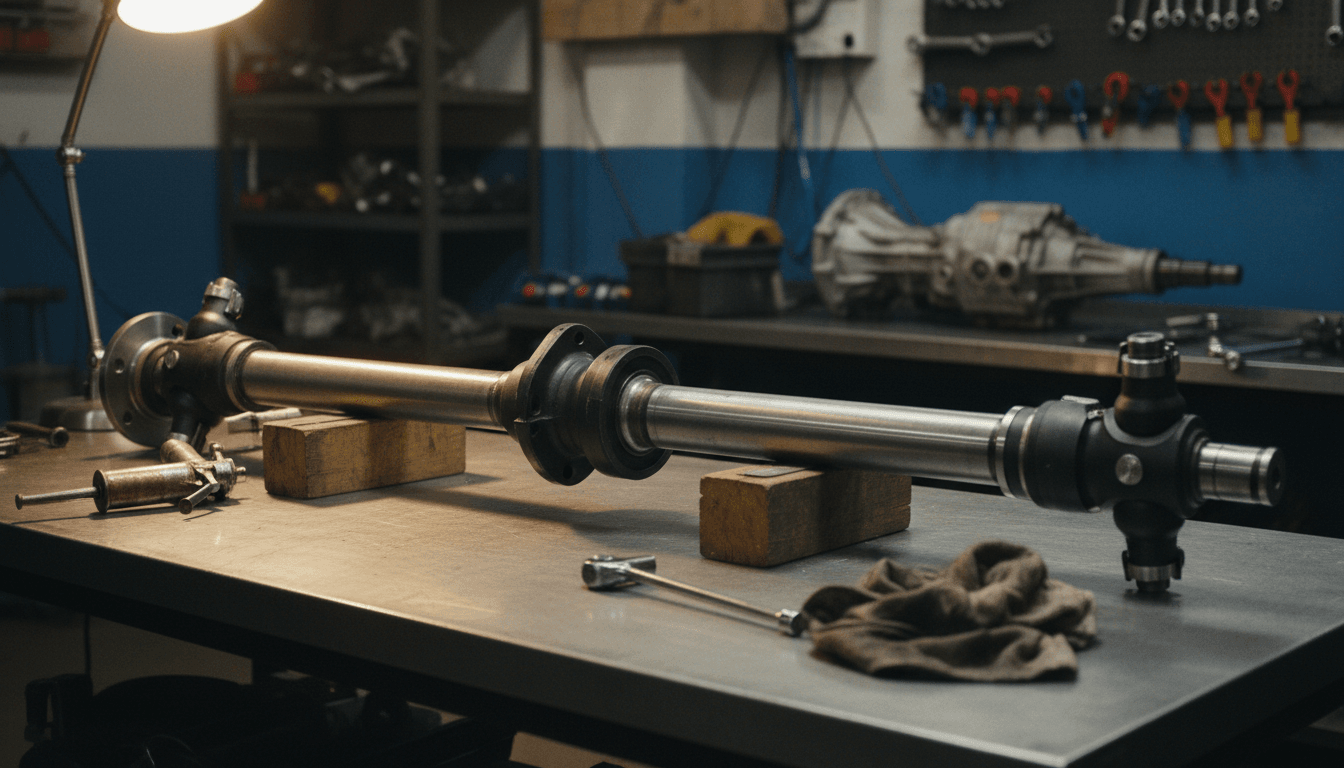
A propeller shaft, commonly referred to as a drive shaft, is a mechanical component that transmits torque and rotation from a vehicle's transmission to the differential, which then rotates the wheels. It serves as the primary bridge in the drivetrain for rear-wheel drive (RWD), four-wheel drive (4WD), and all-wheel drive (AWD) vehicles, ensuring that the power generated by the engine actually reaches the road.1
Because the transmission and the rear axle are not at the same height and move independently due to the suspension system, the propeller shaft must be flexible. It is designed to handle varying angles and lengths while rotating at high speeds to maintain a smooth flow of power.
What are the main components of a propeller shaft?
A propeller shaft is not merely about turning. It is an intricate unit composed of several finely crafted parts that help the car move and deliver power efficiently. The main components include:
Shaft Tube: This is the shaft proper, made of either hollow steel or light, strong aluminium, so it is not easily bent.
Universal Joints (U-joints): These look like crosses, and they make it possible for the shaft to bend and turn together. They also help by compensating for any angular differences between the gearbox and the differential that arise when the vehicle is driven over rough roads.
Slip Joint: With this feature, the shaft can be adjusted slightly in length. As the rear wheels move up and down, the clearance between the transmission and the axle varies. The slip joint helps keep the shaft from either snapping or causing stress on the gearbox.
Yokes: These are the two points at the extreme end of the propeller shaft where it is physically joined to the transmission and the differential.
Centre Bearing: This is a support for the middle of the shaft when it is a longer two-piece shaft; in other words, the centre bearing avoids the shaft vibrating too much.
How does the propeller shaft function?
Torque Generation
The engine-generated thrust passes through the transmission to the output shaft.
Power Transfer
The transmission output shaft is joined by the propeller shaft via a coupling and a U-joint.
Rotation and Flexing
The propeller shaft spins at a high velocity. The U-joints provide the spinning capability even when the car's suspension causes the axle to bounce up and down.
Differential Input
The spinning shaft delivers the torque to the differential at the rear( or front) axle.
Wheel Rotation
By splitting the power, the differential can send the vehicle's power to the wheels.
What are the different types of propeller shafts?
Depending on the car's length and the drivetrain's needs, the propellers' axis may differ. Different models have different kinds of axles so that vehicle weight, balance, or even vibration level would be adjusted accordingly.
| Feature | Single-Piece Shaft | Two-Piece Shaft |
|---|---|---|
| Structure | A single continuous tube. | Two tubes connected by a center bearing. |
| Usage | Short wheelbase vehicles (e.g., small SUVs, compact RWD cars). | Long wheelbase vehicles (e.g., trucks, luxury sedans, buses). |
| Vibration Control | Higher risk of vibration at very long lengths. | Better stability and reduced vibration for long spans. |
| Complexity | Simple and easy to maintain. | More complex due to the additional bearing and joints. |
How much torque does a propeller shaft handle?
The stress in the propeller shaft can be analyzed considering an example where a certain torque is generated by the engine of a vehicle. This torque is multiplied by the gearbox in lower gears, which then transmits it to the wheels through the propeller shaft.
Example Calculation:
Engine Torque: 200 Nm
Gear Ratio in First Gear: 4.0:1
Propeller Shaft Torque: 200 Nm x 4.0 = 800 Nm
In this case, the propeller shaft should be sufficiently strong to withstand 800 Nm of torque without any deformation. If this shaft is slightly out of balance, then this much torque and high revolutions per minute will cause a lot of vibrations inside the passenger compartment.
Propeller shaft failure is most often regarded as a mechanical or wear-related problem rather than an accident, which means its repair or replacement is normally not included in a standard car insurance policy, and comprehensive car insurance is also concerned. However, if the damage was caused as a result of a covered incident (e.g accident) rather than wear and tear, repair or replacement may be covered.
Warning Signs
Usually, a broken propeller shaft will give plenty of indications. If you experience very strong vibration under your seat as speed increases and a loud clunking noise is heard when the vehicle is switched from the "Park" position to "Drive," it is important to have the U-joints and shaft balance checked.
Key takeaways
The function of the propeller shaft is to deliver torque from the transmission to the differential.
The propeller shaft is crucial to RWD, AWD, and 4WD systems but is not common in FWD cars.
Its main parts are the shaft casing, U-joints, and slip joints.
Symptoms of a faulty propeller shaft include severe vibrations, squeaking sounds, and clunking when shifting gears.
Checking the U-joints regularly is crucial to prolong the shaft's lifespan.
Wear and tear damage to the propeller shaft is normally not covered by car insurance; however, damage from an accident could be claimable through own-damage coverage or car add ons.
Frequently asked questions
No, generally FWD cars do not have a propeller shaft. Instead, they use a transaxle, an assembly in which the transmission and differential are integrated, so that power is directly transferred to the front wheels via short CV shafts.
Vibration is commonly caused by faulty universal joints, missing balancing weights from the shaft tube, or a faulty centre support bearing. Physical damage, such as dents on the shaft tube, may cause vibration.
Yes, the two words are indeed sometimes used interchangeably. In many cases, the shaft between the transmission and the differential is called the propeller shaft, while the shaft that connects the differential to the wheels is called the drive shaft or half shaft.
It is not advised. A malfunctioning shaft could easily result in a complete failure, leaving you with no power being transferred to your wheels. In extreme cases, a broken shaft may swing wildly and damage the transmission, fuel lines, and even the brake lines.
About the authors

Nikhila PS
Written by · Senior Content EditorNikhila is a content creator with 6+ years in EdTech and motor insurance, turning complex policies into clear, engaging content. She enjoys exploring digital trends, social media, and art while planning her next short escape.

Rekhit Singh Kaushal
Reviewed by · Senior Director - Motor UnderwritingRekhit Singh Kaushal is Senior Director at ACKO, a leading digital motor insurance provider in India. With deep expertise in insurance strategy and innovation, he brings trusted insights on car and bike insurance to help drivers stay protected.