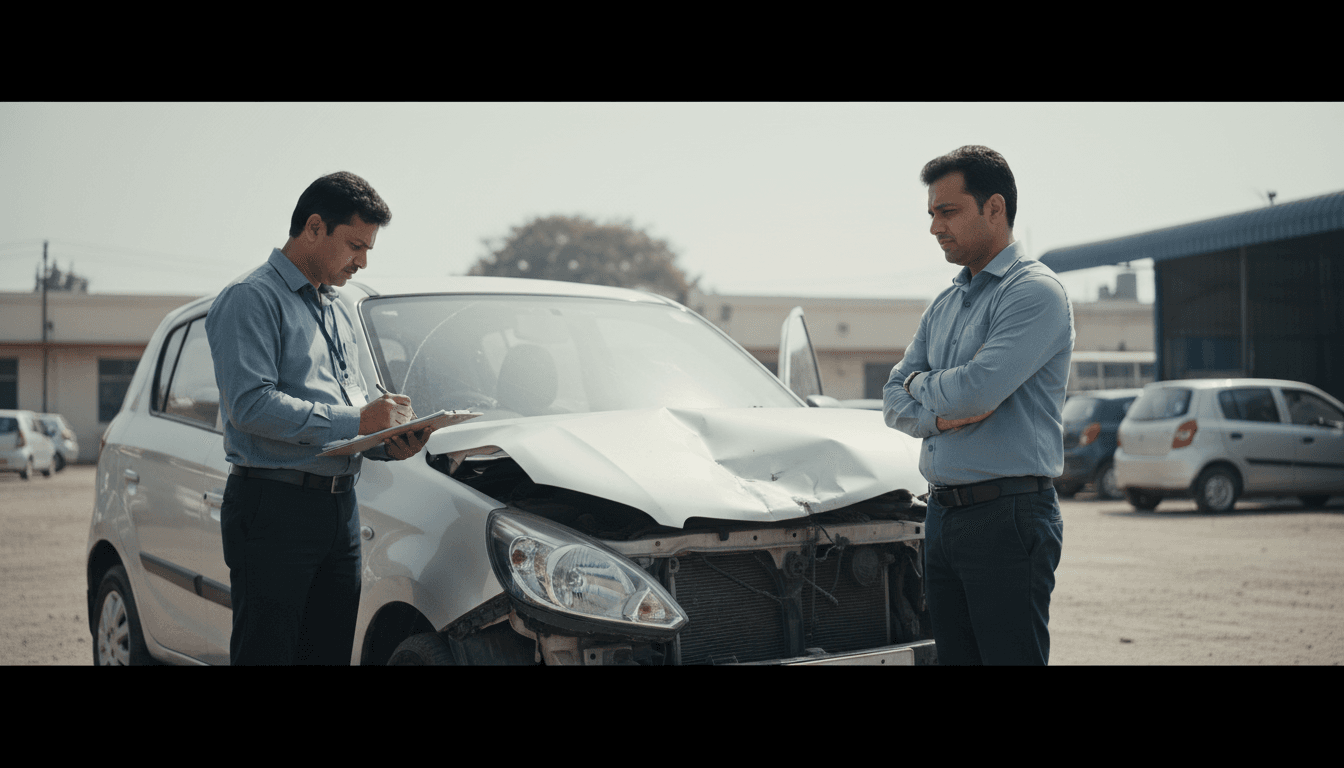
Total loss in car insurance refers to a situation where the vehicle is damaged to the point that the insurance company pays off the loss based on the agreed price of the car (IDV), rather than covering repair costs. Generally, in India, when the total cost of retrieving the injured part plus the repair cost exceeds 75% of the Insured Declared Value (IDV), it may constitute a case of constructive/actual total loss of the vehicle.
What does total loss mean in car insurance?
A total loss car insurance claim happens when it is not practical to fix the car. A total loss car insurance claim isn't simply based on whether the car is, in theory, able to be repaired or not. The insurance company checks the cost of repairing and retrieving the vehicle compared to the insurance policy's deductible (IDV) limit.
| Term | Meaning in car insurance | Typical claim basis |
|---|---|---|
| Total loss | The car is destroyed, damaged beyond usable repair, or lost in a way that makes normal repair settlement unsuitable. | Settlement is based on the car's IDV, subject to policy terms. |
| Constructive total loss | The aggregate cost of retrieval and repair is more than 75% of the IDV.1 | Settlement is treated like a total loss because repairs are economically unreasonable under the policy. |
| Theft total loss | The car is stolen and not recovered after the required police and insurer process. | Settlement is generally based on the IDV, subject to documentation and policy terms. |
IDV is a fixed maximum amount for a vehicle that remains throughout the policy period. It is not the price of a car at the showroom, a resale quote, a loan balance, or a sentimental price. For a total loss and a constructive total loss, IDV is the reference price to be applied for claim settlement.
How is total loss in car insurance calculated?
The total loss test involves comparing the total estimated retrieval and repair costs of the car against 75% of its Insured Declared Value of car. The vehicle is deemed a constructive total loss if the total cost exceeds 75% of the IDV.
Mathematically, it can be represented as:
Constructed Total Loss = IDV × 75%
The insurer will consider and accept the claim as a constructive total loss if the cost of retrieval, along with the cost of repairs, exceeds this cutoff.
| Calculation item | Amount |
|---|---|
| Car IDV in the policy | Rs 8,00,000 |
| 75% of IDV | Rs 6,00,000 |
| Estimated repair cost | Rs 5,80,000 |
| Estimated towing or retrieval cost | Rs 40,000 |
| Total retrieval and repair cost | Rs 6,20,000 |
| Result | Rs 6,20,000 is more than Rs 6,00,000, so the car may be treated as a constructive total loss. |
Here, the insurer does not see a reason to settle the claim as a normal repair claim, because the total cost of repair and recovery would exceed 75% of the IDV.
How much does the insurer pay for a total car loss?
Usually, when a vehicle suffers a total loss, the claim settlement is based on your policy's IDV, not the repair quote. In addition, the insurance company can subtract the appropriate compulsory deductible and apply the claim settlement regulations of the policy.
| Settlement item | Amount |
|---|---|
| IDV stated in policy | Rs 8,00,000 |
| Claim type | Constructive total loss because retrieval and repair cost is Rs 6,20,000, which is more than 75% of IDV |
| Compulsory deductible assumed for this example | Rs 2,000 |
| Illustrative payout before any other policy-specific adjustment | Rs 7,98,000 |
This is an approximate calculation of the settlement if the same car were to be used:
This is an example calculation of the settlement, based on the insurer settling on an IDV basis and taking back the damaged vehicle or salvage in accordance with its claims process. If the policy has an additional deductible, an unpaid premium issue, a hypothecation requirement, or another policy-specific condition, the actual payment amount could vary.
Check the policy IDV first
The 75% test is not calculated from the market resale price of the car. It is based on the IDV (Insured Declared Value) printed on the active policy schedule.
How does IDV affect total loss in car insurance?
IDV is based on the manufacturer's listed selling price, reduced by depreciation based on the vehicle's age. The following depreciation schedule is prescribed by the Indian Motor Tariff for determining IDV of vehicles within five years of manufacture:
| Vehicle age | Depreciation used for IDV | If the listed value is Rs 10,00,000, the IDV becomes |
|---|---|---|
| Not exceeding 6 months | 5% | Rs 9,50,000 |
| Exceeding 6 months but not exceeding 1 year | 15% | Rs 8,50,000 |
| Exceeding 1 year but not exceeding 2 years | 20% | Rs 8,00,000 |
| Exceeding 2 years but not exceeding 3 years | 30% | Rs 7,00,000 |
| Exceeding 3 years but not exceeding 4 years | 40% | Rs 6,00,000 |
| Exceeding 4 years but not exceeding 5 years | 50% | Rs 5,00,000 |
For vehicles over five years old or older models, the IDV is often negotiated and finalised by mutual agreement between the insurer and the insured.
Is total loss different from constructive total loss?
Although total loss and constructive total loss are similar, they are not the same. What sets them apart is whether the car is physically damaged beyond repair or its cost to repair exceeds what it's worth (i.e., its actual cash value) which under the policy's 75% rule, the car is deemed a total loss.
| Point of comparison | Total loss | Constructive total loss |
|---|---|---|
| Basic meaning | The car is destroyed, unrecoverable, or not fit for normal repair settlement. | The car may be repairable, but retrieval and repair cost is more than 75% of IDV. |
| Trigger | Severe accident damage, fire damage, flood damage, or theft not recovered. | Repair estimate plus retrieval cost crosses the policy threshold. |
| Main calculation | Policy IDV is the main settlement value. | 75% of IDV is the threshold for deciding the claim route. |
| Example | A car burns completely and cannot be restored for road use. | A car with IDV Rs 8,00,000 has repair and retrieval cost of Rs 6,20,000, which exceeds Rs 6,00,000. |
What should you do after a total loss accident?
Inform the insurance company
Inform the insurance company immediately regarding the accident site, registration number of the vehicle, policy number, and damage.
Inspection of the car
Begin the repairs only after inspecting the car by the surveyor of the insurance company, unless it is essential to avoid further damage.
Cost of retrieving the car
Retrieve or tow the car through the process of the insurance company and keep all the invoices.
Documents to claim the loss
The estimate of repairs, status of the survey report, registration certificate, driving license, photocopy of the policy, claim form, bank details, and FIR or the required police report have to be submitted.
Settlement procedures
In case of total or constructive total loss, fulfill the settlement procedures according to the insurance company.
What happens to salvage and registration?
In a total loss settlement, the insurer's handling of salvage affects the paperwork and final process. Salvage means the damaged vehicle or its remaining parts after the accident. In many total loss settlements, the insurer settles the claim on IDV basis and takes control of the salvage through its process.
If the car is under a loan, the lender's name may be recorded as hypothecation in the registration certificate and policy. In that case, the insurer may require a no-objection certificate, loan closure confirmation, or direct payment arrangement before the claim is fully released.
If the vehicle is destroyed or permanently incapable of use, registration cancellation or related RTO formalities may apply under the motor vehicle registration rules and insurer process.2
Key takeaways
Total loss under car insurance refers to compensation being paid based on the IDV rather than the repair cost.
Constructive total loss occurs when the sum of recovery and repair costs exceeds 75% of the vehicle's IDV.
For instance, for a vehicle with an IDV of Rs 8,00,000, the 75% constructive total loss limit will be Rs 6,00,000.
At a cost of Rs 6,20,000 for the recovery and repair of a vehicle with an IDV of Rs 8,00,000, the claim might be declared a case of constructive total loss.
The IDV is determined in the policy document and is subject to depreciation based on age of the vehicle.
The total loss claims could involve the transfer of salvage, hypothecation papers, and other registration formalities.
Frequently asked questions
No, a car could still be considered a constructively totalled car even if it is capable of being repaired, but with the cost of retrieving and repairing it exceeding 75 per cent of its IDV.
No, In case of a total loss claim, the compensation will depend on the IDV and terms of the insurance. The company will not be liable for the full cost of repairs.
With a lower IDV, the 75% rule will decrease, as well as the highest claim amount. For instance, if IDV is Rs 6,00,000, the constructive total loss is Rs 4,50,000.
Once the car has been stolen and not recovered through the usual means, it is possible to settle the claim as a total loss on an IDV basis, given that all police papers, insurer verification, and policy terms have been complied with.
If there is any loan on the vehicle, the insurer may need to obtain an NOC or foreclosure letter from the bank before settling the total loss claim.
About the authors

Nikhila PS
Written by · Senior Content EditorNikhila is a content creator with 6+ years in EdTech and motor insurance, turning complex policies into clear, engaging content. She enjoys exploring digital trends, social media, and art while planning her next short escape.

Rekhit Singh Kaushal
Reviewed by · Senior Director - Motor UnderwritingRekhit Singh Kaushal is Senior Director at ACKO, a leading digital motor insurance provider in India. With deep expertise in insurance strategy and innovation, he brings trusted insights on car and bike insurance to help drivers stay protected.