When you are involved in an accident with a driver without valid insurance in India, besides making sure that you are okay, get immediate medical attention, report the incident to the police, take photographs of the scene and any witnesses, and contact your insurer before doing any repairs to your car. If the driver does not have valid third-party car insurance, the damage to your car can be claimed from your insurance provider under the terms of your policy. However, if you are insured only on a third-party basis, you might need to make a claim against the wrongdoer or the owner of the motor vehicle in court.
What should you do immediately after the accident?
Make sure you are safe
If possible, move to a safe location without aggravating your injuries or preventing emergency services from accessing the accident. Turn on the hazard lights and place the warning triangle if available.
Call for help
Call 108 for medical assistance if there are any injured people. In case of injury, death, heavy damage to the vehicles, conflict, suspected drunk driving, commercial vehicle, or uninsured vehicle, call the police.
Gather information of the driver and the vehicle
Get the other driver’s name, contact number, driving licence information, vehicle number, and insurance policy information. Make a note of this information if the other driver claims he or she has no insurance or his/her insurance policy has lapsed.
Gather the evidence
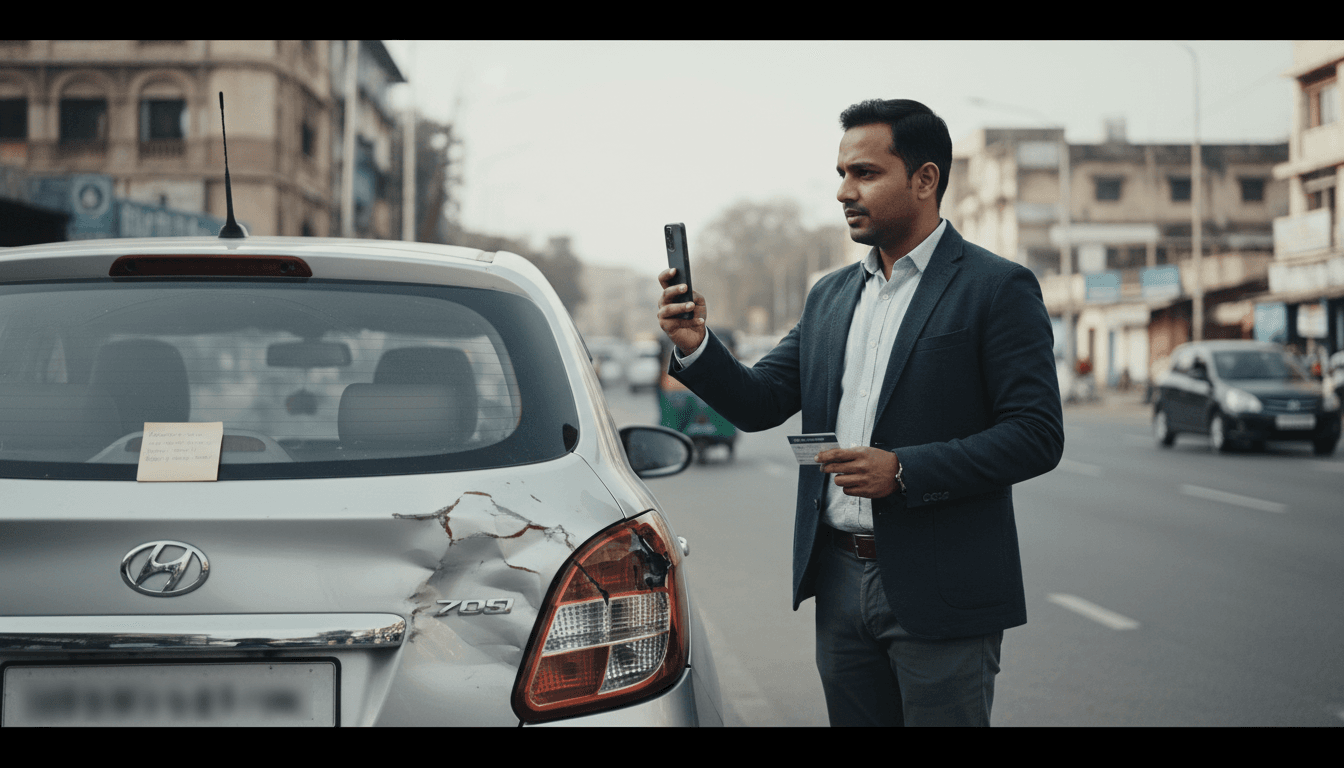
Take pictures and videos of the vehicles, vehicle number plate, the location on the road, point of impact, injuries, skid marks, traffic lights, and surroundings. Get the name and contact numbers of the witnesses.
Get the police report
Ask the police for the FIR number, general diary number, accident report, or acknowledgement, depending on the kind of documentation prepared by the police for your case.
Inform your insurer
Inform your insurance company before moving the car for repairs unless it has to be towed for safety reasons. Ask if you need an inspection, authorisation to tow, cashless repairs, or any paperwork.
Be careful with informal settlements
It is wise never to accept cash settlements on the spot in the event of an accident unless one is absolutely sure there is no injury, no damage to the vehicle, and no dispute, and there is something in writing stating the amount of money given and the reason.
Whose insurance pays when the other driver is uninsured?
The amount you pay will vary according to your type of policy and the situation whether the other vehicle is identified or not. Third party car insurance policy protects you from legal liability to other people, but own-damage cover refers to how your policy will pay for your car's damage after an accident as a claim.
| Situation | Who may pay first | What you can do next | Main catch |
|---|---|---|---|
| You have comprehensive insurance or standalone own-damage cover | Your own insurer may pay for your vehicle repairs after survey and deductibles | You can share the uninsured driver's details with your insurer. The insurer may try recovery from the at-fault party after paying you. | Your no-claim bonus may be affected unless your policy or add-on protects it. |
| You only have third-party insurance | No one pays for your own vehicle damage under your policy | You can pursue the uninsured driver or vehicle owner for compensation through a legal route. | Recovery depends on proving fault and the other party's ability to pay. |
| You are injured as a driver, rider, passenger, cyclist, or pedestrian | Your health insurance, personal accident cover, or eligible motor accident claim route may apply | Keep medical bills, prescriptions, diagnostic reports, discharge summary, police records, and proof of income loss. | Medical and disability claims need strong documents and may take time. |
| The vehicle that hit you cannot be traced | The hit-and-run compensation scheme may apply for death or grievous hurt | Report the accident promptly and follow the police and claims enquiry process. | Hit-and-run compensation is different from a normal claim against an identified uninsured driver. |
How to raise a claim when the other driver has no insurance?
If you have own-damage cover, make sure to contact your insurer first, since most of the time, it is quicker for vehicle repairs. Usually, insurance companies request claim intimation, policy details, RC (registration certificate), driver's licence, repair estimate, photos, and police report, where necessary.
If there is no own-damage cover in place, it will be impossible to repair one's own vehicle with the aid of the third-party policy. Options you have after that are either to ask the uninsured person or vehicle owner to pay for repairs, or you may opt to send a legal notice, or file a recovery claim in case of a motor accident or civil law case, depending upon the circumstances and details of the accident.
In cases where someone is hurt or dead, you should keep all of his/her medical documents, employment, and police records. In addition to the injured persons, it may be necessary to include the driver, the owner, and the insurer, if any. However, when there is no insurance, the burden of payment falls on the driver and owner.
What evidence and proof are needed for a claim?
Save or collect records that support four elements: the accident incident, the other vehicle's involvement, the other driver's culpability, the extent of your injury as per your medical report, or your vehicle's damage, or other property loss.
| Evidence | What it proves | How to collect it |
|---|---|---|
| Photos and videos from the spot | Vehicle position, damage, road conditions, traffic signal, and number plate | Take wide shots and close-ups before vehicles are moved, if it is safe. |
| Police record | Official accident reporting and basic facts | Ask for the FIR number, accident report, or diary entry details. |
| Driver and owner details | Who may be legally responsible | Note name, phone number, driving licence, registration number, and address if available. |
| Witness details | Independent support for your version | Save names, phone numbers, and short written or recorded statements if witnesses agree. |
| Repair estimate and final bill | Actual vehicle repair cost | Use an authorised or insurer-approved garage where possible and keep tax invoices. |
| Medical records | Injury, treatment, disability, and expenses | Keep prescriptions, diagnostic reports, hospital bills, discharge summary, and follow-up notes. |
Would you have any out-of-pocket expenses?
Let's say your car was damaged by an uninsured vehicle, and the workshop's estimated repair cost is 60,000 rupees. You have comprehensive insurance coverage, and after the damage inspection, your insurance company fully accepts 60,000 rupees as repairable expenses before the deductible.
| Item | Amount |
|---|---|
| Accepted repair cost | Rs 60,000 |
| Policy deductible assumed in this example | Rs 1,000 |
| Amount paid by insurer | Rs 59,000 |
| Amount you pay at the garage | Rs 1,000 |
Now, in such an accident, if you just have third-party coverage, your vehicle repair will be totally out-of-pocket. You will bear the Rs 60, 000 repair cost first and then get the amount from the person who was driving without insurance or whose car is uninsured via settlement or legal means.
What if the other vehicle fled the spot?
The difference between an uninsured-driver accident and a hit-and-run accident is important to understand. An uninsured driver is one whose vehicle is uninsured but whose identity is known or can be reasonably identified. On the other hand, a hit-and-run car accident occurs when the responsible vehicle is completely unidentified.
The Compensation to Victims of Hit and Run Motor Accidents Scheme, 2022, offers compensation of Rs 2,00,000 for death and Rs 50,000 for grievous hurt. The amounts are reserved only for cases that qualify as hit-and-run cases and not for every hit by an uninsured vehicle, which can be identified by the police.
| Point | Uninsured driver | Hit-and-run |
|---|---|---|
| Vehicle identified | Yes, usually | No |
| Main recovery route | Own eligible policy, settlement, or claim against driver and owner | Hit-and-run compensation process, plus other eligible personal covers |
| Government scheme amount mentioned in this article | Not the normal route if the vehicle is identified | Rs 2,00,000 for death and Rs 50,000 for grievous hurt |
What actions could weaken your insurance claim?
One should do nothing that could potentially undermine the evidence of the fault, loss, or identity that one might use in the future. These types of errors are generally the source of insurance complications and disputes.
Unless your insurer permits it or safety requires an emergency movement, you should refrain from fixing your car before your insurer's inspection.
You must first take the other vehicle's registration number. Do not depart the scene without it unless you are in extreme medical need.
If your knowledge is uncertain about something you say, do not admit fault in writing or on a recorded call.
Do not put too much faith in the other driver's assurance of payment later.
In case of the slightest pain resulting from the accident, one should not neglect to get a check-up and keep the medical documentation.
The notification of claims should not be postponed. Otherwise, the insurers may ask the reason behind the delayed reporting of the claim.
Key takeaways
In the event of an accident involving an uninsured driver, initial actions will include ensuring safety, providing medical assistance, filing a police report, gathering evidence, and informing the insurer.
Third-party motor insurance is compulsory in India for motor vehicles used in public places.
Own-damage coverage covers your vehicle repair depending on the policy terms, whereas third-party only insurance doesn't cover any loss that happens to your own vehicle.
If the identity of the uninsured driver is known, one might have to recover losses from the driver or the vehicle owner if the loss isn't covered by your policy.
Hit-and-run accidents are different from uninsured-driver accidents. According to the 2022 hit-and-run scheme, the amount payable is Rs 2,00,000 in case of death and Rs 50,000 in case of grievous hurt.
Photographs, police reports, witness statements, repair invoices, and medical certificates are the most relevant documents.
Frequently asked questions
Yes. If your insurance contains coverage for damage to your own property and you make a claim within the limits of your coverage, then yes, it is definitely possible.
That's not necessarily the case. A few scratches with no injuries and no dispute your insurer might not ask for an FIR at all. But you should get the police involved for situations involving injury, big damage, refusal to share personal info, suspected drunk driving, or if the other driver has no valid insurance.
A claim for own-damage can lead to loss of bonus upon non-claim renewal if your insurance has no applicable bonus protection clause in place. Go through the wording of your insurance plan or talk to your insurer beforehand if the repair cost is a small amount of money, a claim may not even be required.
In this situation, you must try to write down the registration number, take pictures, get driver's information together with the contacts of any witnesses and ask them whether the policy really ran out.
You may still get the driver or vehicle owner to pay you back. Nevertheless, since they are uninsured, if they don't want to pay or don't have the means, you might not be able to get the money very fast.
No, in a hit-and-run case, the offender is never caught or identified, and in other words, you are hit by a vehicle whose driver you cannot even spot. You cannot claim under a hit-and-run compensation scheme unless the offending motor vehicle cannot be identified.
About the authors

Nikhila PS
Written by · Senior Content EditorNikhila is a content creator with 6+ years in EdTech and motor insurance, turning complex policies into clear, engaging content. She enjoys exploring digital trends, social media, and art while planning her next short escape.

Rekhit Singh Kaushal
Reviewed by · Senior Director - Motor UnderwritingRekhit Singh Kaushal is Senior Director at ACKO, a leading digital motor insurance provider in India. With deep expertise in insurance strategy and innovation, he brings trusted insights on car and bike insurance to help drivers stay protected.