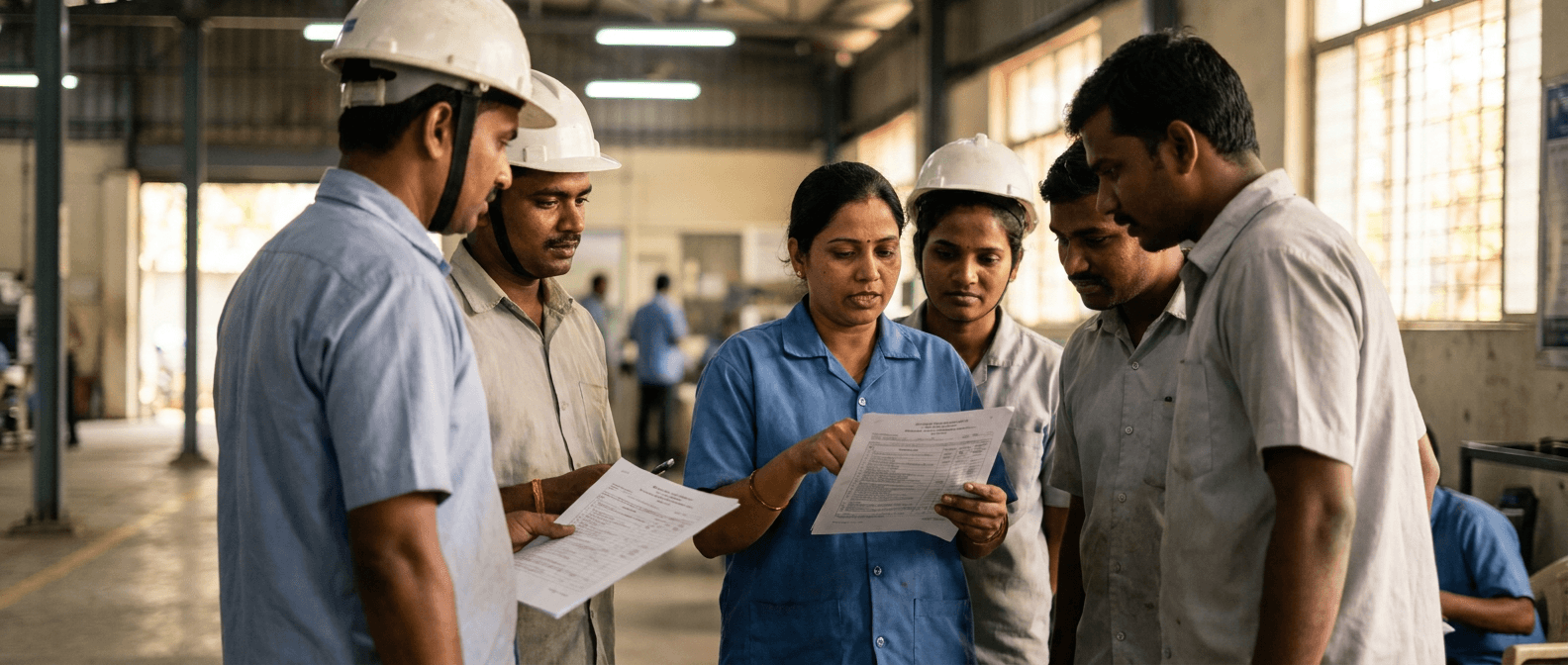
Group health insurance for manufacturing workers is a group health insurance policy that covers factory workers and staff working in a manufacturing company. In India, it is used either as an additional benefit, or to cover workers and staff who are outside ESI eligibility.
The main decision for the employer while purchasing a group health policy is around how to design the policy. For example, who to include, sum insured to set, and, to cover dependants or not.
What does group health insurance mean for a factory workforce?
A group health policy for manufacturing workers covers employees for their medical insurance related requirements and treatments. The employer is called the policyholder in this case, and the covered group in a manufacturing company may include shop-floor workers, machine operators, supervisors, maintenance staff, quality control staff, warehouse workers, administrative staff, and contract workers (depending on the policy structure).
| Term | Meaning for a manufacturing employer | What to check |
|---|---|---|
| Master policy | The master policy issued to the employer for the covered workforce which covers all the active employees, the policy duration, the categories of employees covered, and the terms and conditions of the overall policy | Employer name, policy period, covered locations, and employee categories |
| Insured member | A worker, employee, or employee dependant covered under the master policy | Name, age, relationship, employee ID, and sum insured |
| Sum insured | The maximum claim amount available under the policy for a given treatment | Whether the limit is per employee, per family, or shared as a floater |
| Network hospital | A hospital where the insurer or TPA may provide cashless treatment. These are hospitals that are generally closer to factory sites, worker residential areas, and industrial clusters | Hospitals near factory sites, worker residential areas, and industrial clusters |
| TPA | A third-party administrator that processes group health claims for the insurer and check for the validity of the claims by verifying the documents. | Claim contact details, helpdesk process, and escalation route |
Is Group Health Insurance for Manufacturing Workers the same as ESI?
ESI and corporate health insurance are not the same. Employees’ State Insurance is a statutory social security scheme for eligible employees, while group health insurance is a policy bought from an insurer by the employer.
ESI generally applies to factories and establishments in implemented areas that employ 10 or more persons, subject to the wage and eligibility rules notified for the scheme. For employees covered under ESI, the current contribution rate is 3.25% of wages from the employer and 0.75% of wages from the employee.
| Point | ESI | Group health insurance |
|---|---|---|
| Nature | Statutory social security scheme | Employer-purchased insurance policy |
| Who runs it? | Employees’ State Insurance Corporation | A general or health insurer |
| Typical manufacturing relevance | Applies to eligible workers in covered factories and implemented areas | Used for non-ESI employees, supplementary cover, or broader employee benefits |
| Cost structure | Employer contribution is 3.25% of wages and employee contribution is 0.75% of wages | Premium is based on insurer quote, group size, ages, location, cover, and claims experience |
| Hospital access | Through ESI medical infrastructure and empanelled facilities | Through the insurer’s network hospitals, subject to policy terms |
| Customisation | Rules are statutory and not employer-designed | Employer can choose cover amount, dependants, room rent rules, maternity terms, and add-ons subject to insurer approval |
Important compliance point
A group health policy should not be treated as a substitute for ESI where ESI law applies compulsorily to an eligible worker.
Who can be covered under Group Health Insurance Policy for Manufacturing Workers?
A manufacturing company can cover employees by category, employment status, and location. The simplest approach is to give the insurer an active member list that matches the current set of employees, the payroll records, and the HR policy as a good practice.
Worker or employee category | Can be covered in a group health policy? | Key decision for the employer |
|---|---|---|
Permanent shop-floor workers | Yes, if included in the policy schedule | Whether cover is only for the worker or also for spouse, children, and parents |
Supervisors and line managers | Yes, if included in the policy schedule | Whether they receive the same sum insured as workers or a higher grade-based cover |
Office and administrative staff at the plant | Depends on the policy structure and if a respective position is included as part of the policy | Whether the same plan applies across plant and office employees |
Contract workers | Possible, if the insurer policy includes contract workers at the time of the policy purchase and design | Who pays premium, who submits claims data, and how additions and deletions are handled |
Probationers and trainees | Possible, if the policy allows it | Whether cover starts on joining date or after a waiting period set by the employer |
Dependants | Variable, depending on the policy structure. | Whether dependants include spouse, children, parents, or parents-in-law |
What should the group health policy for manufacturing cover?
The policy should usually cover all the eligible employees, serious illness treatments, good claims support, simple to access insurance with readily available e-cards, and a large hospital network.
For workers, a lot of value can come through the hospital located near the factory/plant, cashless claims support, simple documentation, and whether their families are included.
Cover feature | Why it matters in manufacturing | What to specify in the quote request |
|---|---|---|
Hospitalisation cover | Covers eligible treatment amount when a policy member is admitted to a hospital | Sum insured amount, room rent limits (if any), and limitations. |
Pre-existing disease cover | Important when the workforce has older workers or chronic conditions | Whether pre-existing diseases are covered from day one or after a waiting period |
Cashless hospital network | Workers may need emergency treatment closer to their factories or plants | Network hospital list where cashless treatment is available for the workers and their dependants |
Day-care procedures | Some treatments do not require 24-hour admission | Whether day-care procedures are covered and how claims are filed |
Maternity cover | Relevant if the employer covers spouses or women employees | Limit per delivery, waiting period, normal and caesarean limits, and newborn cover |
Family floater option | Allows one sum insured to be shared by employee and covered family members | Family definition, floater amount, age limits for children, and parent coverage rules |
Ambulance cover | Useful where the plant is away from large hospitals | Per-claim ambulance limit and whether road ambulance is covered |
Personal accident add-on | Health insurance covers medical treatment, while accident cover can address death or disability benefits | Whether accidental death, permanent disability, and temporary disability benefits are included separately |
What limits can reduce the claim payout in Group Health Insurance for Manufacturers?
It is important to know the limits in a group health policy since these can have a direct impact on the claims payouts after the treatment. The main points to check here are the room rent limit, disease-wise sub-limits, waiting period for pre-existing diseases, maternity admission limits, and exclusion of non-medical items such as masks, gloves, syringes, etc.
If these are not taken care of, it may lead to out of pocket expenses for the employee at the time of discharge. At times, these can also be hefty sums and can cause severe financial distress for manufacturing workers.
Limit or exclusion | What it means | Example of impact |
|---|---|---|
Room rent limit | The policy defines the hospital room category or daily room rent that are allowed for the employees. | If an employee chooses, a room type where the rent is higher than the daily room rent limit, they may have to pay the balance out of their pocket. The concept of proportionate deduction also gets activated here which might increase the treatment expense since items like gloves, syringes, etc., are charged higher in a higher room category.
|
Co-payment | The member pays a fixed share of an admissible claim | With a 10% co-payment on an admissible Rs 80,000 claim, the member pays Rs 8,000 and the insurer pays Rs 72,000 |
Disease-wise sub-limit | The policy caps payout for a named treatment or disease | If cataract is capped at Rs 25,000, the policy will not pay more than Rs 25,000 for that eligible cataract claim |
Waiting period | Some conditions are covered only after a defined period | If maternity has a 9-month waiting period, a claim before that period may be rejected |
Non-medical items | Consumables or administrative items may not be payable | Items outside policy coverage can remain payable by the worker even in a cashless claim |
Excluded treatments | The policy does not cover specified treatments or circumstances | Cosmetic treatment without medical necessity is commonly outside standard health cover, subject to policy wording |
Prepare the active members data
Preparing the active employees list with data points such as their family members, existing health conditions, etc.
Define the cover design
Decide whether the policy covers only employees, employees plus spouse and children, or employees plus parents. Also decide the sum insured for each category.
Request comparable quotes
Getting policy quotes from multiple insurers to compare different kind of policies.
Compare terms, not only premium
Compare premium, hospital network, exclusions, sub-limits, cashless process, claim support, and endorsement timelines for additions and deletions.
Issue the policy
Share the final employee list, pay premium, collect policy documents, and verify that member names and dependants are correctly uploaded.
Communicate the claim process
Give workers a simple claim guide in their working language, including helpline number, cashless steps, reimbursement documents, and HR contact.
Maintain the policy through the year
Add new joiners, remove exits, review claim experience, and revise the benefit design before renewal.
What information is needed before buying a Group Health Policy for Manufacturing Workers?
The employer should collect clean employee data before requesting quotes. Incomplete age, dependant, or location data can lead to wrong pricing, missing member cards, and claim delays.
| Data or document | Why it is needed | Practical check |
|---|---|---|
| Employee master list | Used to issue member coverage | Match names with payroll or HR records |
| Date of birth or age | Used for pricing and eligibility | Avoid approximate ages where possible |
| Gender | Used for group profile and some benefit analysis | Keep format consistent across the file |
| Employee category | Used for grade-wise sum insured or benefit differences | Separate workers, supervisors, staff, and management if benefits differ |
| Plant or work location | Used to assess hospital network needs | Include all factories, warehouses, and branch locations |
| Dependant details | Used when family cover is included | Capture relationship, age, and any age limits under the plan |
| Past claims data | Used by insurers to price renewals or large groups | Keep claim amount, diagnosis, member category, and date of claim |
How do workers use the Group Mediclaim policy for Manufacturers during a claim?
Workers can go for both cashless claims as well as reimbursement claims.
Claim type | How it works | What the worker usually needs |
|---|---|---|
Cashless planned admission | The hospital seeks approval from the TPA or the insurer usually before the admission | Health card or e-card, ID proof, doctor advice, and estimated bill |
Cashless emergency admission | The hospital starts emergency care and sends approval request to the insurance company
| Policy e-card, ID proof, and hospital admission details. |
Reimbursement claim | The worker pays first and files a claim after discharge | Claims form, disacharge summary, medical reports, treatment bills, and any other relevant documents. |
The HR or administration team should keep the claim process short and visible. A one-page claim note at the factory, a helpline number, and a named HR contact can reduce confusion at the time of hospitalisation.
What should be checked at renewal in a group health policy for manufacturing companies?
A manufacturing employer company should review the group health policy at every renewal. This will help them track the premium changes better. The policy should be analysed for seeing how many workers are using the policy, how many claims were accepted by the insurance company, and what are the problem areas in the policy.
- Compare total claims paid vs. total premium paid for the year.
- Track the total number of cashless approvals and reimbursement claims by plant location.
- Check whether additions and deletions were completed on time for new joiners and employee exits.
- Update the employee list during renewal so premium is not paid for exited workers and new workers are not left uncovered.
Key Takeaways
- Group health insurance for manufacturing workers is a master group health policy bought by an employer for their manufacturing workforce.
- ESI is a mandatory scheme for low wage workers whereas group health insurance is an optional purchase.
- A manufacturing group health plan usually covers workers, supervisors, admin staff, trainees, contract workers, and dependants, depending on the policy structure.
Frequently asked questions
No. Group health insurance is not mandatory for manufacturing workers. What is compulsory, however, is ESI (Employees State Insurance) for low wage workers below the monthly wage ceiling [₹21,000 for general employees and ₹25,000 for employees with disabilities].
Yes, contract workers can also be covered in the policy if the group policy structure includes contract workers as part of the policy. This needs to be specified before the master policy is activated.
Yes, family members can be covered if the employer includes a family floater or dependant cover in the group health policy. However, a policy usually defines which dependants are included, such as spouse, children, parents, or parents-in-law or all of them.
The sum insured depends on the company's budget, hospital charges near the factory location, employee types, and whether the policy covers the worker’s family or not. The policy buyer can compare quotes from multiple insurers to check the cost differences between different companies.
In a cashless claim, the employee or the patient does not need to pay any amount upfront to the hospital. The hospital gets an approval from the insurer or TPA to check the claim eligibility. In a reimbursement claim, the employee pays the treatment costs at the hospital and gets the same reimbursed through the insurer against the treatment documents such as the prescriptions, bills, medical reports, etc.
It can cover pre-existing diseases from day one if the insurer agrees and the policy wording includes that benefit. If the policy has a waiting period for pre-existing diseases, claims for those diseases may be restricted until the waiting period is completed.
Sources and references
- 1.ESIC: CoverageEmployees’ State Insurance Corporation, coverage overview
- 2.ESIC: ContributionEmployees’ State Insurance Corporation, employer and employee contribution rates
- 3.CBIC: GST rates and notificationsCentral Board of Indirect Taxes and Customs, GST rate notifications for services including insurance
About the authors

Avanindra Jha
Written by · Associate Director - Marketing, ACKO for BusinessAvanindra Jha heads marketing at ACKO for Business. A MICA alum with roots in fintech and SaaS marketing, he writes about growth and business with the occasional detour into cinema and Indian philosophy. Off the clock, you'll find him at the guitar or the piano.

Nitesh Kapur
Reviewed by · Senior Director – Underwriting & Claims, Group Health Insurance at ACKOWith over 15 years of experience in health insurance underwriting, he has led group health insurance strategy, risk assessment, and policy design. He has held leadership roles at leading insurers, building risk frameworks, evaluating complex health risks, and strengthening underwriting standards.