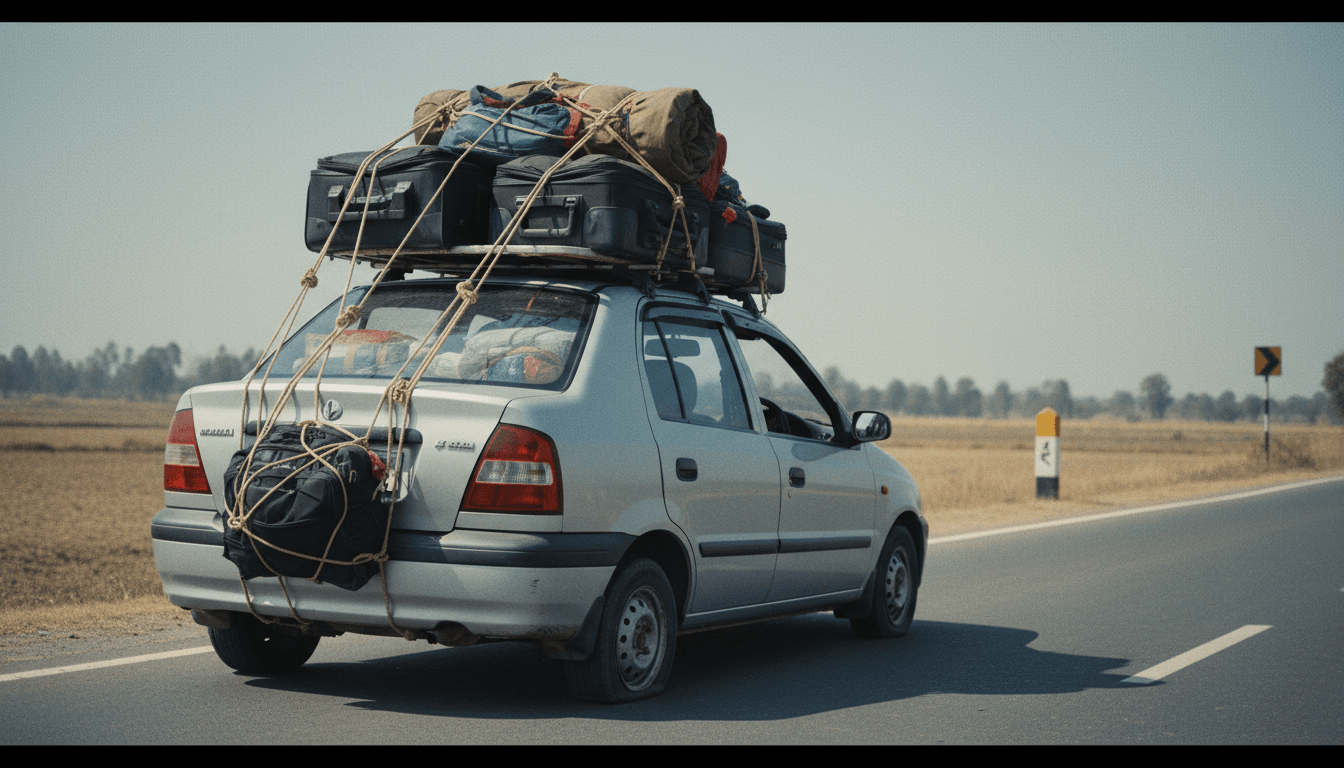
Overloading a car can be dangerous, as it may compromise braking control, increase the risk of a tyre failure, stress the suspension and drivetrain, compromise steering, and lead to legal or insurance issues. You can say a car is overloaded if the total weight of the car body, passengers, luggage, accessories, and fitted carriers exceeds the maximum permitted vehicle weight or the stated maximum number of passengers for that vehicle.
What counts as overloading a car?
When a car's actual loaded weight exceeds the manufacturer's permitted limit, the vehicle is overloaded. In India, driving a vehicle beyond the registered laden weight or the gross vehicle weight recorded for that vehicle is not permitted.
| Term | What it means | Why it matters |
|---|---|---|
| Gross vehicle weight | The maximum permitted weight of the car when fully loaded. | Your loaded car should not exceed this number. |
| Kerb weight | The weight of the car without passengers or luggage, usually with standard fluids as defined by the manufacturer. | It helps you calculate how much load the car can carry. |
| Payload | The weight available for passengers, luggage, accessories, and other load. | Payload is normally calculated as gross vehicle weight minus kerb weight. |
| Seating capacity | The maximum number of occupants the car is registered or designed to carry. | Carrying extra people can overload the car even if luggage is light. |
| Tyre load rating | The maximum load a tyre can safely carry at the specified pressure. | An overloaded tyre can overheat and fail. |
Maximum payload is calculated by taking the gross vehicle weight and subtracting the kerb weight. For instance, if the car's gross vehicle weight is 1, 500 kg and its kerb weight is 1, 100 kg, then the car's maximum payload capacity is 400 kg.
What are the main dangers of an overloaded car?
Overloading the car will have a direct impact on braking, cornering, and road grip as well as suspension comfort. The issue here is not only about carrying extra weight, but also placing it in the right place.
| Danger | What changes in the car | What can happen on the road |
|---|---|---|
| Longer braking distance | The brakes have to slow down more mass than the car was designed to carry. | The car may not stop in time in traffic, at a signal, or before a pedestrian crossing. |
| Poor steering control | The front or rear axle may carry too much weight, reducing balance. | The car may feel heavy, slow to respond, or unstable during lane changes. |
| Tyre overheating or blowout | Tyres carry more load and flex more than intended. | A tyre can fail suddenly, especially on highways and in hot weather.2 |
| Suspension damage | Springs, shock absorbers, bushes, and wheel bearings work beyond their normal range. | The car may bottom out on speed breakers, scrape underneath, or develop costly repairs. |
| Reduced ground clearance | The rear of the car may sag when the boot or rear seat is heavily loaded. | The bumper, exhaust, fuel tank guard, or underbody may hit speed breakers and potholes. |
| Weak headlight aim | A loaded rear can lift the front of the car slightly. | Headlights may point higher and dazzle oncoming drivers at night. |
| Higher engine and gearbox strain | The engine, clutch, transmission, and cooling system work harder. | The car may feel underpowered on slopes, consume more fuel, or heat up in slow traffic. |
| Legal and insurance risk | The car may exceed registered limits or seating capacity. | A police check, accident investigation, or claim assessment may examine whether overloading contributed to the incident. |
Does overloading affect braking and steering?
Yes , overloading would make braking and handling difficult because the tyres and brakes have to handle more load than intended. Overloading is considered a handling and braking problem according to public road safety instructions. This would be most evident when braking under emergency conditions, making sharp turns, driving downhill, driving on slippery roads, and changing lanes on highways.
What seems like a car you could control at 30 kmph in a parking area may turn out to be difficult to control at 80 kmph on a highway. The weight distribution is just as important as the overall weight.
Does overloading damage tyres and suspension?
Loading your car beyond its maximum load capacity can damage tyres for a few reasons. Each tyre has a maximum load rated and overloading would lead to increase in tire flexibility, heat buildup, and wear. Under-inflated tyres also become more vulnerable when there's excess weight as the sidewalls will be getting more flex and heating up.
It's not just the tyres that will get affected. The suspension and underbody carry extra weight every time the car drives over a pothole, speed breaker, broken road edge, or a steep ramp.
| Part affected | Common overload stress | Possible sign |
|---|---|---|
| Tyres | Excess load and heat build-up | Bulges, uneven wear, hot tyre smell, or sudden pressure loss |
| Shock absorbers | Repeated compression beyond normal travel | Bouncing, poor ride control, or bottoming out |
| Springs | Constant heavy compression | Rear sag even after the load is removed |
| Wheel bearings | Extra vertical load and impact force | Humming or grinding noise that changes with speed |
| Clutch or transmission | More effort needed to move the car from rest | Burning smell, jerky starts, or sluggish acceleration |
Warning signs before you drive
If there is a noticeable sagging in the back of the vehicle, the steering seems very light, tires appear flat, and the car makes a noise when going over speed breakers, it's time to realize these symptoms are a red signal. Pull the vehicle over and decrease the weight in it so that the load that is being carried by the car is reduced. Check the tire pressure of the unloaded vehicle against the vehicle-loaded pressure of the manufacturer.
Can tyre pressure fix overloading?
Increasing tyre pressure may help only as far as the load limit permitted by the manufacturer goes. It cannot make it safe for you to drive an overweight car, therefore, it is not advisable that you go beyond the maximum tire pressure that has been indicated on the tire sidewall or the pressure recommendations for your vehicle.
Several car models indicate different tyre pressures depending on whether its normal load or full load condition. For example, the normal-load pressures and full-load pressures are sometimes printed on the passenger-side door pillar, fuel cap, glove box, or in the manual. Apply the maximum-loading pressure only to an under-loaded car or if passengers/luggage are nearly reaching their design limit.
| Situation | What tyre pressure can do | What tyre pressure cannot do |
|---|---|---|
| Car is within payload limit | It can help the tyres carry the allowed load correctly. | It does not remove the need to drive slower with a loaded car. |
| Car is above payload limit | It may reduce visible sidewall bulge if adjusted correctly. | It cannot legally or mechanically increase the car's maximum weight limit. |
| Tyres are under-inflated | Correcting pressure reduces heat and uneven wear risk. | It cannot repair tyre damage already caused by under-inflation or overload. |
Can overloading affect insurance?
Overloading can influence car insurance in several situations: if there are violations of the policy conditions, registration limits, or seating capacity, or if it directly impacted the accident. An insurer during the claims investigation could be checking if at least the vehicle was safe and operating under the allowed levels.
Suppose a car that can safely carry five passengers has seven passengers onboard and the extra weight causes difficulty for breaks just before an accident, then overloading will definitely factor into their damage claim investigation.
A policy for private vehicles usually only covers the car as long as it's not being used outside the terms it's registered under (e.g., not for commercial purposes), and has not exceeded its seating number and weight limits either. So you are advised not to take extra passengers or go outside those limits of vehicle's features.
Do roof carriers and luggage racks help with additional load?
Lifting the roof is not the only danger of overloading with the car. A roof carrier or roof box may overload a car even though the passenger compartment and boot look absolutely normal. Roof load is part of the car's overall load, but roof load particularly affects stability because the weight is way up high above the vehicle's centre of gravity.
Before using a roof carrier there are two separate limits you need to check: the car's overall payload limit and the car or roof rack manufacturer's roof load limit. Even if one limit exceeds the other the setup could still be unsafe.
| Load location | Main risk | Safer approach |
|---|---|---|
| Boot | Rear sag, longer braking, and lower ground clearance | Keep heavy bags low and as far forward as practical. |
| Rear seat | Loose items can fly forward during sudden braking | Use seat belts, nets, or the boot for cargo. |
| Roof carrier | More body roll and crosswind effect | Carry only light items and follow the roof load limit. |
| Cabin floor | Items can block pedals or move under seats | Keep the driver footwell completely clear. |
Key takeaways
Overloading of a car entails loading above the gross vehicle weight, load carrying, tyre load rating, roof load, and seating capacity of the particular car.
The risks associated with overloading include increased braking distance, weak steering, overheating of tyres, damage to suspension, reduced ground clearance, and increased stress on drivetrain.
While the tyre pressure can handle a legal full load, it cannot be used to make an overloaded car safe or to extend the weight allowance of the manufacturer.
A simple calculation to determine the payload would entail gross vehicle weight less kerb weight. For instance, a gross vehicle weight of 1,500 kg and kerb weight of 1,100 kg results in payload of 400 kg while the actual load is 470 kg.
Roof carriers are included in total load and may affect the stability of the car due to high weight on the car.
Overloading could be relevant during legal inspections and assessment of car insurance claims.
Frequently asked questions
Yes. The vehicle load limit refers to the maximum weight of a passenger car, which includes people, luggage and all the items needed by the car.
Yes, the registered seating capacity is for a reason, beyond that it's an unsafe practice to carry more people because there is no chance some of them might not even have a seat or seatbelts. In fact, their weight is still considered part of the car load limit.
Poorly balanced city driving is still dangerous even though it is only a short drive. Nearly all braking incidents, pothole damage, speedbreaker encounters, and low-speed crashes occur during city driving, so just keeping the car in close proximity cannot eliminate the danger altogether.
Overloading a car can cause several issues, such as delayed acceleration, scraping over raised pavement markers, poor uphill performance, excessive bouncing, visible tyre bulges, or a sagging rear. These are indicative warning signs, though, they must be supplemented by a load limit verification as they are, on their own, insufficient.
Details such as gross vehicle weight, kerb weight, number of seats, and tires can often be found in the owner's manual, car registration, manufacturer's plate, or tire pressure sticker. Where precisely you might look will depend on the specific car model.
Yes, the extra heat and stress on the engine that comes along with overloading a vehicle can get even worse if the vehicle also happens to be an automatic one, particularly on a road with stop-and-go traffic, going up-hill, or repeatedly accelerating. Just because it is automatic does not mean it is safe to overload。
About the authors

Nikhila PS
Written by · Senior Content EditorNikhila is a content creator with 6+ years in EdTech and motor insurance, turning complex policies into clear, engaging content. She enjoys exploring digital trends, social media, and art while planning her next short escape.

Rekhit Singh Kaushal
Reviewed by · Senior Director - Motor UnderwritingRekhit Singh Kaushal is Senior Director at ACKO, a leading digital motor insurance provider in India. With deep expertise in insurance strategy and innovation, he brings trusted insights on car and bike insurance to help drivers stay protected.