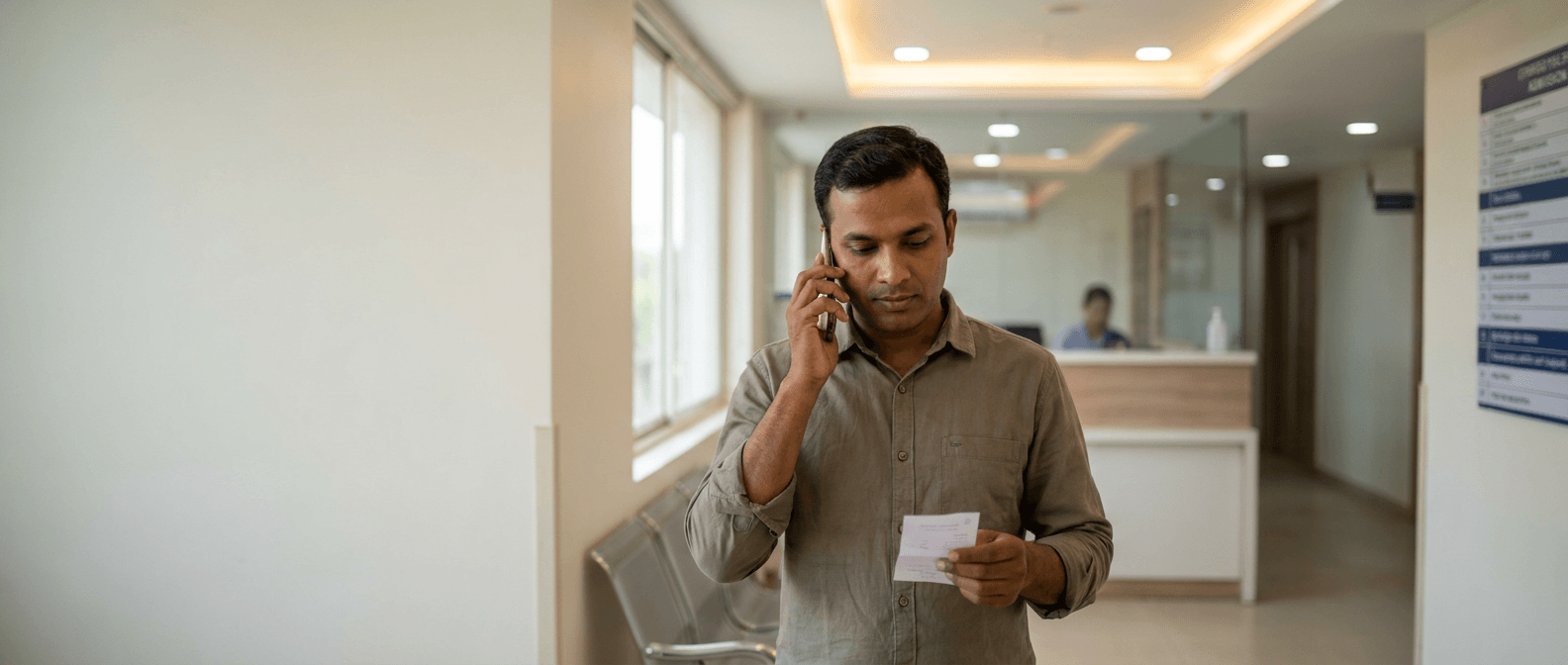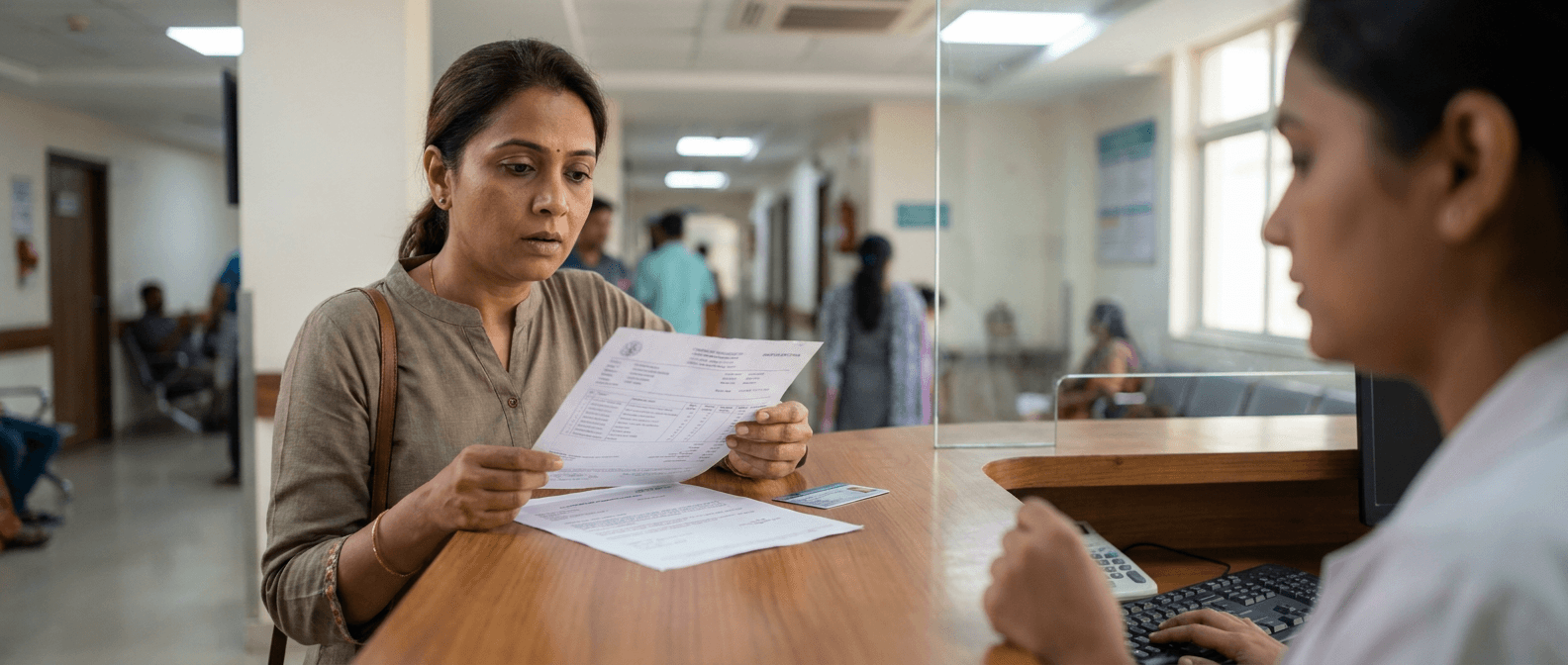
Yes, a health insurance company can refuse to pay the full amount on a cashless network hospital claim, if parts of the bill are not covered by your policy.
A cashless approval means your health insurer settles expenses directly with the hospital, but it may not guarantee a fully covered hospital bill. You may have to pay out of your pocket due to room rent sub-limits, co-payment clause, deductibles, non-medical consumables or deductions applied after the final bill is prepared.
What does a cashless health claim at a network hospital mean?
A cashless network hospital has an arrangement with the health insurance company or their Third-Party Administrator (TPA). When you file a cashless claim at a network hospital, it means the hospital agrees to treat you without asking for the full payment upfront. Instead, your insurer pays the hospital directly for the medical expenses covered as per your policy.
Before settling the hospital bill, the insurer checks and verifies all charges to see if they are covered by your policy, fall within sub-limits, or require a co-payment. They will also check if the hospital has charged you according to the pre-agreed network rates. If any charges fall outside policy coverage, the insurer will deduct that amount from the final payout.
For example: If your final hospital bill is Rs 1,20,000, but the insurer determines that only Rs 95,000 is eligible as per your policy, they will pay Rs 95,000 directly to the hospital. You will have to pay the remaining Rs 25,000 out of your pocket.
Common deductions in a cashless hospital claim
Even with a cashless health insurance claim at a network hospital, you may still have to pay for some costs out of your pocket. These deductions depend on your policy, benefits, and the hospital's pre-agreed tariff rates.
| Deduction type | What it means | Example |
|---|---|---|
| Sub-limits on room rent | Policy covers room rent only up to a daily limit. If you select a room above the policy limit, linked medical charges are also reduced in proportion. | If your limit is Rs 5,000/day and the room costs Rs 10,000/day, the insurer will only cover 50% of the linked medical charges. |
| Co-payment | An insurance clause that requires you to pay a fixed percentage of the approved claim amount out of your own pocket. | If the approved bill is Rs 1,00,000 and your co-pay is 10%, you pay Rs 10,000 and the insurer pays Rs 90,000. |
| Deductible | A fixed amount you must pay yourself before your insurance coverage kicks in. | If your policy has a Rs 20,000 deductible, and your hospital bill is Rs 85,000, you pay the first Rs 20,000, and the insurer covers the remaining Rs 65,000. |
| Non-medical consumable items | Items used during treatment that are not covered by your policy, like PPE kits, gloves, and admission kits. | These costs may have to be paid by you, even during a cashless claim. |
| Disease-specific sub-limit | Limits on specific treatments or conditions, regardless of your total sum insured. | Cataract surgeries and maternity care have specific caps. |
| Package-rate or tariff excess | The network hospital has pre-agreed rates for specific procedures. If they bill above this agreed rate, the insurer won't pay the difference. | If the agreed surgery package is Rs 60,000 and the hospital bills Rs 75,000, the extra Rs 15,000 will be deducted. |
How room rent limits affect your total hospital bill
If you choose a room that costs more than the limit set in your policy, insurers apply a penalty known as proportionate deduction. This means charges closely linked to your room category, such as doctor consultations, nursing fees and operation theatre, or OT, charges, are reduced by the exact same ratio as your room rent coverage.
However, many patients, and some hospital billing desks, mistakenly believe this ratio cut applies to the entire bill. It does not. Under IRDAI guidelines on associated medical expenses, insurers are strictly barred from applying a proportionate deduction to the following:
- Medicines and pharmacy
- Medical implants and devices
- Diagnostic tests, such as blood work, scans and X-rays
- ICU charges, since ICUs are usually flat priced and not tiered by room category
A worked example: Let's say your policy caps your room rent at Rs 5,000 per day, but you choose a private room costing Rs 10,000 per day. Your eligible room ratio drops to 50%.
| Bill component | Hospital bill | How the insurer treats it | Approved amount |
|---|---|---|---|
| Room rent for 3 days | Rs 30,000 | Capped at eligible Rs 5,000 per day | Rs 15,000 |
| Associated charges, such as surgeon fee, nursing and OT | Rs 1,00,000 | Reduced by 50% proportionate ratio | Rs 50,000 |
| Protected charges, such as medicines, implants and diagnostics | Rs 1,00,000 | Paid in full, exempt from deduction | Rs 1,00,000 |
| Total | Rs 2,30,000 | Before any other policy deductions | Rs 1,65,000 |
Check your room category before admission
Choosing a room strictly within your policy limit is the single best way to protect your cashless claim from severe ratio cuts.
Other common deductions on a cashless health claim
Beyond room limits, your claim might face deductions from three other common clauses.
- Non-Medical Consumables: Standard policies do not cover all disposable items used during treatment. You may be billed directly at discharge for items like PPE kits, syringes, gloves, administrative fees and admission kits unless you purchased a specific add-on for consumables cover.
- Disease-Specific Sub-Limits: Certain diseases or procedures have strict financial limits independent of your total sum insured. For example, if your total cover is Rs 5 Lakhs, your policy might cap a cataract claim at Rs 40,000 per eye. The insurer will not cover medical expenses above that cap.
- Tariff Violations,or Overbilling: Network hospitals have agreed on pre-negotiated package rates, called GIPSA rates. If a hospital's package for a surgery is Rs 60,000, but they bill the insurer Rs 75,000, the insurer will deduct the Rs 15,000 excess.
If you see a tariff deduction, use this quick guide:
| Situation | Who to contact | What you should ask for |
|---|---|---|
| The policy excludes the item | Insurer or TPA | Written deduction reason linked to the policy clause |
| The policy has a sub-limit | Insurer or TPA | Calculation showing the applicable sub-limit and payable amount |
| The hospital bills above network tariff | Hospital and insurer or TPA | Tariff comparison or package-rate explanation |
Difference between pre-authorisation amount and final claim amount
A common misunderstanding is confusing pre-authorisation approval amount with the final claim settlement amount.
Initial approval: This is a quick approval based on the hospital's estimated cost. It helps you get a bed and lets your treatment begin.
Final approval: This happens only after the doctor says you can go home and the hospital sends the final, detailed bill. Your insurer will check every item, apply policy limits, remove charges that are not covered and verifies the hospital's rates.
The 1-hour / 3-hour rule: To prevent you from being stuck in the hospital waiting for approvals, IRDAI, introduced strict timelines in 2024. As per IRDAI, insurers must approve your initial admission request within 1 hour. They must clear your final discharge bill within 3 hours of the hospital sending it.
Steps to dispute an incorrect deduction on your hospital bill
Ask for the TPA deduction letter
Request an official written deduction letter or cashless approval sheet that lists deductions, the amount deducted and the policy clause used for the deduction.
Compare each deduction with your policy
Check your policy for room rent limits, co-payment, deductible, disease-specific sub-limit and exclusions.
Ask the hospital to explain tariff differences
If the deduction is linked to package rates or network tariff, ask the hospital insurance desk why the charge was above the agreed rates or billed separately.
Pay under protest if discharge is delayed
If you have to pay for discharge, write "paid under protest" on the receipt or send an email immediately after payment. Keep all bills, discharge summary and deduction letter.
File a reimbursement claim
Submit a reimbursement claim for the disputed amount with the insurer. Attach all hospital documents and a clear explanation of why the deduction was incorrect.
Reach out to IRDAI for any wrongful deductions
If the insurer refuses to correct an unfair deduction, you can escalate the issue to the insurer's Grievance Redressal Officer. If it remains unresolved, file a complaint through the IRDAI Bima Bharosa portal.
Key takeaways
- A cashless network hospital claim guarantees direct settlement of eligible expenses with the hospital by the insurer.
- Room upgrades can cause proportionate deductions on surgeon and Operation Theatre fees.
- Your initial pre-authorization is only an estimate. Final deductions are calculated during the itemized bill audit at discharge.
- Insurers have a strict 3-hour window to approve your final discharge bill.
- Always ask for the official TPA deduction letter to cross-check deducted charges from your final settlement.
Frequently asked questions
No. Cashless health insurance means the insurer pays the hospital directly for admissible expenses. You may still pay non-admissible items, co-payment, deductible amounts, expenses above sub-limits and charges above agreed network tariffs.
Yes. A network hospital can ask you to pay the amount not approved by the insurer or TPA. You should ask for the deduction letter and itemised bill before paying, especially if the amount appears linked to package-rate or tariff differences.
Yes. The pre-authorization amount is based on estimates. The final approval can change after the insurer reviews the final bill, discharge summary, treatment records, sub-limits, exclusions and tariff agreement.
Collect the final itemised bill, discharge summary, payment receipts, TPA deduction letter, final cashless approval sheet, investigation reports and any hospital explanation for package-rate or tariff differences.
First complain to the insurer's Grievance Redressal Officer with documents and a clear calculation of the disputed amount. If the issue is not resolved, escalate it through the IRDAI grievance route available for insurance policyholders.
About the authors

Neviya Laishram
Written by · Senior Editor – Health, Life and Group Health Insurance Content at ACKOWith a journalism background, she brings 9 years of experience in strategising and editing health, life, and group health insurance content. Having written for magazines and digital publications, she combines research and editorial expertise to create credible, useful content for readers.

Dr Nitin Kumar Gupta
Reviewed by · SVP – Health Underwriting & Claims at ACKO General InsuranceWith 20+ years of experience in digital transformation and growth, he is a leader specialising in health, life, accident, and disability insurance. Backed by an MBBS degree and insurance designations (FLMI, FALU, FLHC, ACS, ARA), he combines expertise with leadership.