Visa


Home / International Travel Insurance / Visa / What is a visa?
What is a Visa?

A Visa is your official permission to travel abroad, and for Indian travellers, visa requirements vary by country. While some destinations offer a visa-free entry for Indians, others provide a Visa on Arrival or e-Visa option. Popular countries like the US, UK, and Schengen nations still require a travel visa approved in advance.
If you are planning to travel abroad for leisure, work, business, or to study, understanding the different types of visas, their application process, eligibility criteria, and visa documents helps you avoid delays, rejections, and last-minute surprises.
A visa is an official authorisation issued by a country’s government that permits a person to:
Enter the country
Stay for a specific duration
Travel through the country for a defined purpose
It is usually stamped on a passport or issued electronically and is mandatory for most international travellers.
Why are visas required?
Visas help countries manage, regulate, and secure international travel. They allow governments to decide who can enter, how long they can stay, and for what purpose. Here’s why visas matter:
Security & Border Control
Visas help countries maintain their border security by monitoring who enters. This protects residents and helps prevent illegal activities such as smuggling, trafficking, and security threats.
Fairness Between Countries
Visa rules often operate on a principle of reciprocity. If one country requires a visa from citizens of another country, the same rule may apply in return, ensuring equal treatment for travellers.
Agreements Between Countries
Certain countries have established special agreements that permit visa-free travel or expedited visa processes. These agreements encourage tourism, business, and stronger diplomatic ties.
Types of visas
Visas can be used for various purposes, such as work, study, or visiting a foreign country. Here are some of the most common kinds of visas you might come across.
Travel/Tourist Visa
A tourist/travel visa is intended for individuals visiting a foreign country for leisure, tourism, or short-term purposes. It typically allows individuals to stay for a limited duration and engage in non-work-related activities. Requirements for a travel visa may include proof of accommodation, return tickets, and sufficient funds for the duration of the trip.
Work Visa
A work visa permits individuals to live and work in a foreign country for a specified period. These visas are usually granted based on an offer of employment from a company or organisation in the host country. Employment visas often have specific requirements, such as a job offer letter, proof of qualifications, and sponsorship from the employer.
Business Visa
A Saudi business visa is issued for official or professional travel purposes. Under current regulations, Indian travellers holding a valid business visa are allowed to perform Umrah during their stay, provided they follow the required booking procedures. This option is suitable for professionals who wish to perform Umrah alongside work commitments.
Student Visa
A student visa enables individuals to pursue their education in a foreign country. It is granted to students accepted by educational institutions for full-time courses or academic programs. The requirements for a student visa typically include proof of enrollment, financial support, and a letter of acceptance from the educational institution.
Refugee/Asylum Visa
A refugee or asylum visa is granted to individuals fleeing persecution, conflict, or violence in their home country. These visas offer protection and legal status to individuals seeking refuge and are typically granted through a formal application process, requiring evidence of the need for protection.
Working Holiday Visa
Some countries offer working holiday visas that allow individuals to travel and work for a specific period. These visas encourage cultural exchange and typically have age restrictions. They provide opportunities for individuals to explore a foreign country while supplementing their finances through short-term employment.
Spousal Visa
A spousal visa allows individuals to join their spouse or partner who is a citizen or permanent resident of a foreign country. It enables spouses to live together and may eventually lead to permanent residency or citizenship, depending on the country's regulations.
Transit Visa
The Saudi transit visa allows short stays for travelers passing through Saudi Arabia. If the transit duration permits, Indian travellers can perform Umrah during their layover. This option is best suited for travelers with long stopovers, though careful planning is required due to limited time.
eVisa
An eVisa, or electronic visa, is a digital version of a traditional visa. It eliminates the need for a physical visa label or stamp on the passport. eVisas are typically obtained by applying online, and upon approval, the visa is electronically linked to the individual's passport.
Note: Visa types and their specific requirements can vary from country to country. Therefore, individuals should consult the relevant embassy or consulate of their destination country to obtain accurate and up-to-date information regarding the specific visa requirements and application process.
Eligibility Criteria for Visa Applicants
To be eligible for a visa, Indian applicants generally need to meet the following conditions. Exact criteria may vary depending on the destination country and visa type.
Purpose of visit: Applicants must clearly state the purpose of their visit, whether it is for tourism, business, work, study, or any other relevant category. Supporting documents related to the purpose of the visit may be required.
Valid Passport: Applicants must have a passport that is valid for at least six months beyond the intended duration of stay. The passport should have blank pages available for visa stamping.
Financial stability: Ability to cover travel, accommodation, and daily expenses during the stay
Intent to return: Proof of strong ties to India, such as employment, business, education, or family
Health requirements: Certain countries may have specific health requirements, such as a valid yellow fever vaccination certificate, a medical examination report, or COVID-19-related documentation. It is important to check the visa requirements of the destination country for any health-related prerequisites.
Character and background information: Applicants may be required to provide information regarding their character, criminal record, and background history. This may involve disclosing previous travel history, employment details, and any past visa rejections or violations.
Documents Needed to Apply for a Visa For Indians
Indian visa applicants are usually required to submit the following documents. Requirements may vary by country and visa category.
Passport: Valid Indian passport with blank pages
Visa application form: Duly filled and signed (online or offline, as applicable)
Photographs: Recent passport-sized colour photographs as per specifications
Proof of travel itinerary: Applicants may need to provide confirmed onward or return tickets indicating their intended dates of entry and departure from the country.
Proof of accommodation: Hotel bookings, invitation letter, or rental agreement
Financial documents: Bank statements, salary slips, ITR, or sponsorship letters
Travel insurance: Some countries may require applicants to provide evidence of travel insurance that covers medical emergencies, evacuation, and repatriation (if required)
Purpose-specific documents:
Employment letter or NOC (work/business visa)
Admission letter (student visa)
Invitation letter (business or family visit)
Health documents: Medical reports or vaccination certificates, if mandated
Background details: Previous travel history and details of past visa approvals or refusals
How to Apply for a Visa Online Through ACKO?
Apply for your visa online through ACKO in just a few simple steps, starting with selecting your destination and the right visa type.


Step 1: Choose Your Destination & Visa Type
Select the country you’re travelling to and the type of visa you need - tourist, business, work, or study.
Step 2: Fill in Your Details Online
Enter your personal, travel, and passport details. ACKO auto-fills most fields to make the process quick and error-free.
Step 3: Upload Required Visa Documents
Upload clear copies of your passport, photographs, and other required documents based on your visa type and destination.
Step 4: Pay the Visa Fees Securely
Complete your payment online using a debit card, credit card, UPI, or other supported payment methods.
Step 5: Book Biometrics Appointment (If Required)
For sticker visas, ACKO helps you book your biometric appointment at authorised visa centres like VFS Global.
Step 6: Track Your Visa Status in Real Time
Stay updated with live visa status tracking, clear timelines, and alerts at every stage of your application.
Note: Once approved, you will receive your e-visa via email or have your passport delivered with the visa sticker, depending on the type of visa.
How to Apply for a Visa Offline?
Applying for a visa offline involves visiting the relevant embassy, consulate, or authorised visa application centre in person. While the exact steps may vary by country, the overall process is largely similar.
Identify the Visa Type: Determine the correct visa type based on your travel purpose (tourist, business, work, or study) and the destination country.
Collect the Visa Application Form: Obtain the visa application form from the embassy/consulate website or directly from the visa application centre.
Prepare Required Visa Documents: Gather all necessary documents like your passport, photographs, travel itinerary, proof of funds, accommodation details, and supporting document,s based on the visa type.
Book an Appointment (If Required): Schedule an appointment with the embassy, consulate, or authorised centre (such as VFS Global) for document submission and biometrics.
Visit the Visa Application Centre: Submit your application form and documents in person. Provide biometric data (fingerprints and photograph) if required.
Pay the Visa Fees: Pay the applicable visa fee and service charges at the centre.
Track Your Visa Status: After submission, you can track your visa status using the reference number provided by the visa application centre.
Collect Your Passport: Once processed, collect your passport with the visa sticker or receive it via courier, depending on the service opted for.
Why Choose ACKO for Your Visa Application?
Choose ACKO for a fast, hassle-free visa application with a seamless online process and reliable support at every step.
Fast & Simple Visa Process
Apply for your visa in just minutes. ACKO simplifies requirements and automates most of the form-filling so you can get started quickly.
E-Visa & Sticker Visa Applications
Apply seamlessly for both e-visas and traditional sticker visas. Get instant e-visa access for countries like Dubai, Vietnam, Turkey, Oman, Qatar, Saudi Arabia, Indonesia, and Egypt, or apply easily for sticker visas to destinations such as the US, UK, Europe, Canada, Singapore, Japan, and more.
Visa Support for 150+ Countries
Get clear and up-to-date visa support for over 150 destinations worldwide.
Real-Time Visa Status & Tracking
Track every stage of your visa application with live updates, clear timelines, and accurate ETAs—backed by 90% on-time visa processing.
Reliable & On-Time Processing
With hundreds of thousands of visas processed, ACKO ensures a smooth experience. If your visa is delayed, you’re protected by ACKO’s on-time guarantee.
Trusted by 1,50,000+ Travellers
Join over 1.5 lakh travellers who rely on ACKO for reliable visa support and services.
What Is Biometrics Enrolment for a Visa?
Biometrics enrolment for a visa means providing your biological identifiers so the embassy or immigration authority can verify your identity and enhance security.
In most cases, biometrics enrolment includes:
Fingerprints (usually all 10 fingers)
Digital photograph (face image)
Sometimes a signature
How does Biometric Enrolment work?
Here are the steps of biometric enrollment in Embassy or Visa application centre:
Step 1
You attend a Visa Application Centre (VAC) or embassy in person.
Step 2
Your fingerprints and photo are captured electronically.
Step 3
The data is securely stored and used for identity verification during visa processing and at border control.
Key points to know about Biometric Enrolment
Biometrics are usually required for applicants above a certain age (often 5–12 years, depending on the country).
For minors, fingerprints may be partially required or exempt, but a photo is almost always taken.
Biometrics are valid for a limited period (e.g., 5 years for Schengen visas).
Biometrics enrolment is separate from the visa interview (if an interview is required).
Visa Checklist for Minor Applicants (Under 18)
This checklist outlines the standard documents required for minor visa applicants. Requirements may vary by country and visa type, so applicants should always verify with the relevant embassy or consulate.
Category | Required Documents |
|---|---|
Child’s documents | • Valid passport (with required validity and blank pages)• Visa application form signed by both parents / legal guardians• Birth certificate (showing parents’ names)• Passport-size photographs (as per embassy specifications) |
Parent / guardian documents | • Passports of both parents / legal guardians (copies)• Marriage certificate of parents (if applicable)• Legal guardianship or custody documents (if applicable) |
Consent documents (mandatory in most cases) | • Notarized consent letter (NOC) from: – Both parents (if child travels alone / with third party), OR – Non-travelling parent (if child travels with one parent)• ID / passport copy of non-travelling parent(s) |
Travel & support documents | • Flight itinerary / travel plan• Accommodation proof• Travel insurance (if required by destination)• Proof of financial support (parent’s bank statements / sponsorship letter)• School letter (bonafide / leave approval) |
Additional (if applicable) | • Death certificate of deceased parent (if applicable)• Court order for sole custody (if applicable)• Details of accompanying adult (passport copy + responsibility letter)• Translations / apostille of documents (if required) |
Important notes:
All names and passport numbers must match exactly across documents.
Consent letters usually must be notarised.
Visa Application Fees
Visa fees vary based on the destination country, visa type, duration, and applicant category. With ACKO, you get transparent fee details upfront, so there are no surprises while applying for your visa. Here’s a clear breakdown to help you understand what you may need to pay:
Fee Type | Description |
|---|---|
Visa Application Fee | Charged by the destination country; varies by visa type (tourist, business, work, study) and duration |
Service Fee | Applicable when applying through authorised centres or platforms (e.g., VFS Global or online facilitation services) |
Biometric Fee | Charged for fingerprinting and photograph collection, if required |
Urgent / Express Fee | Optional fee for faster processing (available for select countries) |
Courier Fee (Optional) | For passport delivery to your address |
Additional Charges | May include document translation, notarisation, or insurance, depending on visa requirements |
Note: Visa fees are generally non-refundable, even if the application is rejected. Charges can change based on exchange rates and embassy policies.
Visa Fees for Popular Countries
Get a quick overview of visa fees for popular countries to help you plan your travel budget with confidence.
Country | Visa Type | Tourist Visa Fee (Approx.) |
|---|---|---|
France | Schengen Visa | €90 (≈ ₹8,100) |
Spain | Schengen Visa | €90 (≈ ₹8,100) |
United States | B1/B2 Visitor Visa | USD 185 (≈ ₹15,400) |
China | Tourist Visa | USD 140 (≈ ₹11,600) |
Italy | Schengen Visa | €90 (≈ ₹8,100) |
Turkey | e-Visa | USD 50–60 (≈ ₹4,200–₹5,000) |
Mexico | Tourist Visa | USD 53 (≈ ₹4,400) |
Thailand | Visa on Arrival | THB 2,000 (≈ ₹4,600) |
Germany | Schengen Visa | €90 (≈ ₹8,100) |
United Kingdom | Standard Visitor Visa | £115 (≈ ₹12,000) |
Note: Fees may vary based on exchange rates, visa type, and processing method (e-visa, sticker visa, or visa on arrival).
Visa processing times
When you’re planning an international trip or a long-term stay abroad, it’s super important to know how long your visa will take to process, as timelines can vary widely. In most cases, tourist visas are processed within 10 to 25 working days, while transit visas usually take around 5 to 15 working days, depending on the country and application volume. Knowing these timelines in advance helps you plan better and avoid last-minute stress. Here are some factors that can make your visa processing time shorter or longer:
Factors Affecting Visa Processing Time
Visa type: The processing time can vary depending on the type of visa you are applying for. Different visa categories, such as tourist visas, student visas, work visas, and business visas, may have varying processing times due to the specific requirements and complexities associated with each category.
Country and embassy/consulate: The processing time can also be influenced by the country where you are applying for the visa and the workload of the respective embassy or consulate. Some countries may have faster processing times due to efficient visa processing systems, while others may have longer processing times due to higher volumes of visa applications.
Application completeness: The completeness and accuracy of your visa application play a significant role in determining processing time. Ensure that you submit all the required documents and information correctly, as incomplete or incorrect applications may lead to delays or even visa rejections.
Peak seasons: During peak travel seasons or popular holiday periods, visa processing times may be longer due to increased demand. It is advisable to apply well in advance to allow for any potential delays during these periods.
Security and background checks: In some cases, additional security or background checks may be required for visa applicants. These checks can lengthen the processing time as they involve coordination between different government agencies to ensure the safety and security of the host country.
What is Visa Duration?
Visa duration refers to the time period for which your visa is valid and how long you are allowed to stay in a country. Visa duration varies by country, visa type, and purpose of travel. Always check the details printed on your visa or e-visa.
It usually includes two key parts:
Validity period: The dates between which you can enter the country (e.g., valid from 1 Jan to 30 Jun).
Duration of stay: The maximum number of days you can stay (e.g., 30, 60, or 90 days per visit).
Important points to know
You must enter the country within the validity period.
You cannot stay beyond the permitted duration, even if the visa is still valid.
For multiple-entry visas, the duration of stay applies per visit, not across the entire validity period.
Immigration officers may grant a shorter stay than the maximum allowed.
How to Track Visa Application Status?
Tracking a visa application status depends on which country’s visa you applied for and how you applied (online, VFS, embassy, etc.). Here’s a clear, general guide that works for most cases:
Keep your reference details ready
Before starting a visa status check, make sure you have the identifiers needed to locate your application.
Application or reference number
Passport number (commonly used for visa check online by passport number)
Date of birth
Email ID or mobile number used during submission
Acknowledgement receipt or payment confirmation
Identify the application channel
The way you apply determines where and how your visa status check can be performed.
A. Online application
If you applied digitally, your visa status is usually available in the same account.
- Log in to the portal used for submission
- Go to My Applications / Track Status / Visa Status Check
- Enter required details such as passport number or application ID
B. Third-party service provider
If a visa facilitation centre handled your submission, tracking is done on their platform.
- Open the provider’s tracking page
- Use reference number and date of birth
- Check movement of application and visa card / passport dispatch status
C. Embassy or consulate submission
If you applied directly at an embassy or consulate, tracking may be limited, but it is still possible.
- Use the reference number provided during submission
- Monitor email or SMS updates related to visa processing
- Contact official support for a visa status check if require
Understand common status messages
Visa tracking systems use standard terms to indicate progress, not outcomes.
Application Received – Documents accepted
Under Processing / In Review – Application under assessment
Additional Documents Required – Applicant action needed
Approved / Granted – Visa approved and visa card decision completed
Refused / Denied – Visa not approved
Dispatched / Ready for Collection – Passport or visa card ready
How to Extend Your Visa?
Visa extension rules depend on the country, visa type, and reason for extension, but the general process usually works like this:
Check eligibility: Confirm whether your visa type allows extensions (tourist visas are often restricted).
Apply before expiry: Submit your extension request before your current visa expires to avoid penalties or overstays.
Apply with the right authority: Apply online or in person through the immigration office, the home ministry, or the designated portal of the destination country.
Provide the required documents
Common documents include:Valid passport and current visa
Visa extension application form
Proof of reason for extension (medical, studies, work, emergency, etc.)
Proof of funds and accommodation
Passport-size photographs
Pay the extension fee: Fees vary by country and duration of extension.
Attend biometrics or interview (if required): Some countries require fresh biometrics or an in-person appointment.
Wait for a decision: Processing times vary. Approval is not guaranteed.
Important notes:
Not all visas can be extended. Some require you to exit and reapply.
Overstaying can lead to fines, bans, or future visa refusal.
Extension approval and duration are at the immigration authority’s discretion.
The Visa Interview: A Simple Guide
If you want to ace your visa interview, preparation is key. Here’s what you need to know.
1. Interview Location and Process
Visa interviews are usually conducted at the destination country’s embassy or consulate.
Familiarise yourself with the interview location in advance.
Arrive early to allow time for security checks and registration.
After security, you’ll be directed to a waiting area use this time to relax and mentally prepare.
When your turn comes, you’ll be called into the interview room to meet the consular officer.
2. Interview Questions and How to Answer Them
The consular officer will ask questions to assess your travel purpose, financial stability, and ties to your home country. Answer honestly, clearly, and confidently.
Common questions include:
What is the purpose of your visit?
How long do you plan to stay?
What is your occupation, and how long have you been working there?
Do you have family or relatives in the destination country?
What ties do you have to your home country that ensure your return?
How will you finance your trip?
Tips for answering:
Prepare your responses in advance.
Be concise, specific, and truthful.
Avoid vague or ambiguous answers.
3. Body Language and Communication
Your non-verbal communication is just as important as your answers.
Maintain eye contact with the consular officer.
Sit upright and maintain good posture.
Speak clearly and audibly, demonstrating good diction.
Use appropriate gestures and facial expressions to express yourself.
Remain calm and composed, even if you feel nervous.
Practising beforehand can help you appear confident and well-prepared.
4. Additional Procedures
Depending on the visa type and country, additional steps may be required, such as:
Fingerprinting
Submission of extra documents
Medical examinations
Make sure to research these requirements in advance so there are no last-minute surprises.
What information will my Visa have?
A visa (whether a sticker, stamp, or e-visa) usually contains a standard set of details that identify you, the issuing country, and the conditions of travel. Here’s what you’ll typically see:
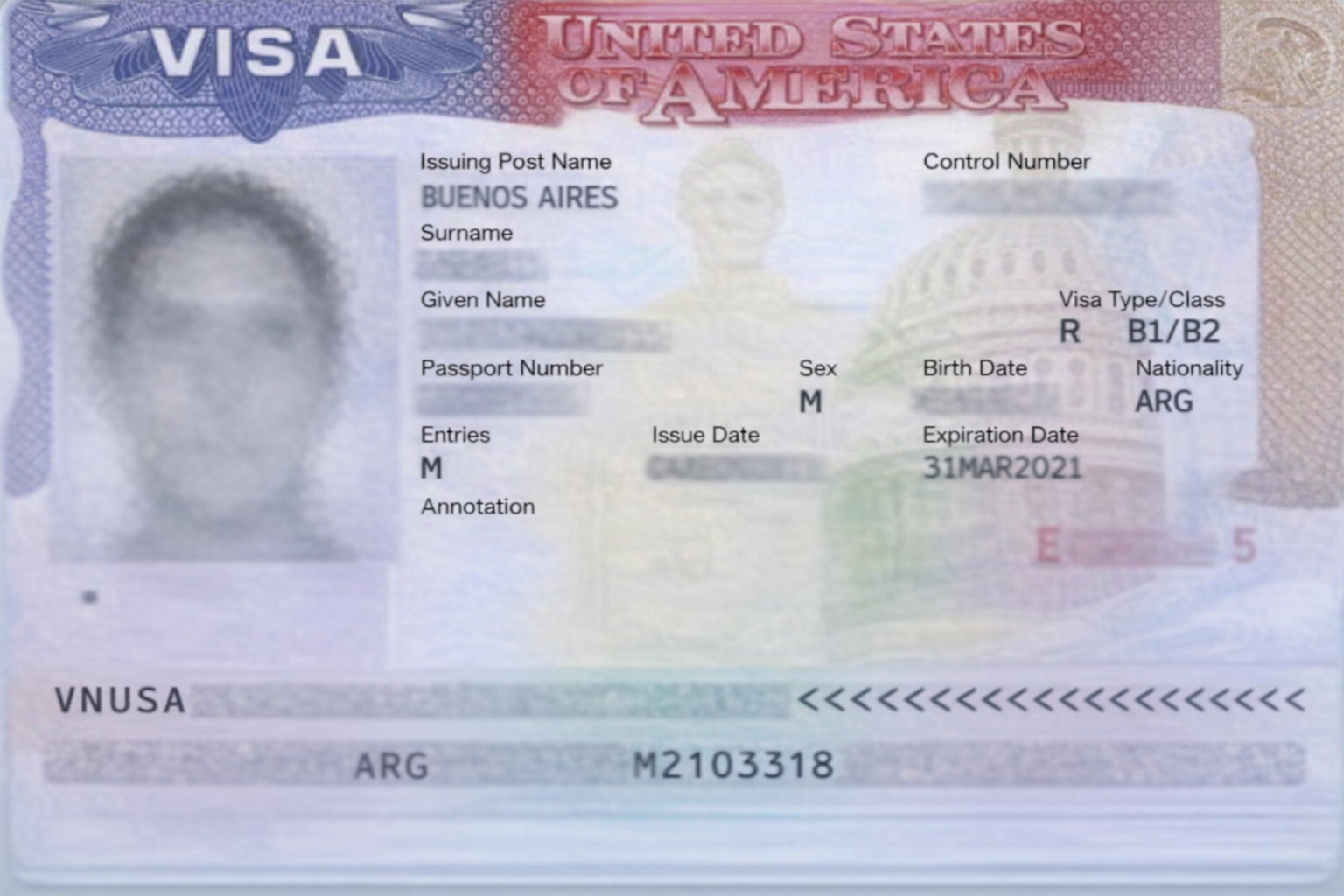
Personal details
- Full name (as in your passport)
- Passport number
- Date of birth
- Nationality
- Sex
- Photograph (for sticker visas)
Visa details
- Visa type / category: (e.g., Tourist, Business, Work, Student)
- Purpose of travel (sometimes coded)
- Number of entries: (Single / Double / Multiple)
- Validity period
- Valid from date
- Valid until date
- Duration of stay: (e.g., 30 days, 90 days per visit)
Issuing authority information
- Country issuing the visa
- Place of issue (city/embassy/consulate)
- Date of issue
- Visa number (unique identifier)
Difference between Immigrant and Non-Immigrant Visas
Immigrant visas and nonimmigrant visas are the two major types of visas. The key differences are listed in the table below.
Parameter | Immigrant Visa | Nonimmigrant Visa |
Purpose | Intended for individuals seeking permanent residence in a country | Intended for individuals with temporary purposes such as tourism, work |
Length of Stay | Generally allows for long-term or permanent residence | Allows for a limited duration of stay, typically temporary |
Eligibility Criteria | Typically based on family relationships, employment, or investment | Based on specific purposes such as tourism, study, or work |
Intent | Intends to establish a permanent residence in the country | Intends to visit temporarily or engage in specific activities |
Path to Citizenship | Can lead to eventual eligibility for citizenship | Does not typically lead to citizenship |
Residency Requirements | Requires the applicant to reside continuously in the country | Requires the applicant to maintain temporary residency |
Job Opportunities | Offers potential employment opportunities in the country | May have limitations on employment or restrict certain types of work |
Documentation and Process | Usually involves a complex application process and documentation | Involves a relatively simpler application process and documentation |
Sponsorship and Support | May require a sponsor or petitioner to support the application | Sponsorship or petitioning may not be required |
Potential Benefits and Privileges | Grants access to social benefits, healthcare, and education | Provides temporary access to specific privileges and benefits |
Note: The table above provides a general comparison between immigrant and non-immigrant visas. The specific details and requirements may vary depending on the country and its immigration policies.
Why Visas Get Rejected ?
Visa rejections often happen due to small mistakes or missing details. With ACKO, you get guided support to reduce these risks.
Errors in Application Forms
Even minor mistakes can lead to rejection. ACKO simplifies form-filling and helps minimise errors.
Insufficient Financial Proof
Embassies require proof that you have sufficient funds to support your trip. ACKO clearly lists the required financial documents based on your destination.
Unclear Travel Purpose
Vague travel intent raises red flags. ACKO helps you choose the right visa type and prepare purpose-specific documents.
Missing or Incorrect Documents
Incomplete document sets are a common cause of rejection. ACKO provides a personalised checklist so nothing is missed.
No or Inadequate Travel Insurance
Many countries require insurance. With ACKO, you can easily secure compliant travel insurance along with your visa.
Weak Proof of Return
Not showing strong ties to India can impact approval. We guide you on the right supporting documents to submit.
Passport Validity Issues
Expired or insufficient passport validity can delay or reject applications. We alert you to passport requirements early.
Interview or Background Concerns
Previous refusals or unclear answers may affect outcomes. We offers clear guidance to help you prepare better.
Popular Countries Where Indians Need a Visa
Indians travelling to the following popular destinations must apply for a visa before travel:
United States: Indian travellers must apply for a US tourist, business, work, or student visa before travel. The US visa for Indians requires an online application, a biometric appointment, and in-person interview.
United Kingdom: Indians need a visa to visit the UK for tourism, business, or study purposes. A UK visa for Indians is applied for online, followed by biometrics at an authorised visa centre.
Canada: Indian citizens must obtain a visa before travelling to Canada for tourism, work, or education. The Canada visa for Indians involves online submission, biometrics, and document verification.
Schengen: Indians require a Schengen visa to travel across European countries like France, Germany, Italy, Spain, and the Netherlands. A Schengen visa for Indians allows travel to up to 27 countries with a single visa.
Australia: A visa is mandatory for Indians travelling to Australia for tourism, work, or study. The Australia visa for Indians is typically applied for online with supporting documents.
New Zealand: Indian passport holders must apply for a visa before entering New Zealand. The New Zealand visa for Indians requires an online application and relevant travel documents.
Japan: Indians need a visa to visit Japan for tourism, business, or study. A Japan visa for Indians involves submitting documents and biometrics through authorised centres.
South Korea: Indian travellers must obtain a visa before travelling to South Korea. The South Korea visa for Indians depends on the travel purpose and requires prior approval.
China: A visa is compulsory for Indians travelling to China for tourism or business. The China visa for Indians must be applied for in advance through authorised centres.
Brazil: Indians need a visa to enter Brazil for tourism or business travel. A Brazil visa for Indians requires document submission and prior approval before departure.
Argentina: Indian passport holders must obtain a visa to travel to Argentina. The Argentina visa for Indians can be applied for through the embassy or approved online channels.
Mexico: Indians require a visa to travel to Mexico unless holding a valid US, UK, or Schengen visa. The Mexico visa for Indians must otherwise be obtained before travel.
Russia: Indian citizens must apply for a visa before visiting Russia. A Russia visa for Indians is issued based on the travel purpose and supporting documents.
Turkey: Indians need a visa to travel to Turkey, available as an e-visa or sticker visa. The Turkey visa for Indians depends on eligibility and existing visas.
South Africa: Indian travellers must apply for a visa before entering South Africa. The South Africa visa for Indians requires online application and document submission.
Note: Visa requirements, documentation, processing times, and fees may vary depending on the country, travel purpose, and duration of stay.
List of Visa Embassy and Consulates in India
Here’s a comprehensive overview of foreign Embassies, High Commissions, and Consulates located in India. These are the diplomatic missions where you can typically inquire about visa services or consular support. India hosts missions from most countries of the world, especially in New Delhi, Mumbai, Chennai, Kolkata, Bengaluru, Hyderabad, and other cities
Major Embassies & High Commissions
Most countries maintain their embassy (or high commission for Commonwealth countries) in New Delhi, India’s capital and main diplomatic hub. There are around 159 such missions. Below are key examples (with some major visa-issuing missions you may need):
Country | Type | City |
|---|---|---|
United States | Embassy | New Delhi |
United Kingdom | High Commission | New Delhi |
Canada | High Commission | New Delhi |
Australia | High Commission | New Delhi |
Germany | Embassy | New Delhi |
France | Embassy | New Delhi |
Japan | Embassy | New Delhi |
China | Embassy | New Delhi |
Russia | Embassy | New Delhi |
Italy | Embassy | New Delhi |
UAE | Embassy | New Delhi |
Saudi Arabia | Embassy | New Delhi |
Pakistan | High Commission | New Delhi |
Bangladesh | High Commission | New Delhi |
Singapore | High Commission | New Delhi |
Consulates & Consulates-General Across India
Many countries also have consular offices outside New Delhi to provide localised visa/immigration and other services. These are often in Mumbai, Chennai, Kolkata, Bengaluru, Hyderabad, Ahmedabad, Chandigarh, etc.
Country | Diplomatic Mission Type | City / Cities |
|---|---|---|
United States | Consulate General | Mumbai |
United States | Consulate General | Hyderabad |
United Kingdom | Deputy High Commission / Consulates | Major cities (e.g., Mumbai, Chennai) |
Canada | Consulate General | Mumbai |
Canada | Consulate General | Bengaluru |
Canada | Consulate General | Chandigarh |
Japan | Consulates General | Bengaluru, Chennai, Kolkata, Mumbai |
China | Consulate General | Mumbai |
China | Consulate General | Kolkata |
South Korea | Consulate General | Chennai |
South Korea | Consulate General | Mumbai |
South Korea | Embassy | New Delhi |
Russia | Consulate General | Chennai |
Russia | Consulates | Mumbai, Kolkata |
Russia | Embassy | New Delhi |
Sweden | Consulate General | Mumbai |
Visa-Free Countries for Indians
Indian passport holders can currently travel visa-free or get a visa on arrival/eVisa access to ~60 countries and territories worldwide. This includes popular destinations across Asia, Africa, the Caribbean, and parts of Oceania, making international travel easier for short holidays, business trips, and transit travel. However, for many high-demand global destinations, Indian travellers are still required to apply for a visa in advance.
Popular Visa-Free Destinations for Indians:
An Indian passport offers entry to numerous stunning countries that do not require a pre-arranged visa. The following is a list of these visa-free countries for Indian passport holders:
Region | Countries (Visa Status) |
|---|---|
Asia | Nepal; Bhutan; Maldives (VoA); Malaysia; Thailand (VoA / e-Visa); Sri Lanka (e-Visa / VoA); Indonesia (e-VOA / VoA); Iran (VoA / e-Visa) |
Africa | Kenya (Visa-Free / VoA); Mauritius; Seychelles (VoA); Rwanda (VoA / e-Visa); Ethiopia (VoA / e-Visa) |
Caribbean & Americas | Barbados; Grenada; Haiti; Jamaica; St. Kitts & Nevis; Trinidad & Tobago; Dominica; Fiji; Guyana; El Salvador |
Middle East | Qatar (VoA); Oman (VoA / e-Visa) |
Europe / Eurasia | Serbia; Kazakhstan; Georgia; Albania; Bosnia & Herzegovina; Montenegro |
Oceania | Fiji; Cook Islands; Niue; Vanuatu; Samoa; Micronesia |
Visa and Travel Insurance: What You Need Before You Fly?
A visa is your official permission to enter a country, stay for a specific period, and travel for a defined purpose. Keep your visa documents handy, track your application on the official portal, and verify your visa details (entry type, validity, and duration of stay) before you fly.
However, a visa only allows entry; it doesn’t protect you if something goes wrong. That’s why travel insurance is just as important. Travel insurance policy may be mandatory in some countries, but even when it’s optional, it can save you from major, unexpected expenses. Travel insurance cover:
Medical emergencies & hospitalisation abroad
Emergency evacuation and repatriation
Trip cancellations or delays
Lost baggage and passport support
So, before you leave: confirm your visa, complete your visa checklist, track your visa status, and secure travel insurance.
Frequently asked questions
Here are some common questions people have about visas.

What documents are needed for a visa application?
Visa requirements vary significantly based on the destination country and the type of visa sought. Documents required for a visa include a valid passport, a completed application form, and photographs. You will also need to provide proof of the purpose of your visit, such as flight itineraries, hotel bookings, or official employment letters. Many applications also require financial evidence, such as bank statements or salary slips, and sometimes specific forms, including parental consent for minors.
What are the 5 steps to apply for a visa?
Applying for a visa typically involves five main stages, though the exact process is country-specific:
- Determine Eligibility: Identify the appropriate visa category and confirm you meet the requirements.
- Preparation: Complete the online application form and compile all necessary supporting documents.
- Financial: Pay the required visa application fees.
- Appointment: Schedule and attend the biometrics collection and/or interview.
- Finalisation: Monitor the application status, and collect your passport once the decision is made.
How long does it take to obtain a visa?
The processing time for a visa can vary depending on the country and the type of visa being applied for. It can range from a few days to several weeks. It is best to apply well in advance of your intended travel dates to ensure adequate processing time.
How much does a visa cost in India?
Indian visa fees vary significantly, depending on the applicant's nationality, the type of visa requested (e.g., Tourist, Business, Student), and the duration of stay. For many common types, such as 1-5 year Tourist visas, the cost typically falls between $40 and $160 USD. However, fees can be higher for specific categories, such as employment visas or longer durations. Additionally, applicants should anticipate potential extra charges, including service fees for processing agencies like VFS or BLS, and the ICWF fee.
What are the processing times for Indian eVisa applications?
The processing time for an Indian e-Visa (for most tourist/business applications) usually ranges from 24 to 72 hours (1 to 3 days). While official guidance suggests a maximum of 4 days, high application volumes can sometimes cause further delays. Therefore, it is strongly recommended that you apply well in advance, ideally 7–10 days before your scheduled travel date.
How to check my visa status online?
To check your visa status online, you should visit the official website of the embassy or consulate where you submitted your visa application. While the specific procedure may differ by country, you will typically need your application ID or passport number to access the status information.
What to do if my visa status is pending?
If your visa application status is "pending," it signifies that the processing is ongoing. The recommended course of action is to await subsequent updates or contact the embassy or consulate directly for further information.
Can I check another person's visa status?
No, online visa status checks must be performed by the individual using their personal application ID or passport number. You cannot check someone else's visa status.
Can I extend my visa?
It depends on the specific rules of the country you're visiting. Each country has its own visa policies, and they can be quite different. Some nations permit visa extensions under specific conditions, whereas others may require you to leave the nation and reapply for a visa. To know for sure, it's best to check with the immigration authorities or embassy/consulate of the country you’re in.
What happens if my visa application is denied?
When your visa application is denied, it means the immigration authorities have looked at your application and decided that you don't meet the requirements for that visa. There can be different reasons for this, like if your application was missing some important documents, if you didn't have enough money for your trip, or if you didn't meet certain criteria they're looking for. If this happens, you may have the option to appeal the decision or reapply with a more comprehensive application.
Can I work on a tourist visa?
In most cases, it is not permitted to work on a tourist visa. Tourist visas are generally issued for leisure or recreational purposes only, and engaging in employment or any form of paid work is often prohibited. If you intend to work in a foreign country, you will usually need to apply for a specific work visa that is tailored to your employment situation.
Do I need a visa for transit?
Whether you need a visa for transit depends on various factors, including your nationality, the country you are transiting through, and the duration of your layover. Some countries have transit visa exemptions for certain nationalities, allowing you to transit through their airports without a visa for a limited period. However, it's important to check the transit visa requirements of the specific country you will be transiting through to ensure compliance.
Are there any visa exemptions for specific countries?
Yes, some countries have visa exemptions or visa-free arrangements for certain nationalities. These exemptions may allow citizens of specific countries to enter, stay, or transit through the country for a limited period without requiring a visa. The duration and conditions of these exemptions can vary, so it's advisable to research the visa policies of the country you plan to visit to determine if you qualify for a visa exemption.
Disclaimer: The content on this page is generic and shared only for informational and explanatory purposes. It is based on several secondary sources on the internet and is subject to changes. Please consult an expert before making any related decisions.
Explore More On Visas
Travel Insurance for Popular Destinations from India

Written by
Shreya Sahu
Content Editor

Shreya is a travel content writer with 5+ years of experience, turning hidden gems and dream getaways into inspiring, engaging stories. She enjoys exploring local cultures, slow travel experiences, and meaningful journeys while planning her next escape.

Reviewed by
Chirag Mahajan
Associate Director - Retail Travel Insurance
Chirag Mahajan leads Acko’s Retail Travel business, driving strategy, growth, and customer-centric travel insurance solutions. A travel enthusiast himself, he blends industry expertise with passion to build seamless and reliable travel protection experiences.


#36/5, Hustlehub One East, Somasandrapalya 27th Main Rd, Sector 2, HSR Layout, Bengaluru, Karnataka 560102