

speak for ACKO
speak for ACKO
speak for ACKO
Home / Life Insurance / Articles / Life Insurance General / What Does ‘Pure Term Insurance’ Really Mean for Your Loved Ones?
What Does ‘Pure Term Insurance’ Really Mean for Your Loved Ones?
Neviya LaishramJan 14, 2026
Share Post
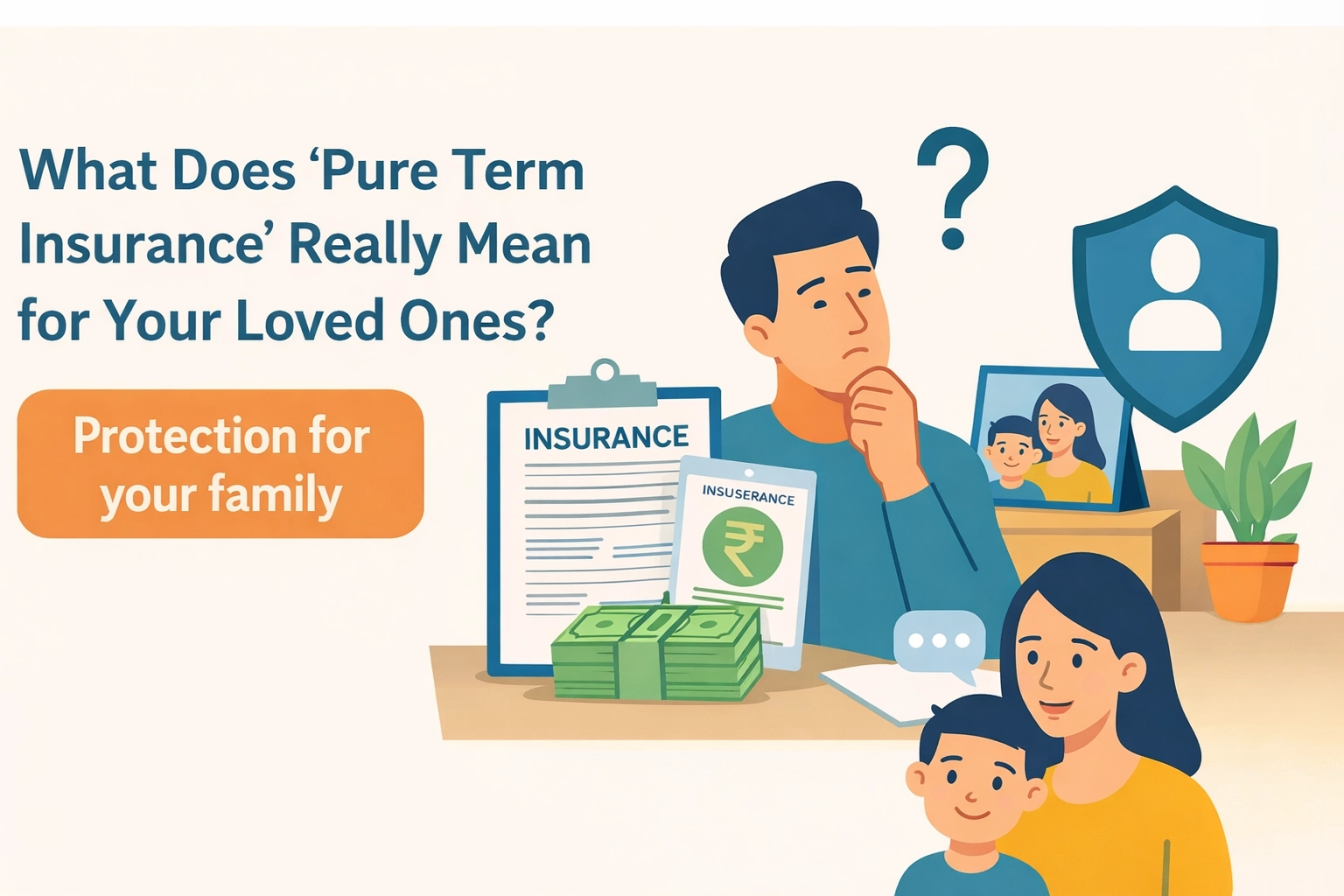
To your family, pure term insurance is financial security that is simple, clear, and dependable. That’s because pure term insurance is a type of life insurance designed only to provide life cover, without any savings or investment features.
Pure term insurance is designed solely to address a very specific problem: the loss of income due to the insured's untimely demise. By limiting itself solely to the element of protection, it makes sure that dependents will not be left without financial support during difficult times. Understanding this purpose clearly separates protection from other financial goals and removes confusion about what term insurance is meant to do.
Contents

- The Problem Pure Term Insurance is Designed to Solve
- What Makes a Term Plan “Pure”
- How Protection Shows Up in Real Life
- Why There Is No Payout at the End of the Term
- How Coverage Duration and Structure are Chosen
- ACKO’s Life Insurance Philosophy: Pure, Unmixed Protection
- Conclusion
- Frequently Asked Questions
The Problem Pure Term Insurance is Designed to Solve
Pure term insurance is structured to manage clearly identified financial risks during specific phases of life:
Loss of income due to insured untimely death: The main function of pure term life insurance is to financially protect the family if the insured (breadwinner) passes away during the policy term. The family would then have resources to continue meeting their everyday needs.
Time-bound financial responsibilities: Term insurance is typically chosen to cover periods of higher financial responsibility, e.g., the years they are paying off the mortgage, raising their children, or relying on a single income.
A clearly defined outcome: The policy is designed in such a way that it will only pay out if the insured passes away within the policy term. Thus, it keeps the conditions clear and straightforward as to when and why the benefit would be given.
This focused design ensures that the policy serves a clear protective purpose.
What Makes a Term Plan “Pure”
The word pure reflects clarity of intent rather than limitation or lack of value.
Single-purpose design: A pure term plan is essentially a type of insurance plan offering only life coverage. It has been designed not to combine elements of savings, investment, or wealth creation with protection; thus, the function of the plan remains very transparent.
No accumulation of value over time: The policy does not generate a fund value or provide a maturity benefit. This certainly helps to avoid any misunderstanding about evaluating the policy based on survival benefits or financial growth.
Premiums directed only toward protection: The policyholder's entire premium goes toward risk coverage throughout the policy period. It is not divided between different savings or investment components.
Coverage unaffected by external conditions: The policy stays the same, no matter if the market goes up or down. The protection is guaranteed for the whole period.
By staying within these boundaries, pure term insurance remains straightforward to understand and evaluate.
How Protection Shows Up in Real Life
Protection is meaningful when it provides real financial support in tough moments.
Continuity of household expenses: A term policy can be a great help for a family to meet their daily expenses, such as rent, utilities, children's education, and other basic needs, during the absence of the main income earner.
Support for existing obligations: Financial commitments, such as home loans, personal loans, or planned expenses, can be addressed without forcing families to make immediate or distress-driven financial decisions.
Time to regain stability: It gives dependents the time and financial space to cope with the loss, adjust to the change, and plan their next steps without feeling rushed or pressured.
Why There Is No Payout at the End of the Term
The absence of a maturity benefit is often misunderstood, but it is central to how pure term insurance works.
Insurance is meant to cover risk, not reward survival: A term insurance policy pays out only if the insured event occurs during the policy period.
If a term policy ends without a payout, it means the protection was not required during those years. Throughout the coverage period, the policy stood in place to ensure that financial support would have been available if needed, allowing the insured person to continue building their life with that safeguard in place.
This helps set clear expectations from the start.
How Coverage Duration and Structure are Chosen
Even within a simple structure, pure term insurance allows thoughtful planning based on personal circumstances.
Choice of policy term: The duration is usually selected based on how long financial protection is required, often linked to earning years, dependent needs, or outstanding liabilities.
Stable premium commitments: Premiums are generally fixed for the chosen term. This makes long-term budgeting more predictable and easier to manage.
Optional riders for additional protection: Add-ons such as accidental death, disability income, and critical illness riders can strengthen coverage without altering the core purpose of the policy.
These choices allow flexibility while keeping protection central.
ACKO’s Life Insurance Philosophy: Pure, Unmixed Protection
At ACKO Life Insurance, life insurance is viewed primarily as a protection tool. Its role is to provide financial security to families when it matters most, without being combined with savings or investment objectives.
Over time, many life insurance products have expanded to serve multiple purposes by blending protection with returns or market-linked features. While these may appeal to certain financial preferences, they often add complexity, increase costs, and make it harder to understand what the policy is meant to deliver.
ACKO believes protection works best when it remains clear, focused, and easy to evaluate. By offering only term insurance, life insurance stays centred on protection, allowing families to benefit from:
Higher coverage at more affordable premiums
Simple and transparent policy structures
Clearly defined benefits that are easier to understand and claim
This philosophy guides how ACKO Life designs its life insurance offerings, with a consistent focus on term insurance rather than layered or complex products.
Conclusion
Pure term insurance has one clear purpose: to protect your family financially in the event of an income loss. It provides support during uncertain times, helping families stay stable when they need it most.
Investments and savings are meant for growth and accumulation. They help to increase value over time and thereby support wealth creation in the long run. By clearly differentiating these roles, each tool can be leveraged for its intended purposes without any confusion or overlapping.
Frequently Asked Questions
Below are answers to some frequently asked questions to help you better understand the topic.
Which is the simplest form of term insurance?

Pure term insurance is known as the simplest type of term insurance. It simply offers a life cover for a specified number of years and will pay out a death benefit if the insured passes away during that period, without any element of savings or maturity.
What is the maximum sum assured policyholders can choose?
There is no standard maximum limit for the sum assured. The sum insured is generally a function of the person's earnings, age, financial commitments, and the insurer's underwriting policy.
Does pure term insurance pay back the sum assured on maturity?
No, pure term insurance does not pay any amount on maturity. If the policyholder survives the policy term, the coverage ends, and no payout is made.
What are the advantages of term life insurance?
Term life insurance gives you strong financial protection at an affordable cost. It’s simple to understand, clearly defined, and focused only on supporting your family in case you are no longer around.
Explore Life Insurance Product

Was this article helpful?

Recent
Articles
Pure Term Insurance vs Money Back Policy: Which Is Better in India?
Neviya Laishram Jan 14, 2026
Is ULIP Really Worth It?
Neviya Laishram Jan 14, 2026
Should I Rely Only on Employer Group Term Insurance or Buy a Pure Term Plan?
Neviya Laishram Jan 14, 2026
What Does ‘Pure Term Insurance’ Really Mean for Your Loved Ones?
Neviya Laishram Jan 14, 2026
Why Life Insurance Isn’t Meant to Be an Investment
Neviya Laishram Jan 14, 2026
All Articles


Want to post any comments?

Life insurance is about to get a whole lot better with ACKO
ARN:L0072|*T&Cs Apply

Check life insurance


#36/5, Hustlehub One East, Somasandrapalya 27th Main Rd, Sector 2, HSR Layout, Bengaluru, Karnataka 560102